Authored by Mark Jeftovic via BombThrower.com,
“Two-thirds of young people would like to live under an explicitly socialist economic system”

Even worse: They have no idea what socialism is.
Not long ago we looked at The Future Laboratory’s report on travel that predicted carbon passports and limits on personal CO2 emissions as a way to mitigate climate change.
The back of the napkin math from our look at that report, was that living standards in G-20 nations would have to drop by 75% in order to bring personal carbon footprints in line with “expert” recommendations (the typical North American pleb emits somewhere between 12 and 13 tonnes of CO2 per year – to meet those netzero objectives, set by unelected, globalist technocrats, we need to ratchet that down to 2.3 tonnes per year).
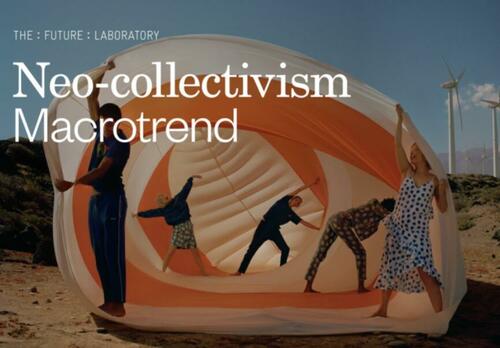
In the course of breaking that down I came across another report, also authored by Future Labs (whom I described then, as coming across as a WEF-wannabe). That was on the coming “macrotrend” of Neo-Collectivism. At the time I plunked down £265.00 to buy the report, promising to write it up in an upcoming piece.
Here it is:
There are five core themes running through 40-page, high-gloss PDF:
-
Climate disaster is imminent.
-
Democracy and capitalism in their current state aren’t working.
-
Individualism is on the way out.
-
“Web3” is a driving force of decentralization, (but it is being co-opted by capitalism).
-
Young people increasingly see collectivism, if not outright socialism as the solution.
Like everything The Future Laboratory emits, there’s a lot of word salad:
“a new model has the potential to reroute power from organisations: Web3. In this digital laboratory, decentralisation reigns: citizens become squads, profits are dispersed and community is king.
It represents a fresh start, an Alternet Economy that allows us to imagine how systems rooted in consensus, equity and care can be reproduced in offline societies too. How, for example, could cities, wealth and even entire organisations be shaped by solidarity?”
The report promises that, “These practical strategies will guide your brand through the shift from individualism to collectivism“
However, when you peel back the veneer of equity, social justice and “deeper meaning” that are supposed to supplant the crass, destructive impulses like capitalism and free exchange, the trends highlighted as “re-imaginings” of work, organization and ownership, turn out to be… somewhat capitalist and free enterprise-y.
And that’s a problem.
Any kind of co-operative enterprise that is entered into consensually and produces excess time, services or goods (profit) which is then divided among the participants is basically a free enterprise venture. It’s nothing new.
“This means that brands, which are nothing without their communities, will make the radical move from being sellers to coordinators. To genuinely place collectivism at the heart of their products, campaigns and workforces, brands should prepare for a future in which they invite customers to run their businesses, design infrastructure as a service, and blur the boundaries between a company, a community and a collective.”
One could argue that customers already run businesses. Or at least they would, if left to themselves: “The customer is always right” and “Necessity is the Mother of Invention” are what drive a pure market economy.
What customers value, what they need, is what gets produced. All other factors are distortions.
You can ruminate on how profits tend to coagulate toward the few, how monopolies emerge and hierarchies ossify into oligarchs and elites – but closer inspection on why – for anybody who cares to go down that rabbit hole, usually reveals a broken monetary system, Cantillon Effects and a political class hell bent on perpetuating the grift.
These realities tend to cast a pall over “collectivist opportunities”:
Decentralisation is one of the driving forces behind Web3. This re-imagined internet is intended to be governed by its users, and its collectives are flourishing in gaming platforms like Roblox and decentralised autonomous organisations (DAOs) like Friends with Benefits.
But this sense of ‘freedom’ that Web3 promises is already being disputed. Ed Zitron, CEO of media relations company EZPR, argues that Web3’s veneer of equity is being rubbed away to resemble the hierarchies of Silicon Valley – an idea exemplified by Facebook’s acceleration into the metaverse. ‘These systems are not ‘free’ or ‘owned by the people’, but owned by the people who created the systems,’ he writes.
You mean platforms and infrastructure are owned by the very people who risk their own capital and time in order to invent and build them? The horror!

Even Decentralized Autonomous Organizations (DAOs) find it necessary to implement policy and consensus through the ownership of governance tokens, and those tokens are usually bought and sold like commodities. They have to be, or else nobody would ascribe value to a governance token – that may be what the project participants are initially paid in.
The sub-text of all collectivist or socialist aspirations, spoken or not, is “equality of outcome” – something which is categorically impossible so long as there are any vestiges of free will.
No matter how much you try to democratize and make any given venture equitable – at some level people have to decide whether to allocate their time, energy, resources to it, or to something else – and the only way to do that is to make doing so involve an economic trade-off. It’s the same reason why Proof-of-Work (mining) is so integral to the success of Bitcoin.
Choice ensues, as does subjective value, then ownership. And wherever you get ownership, you get concentration of ownership. It’s the Pareto Principle 101 (the 80/20 Rule, which we find everywhere, is like a naturally occurring constant of the universe, like the Golden Mean).
The only way to obviate concentration and “unfair” ownership distribution, isn’t through halfway-communist euphemisms like “Neo-Collectivism”, communitarianism or “socialism” – you have to go full-throttle: 100% central planning and abolition of individual rights on everything.
No “skin in the game”, no subjective value, no individual choice – just the fulfillment of a collectively decided central plan, against which there are no alternative actions or considerations (sounds a lot like #netzero and #degrowth, tbh).
In case you think I’m exaggerating the end-point of socialism, the report points (rather blithely, I might add) toward a Brave New World of “Post-Family kinship”:
“something ME O’Brien, a trans communist writer, is calling for: ‘In place of the coercive system of atomised family units, the abolition of the family would generalise what we now call care.’”
Noting that the “generalization of care” would only accomplish commoditizing it – we get a sense of where collectivism inexorably leads: abolition of basic human rights.
The primary mechanisms through which individual choice and action occur (along with the choice of vocation), include the selection of a spouse, the raising of one’s family and relations with kin.

Theoretical depiction of a post-kinship collective living the proletarian dream.
Confusing “Decentralization” With “Collectivism” Considered Harmful
“Neo-collectivism is not only motivating consumers to create their own systems of commerce, care and community, but leading brands and organisations to reconfigure their own anatomies too.
New initiatives are applying this sense of localism to the retail market, using communal sharing models in order to decouple consumption from capitalism.
Where citizens once relied on Silicon Valley powerhouses to spearhead better technologies, they are now taking control, forming human networks that rely on groups of people working in tandem.”
These are all just rhetorical repackagings of free enterprise , entrepreneurship and dare I say it, competition.
You can call an employee owned co-operative with a relatively flat org chart neo-collectivist and socialist: but it isn’t. It’s a capitalist, free enterprise business and more power to those who can make it work, especially by giving everyone on the team skin in the game (ownership, “equity”, shares).
But the danger here is packaging all these ideas around decentralization and new ways to do business as some kind of vindication of collectivism, or socialism. The report introduction cites the Institute of Economic Affairs, that
“Two-thirds (67%) of young people in Britain would like to live under an explicitly socialist economic system”
Yet very little in this report, that purports to describe the coming “macrotrend” of neo-Collectivism, is actually socialist or even really collectivist (except maybe the idea of abolishing the family).
What the Future Labs report is really talking about is decentralization. It talks about localism – which is another megatrend, closely related, and coincidentally something I’ve been recently talking about with Charles Hugh Smith, regarding one his books, Self-Reliance in the 21st Century:
Here’s the Future Lab word salad version:
“The pandemic helped people recognise the personal limitations of aligning career with purpose, motivating people to find life satisfaction closer to home, and within more localised communities and collectivist opportunities.”
“New initiatives are applying this sense of localism to the retail market, using communal sharing models in order to decouple consumption from capitalism.”
And here’s what Charles wrote:
“the entire premise of self-reliance is to relocalize one’s own economy as much as possible by earning and spending money in one’s own community, outside the control of corporations / globalization.”
and how he describes his book:
“self-reliance in the 21st century means reducing our dependency on fragile supply chains and becoming producers as well as consumers.
“[it] is often confused with self-sufficiency–the equivalent of Thoreau s a cabin on Walden Pond. But self-reliance in the 21st century isn t about piling up money or a cabin in the woods; it s about humanity’s most successful innovation: cooperating with trustworthy others in productive networks.”
The Future Laboratory and Charles Hugh Smith are talking about the same thing. But when you filter out the “WEF-speak” and glorification of collectivism – what we’re really looking at is driven by self-reliance (individualism) – which occurs within a community or what Charles calls a “productive network” (a free market).
I’ve heard people whom I thought would know better, such as ‘Exponential Organizations’ author Salim Ismail, trying to make the case (on Robert Breedlove’s ‘What Is Money’ show) that “privately run socialism” would work better than state run, because it’s the central planning of The State that is inefficient.
This is really just a variation of “True Communism has never been tried”, where techno-utopians like Ismail inadvertently drift toward the “Fully Automated Luxury Communism” ideations of Aaron Bastani (publisher of Jacobin Magazine). We’ll have to to break that out into another post. The short version is that all versions of “FALC” assume a near-zero marginal cost of energy – which, at least for now, is not the case.
Ismail cited Uber as an example of a socialist app, proving that even brainy people are prone to conflating sharing (or even cooperation) with socialism.
When you think about it, sharing is impossible without ownership and without capitalism, specifically. Private property is what makes sharing even possible. Without it, in a truly socialist system (no private property), there is no sharing – there is only taking turns using things – and who’s turn it is gets decided by somebody else.
So too, is cooperation decidedly individualistic – one must decide to enter into a mutual agreement with another – and at least two individuals have to decide it to have any cooperation at all. Socialism, or collectivism is not cooperative – it is conformity and compliance – enforced by other people.
What Future Labs is articulating in this report, and techno-utopians like Ismail are hinting at, are really the myriad permutations that can and will arise on the crest of the decentralization revolution. Some may be hyper-individualistic, other decidedly communal, let a thousand flowers bloom.
But let’s not fool ourselves – or worse – mistakenly vote ourselves into socialism or embracing collectivism because we think they’re the same thing as decentralization.
The late great Ross Elver (my long-time lawyer and mentor) was fond of saying “You can’t suck and blow at the same time”. The coming megatrend is decentralization, and you can’t have decentralization and collectivism at the same time.
Who gets to decide what you do? You or somebody else?
Decentralization is about the core, fundamental human right: choice – and choice is all about individualism.
Collectivism, under whatever name you want to call it abolishes choice.
The easiest way to tell the difference is to ask yourself “Who gets to decide what you do (or don’t do)? You? Or somebody else?”
Decide what? Your travel allowance, your meat consumption, your energy usage… everything.
If it’s somebody else, then it’s socialism / collectivism.
I won’t post the Future Labs report here because it’s their paid content and, I assume, their copyright. Perhaps someday, after the abolition of private property, they won’t mind.
* * *
My next e-book The CBDC Survival Guide: Navigating Monetary Apartheid will be out soon (honest), sign up for The Bombthrower mailing list and I’ll let you know when it drops – and get a copy of the The Crypto Capitalist Manifesto in the meantime.
Authored by Mark Jeftovic via BombThrower.com,
“Two-thirds of young people would like to live under an explicitly socialist economic system”
Even worse: They have no idea what socialism is.
Not long ago we looked at The Future Laboratory’s report on travel that predicted carbon passports and limits on personal CO2 emissions as a way to mitigate climate change.
The back of the napkin math from our look at that report, was that living standards in G-20 nations would have to drop by 75% in order to bring personal carbon footprints in line with “expert” recommendations (the typical North American pleb emits somewhere between 12 and 13 tonnes of CO2 per year – to meet those netzero objectives, set by unelected, globalist technocrats, we need to ratchet that down to 2.3 tonnes per year).
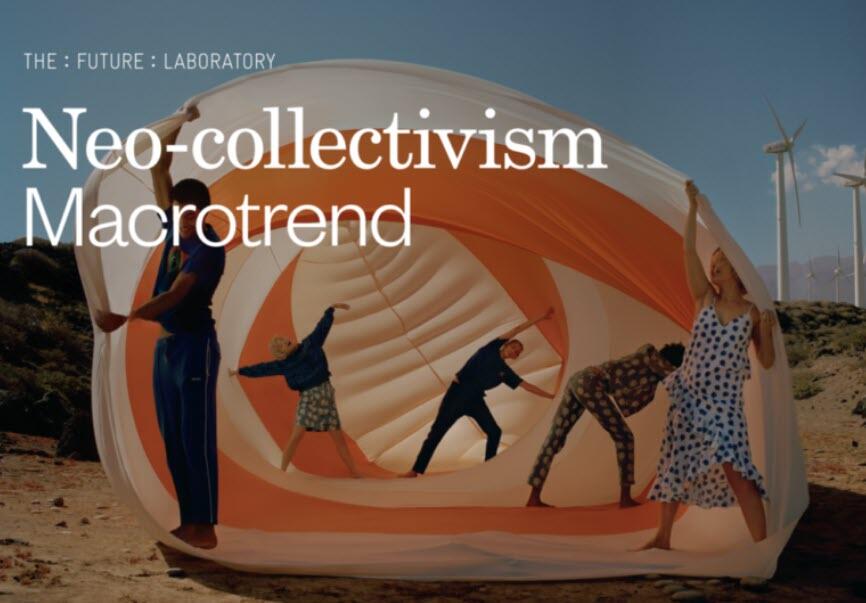
In the course of breaking that down I came across another report, also authored by Future Labs (whom I described then, as coming across as a WEF-wannabe). That was on the coming “macrotrend” of Neo-Collectivism. At the time I plunked down £265.00 to buy the report, promising to write it up in an upcoming piece.
Here it is:
There are five core themes running through 40-page, high-gloss PDF:
-
Climate disaster is imminent.
-
Democracy and capitalism in their current state aren’t working.
-
Individualism is on the way out.
-
“Web3” is a driving force of decentralization, (but it is being co-opted by capitalism).
-
Young people increasingly see collectivism, if not outright socialism as the solution.
Like everything The Future Laboratory emits, there’s a lot of word salad:
“a new model has the potential to reroute power from organisations: Web3. In this digital laboratory, decentralisation reigns: citizens become squads, profits are dispersed and community is king.
It represents a fresh start, an Alternet Economy that allows us to imagine how systems rooted in consensus, equity and care can be reproduced in offline societies too. How, for example, could cities, wealth and even entire organisations be shaped by solidarity?”
The report promises that, “These practical strategies will guide your brand through the shift from individualism to collectivism“
However, when you peel back the veneer of equity, social justice and “deeper meaning” that are supposed to supplant the crass, destructive impulses like capitalism and free exchange, the trends highlighted as “re-imaginings” of work, organization and ownership, turn out to be… somewhat capitalist and free enterprise-y.
And that’s a problem.
Any kind of co-operative enterprise that is entered into consensually and produces excess time, services or goods (profit) which is then divided among the participants is basically a free enterprise venture. It’s nothing new.
“This means that brands, which are nothing without their communities, will make the radical move from being sellers to coordinators. To genuinely place collectivism at the heart of their products, campaigns and workforces, brands should prepare for a future in which they invite customers to run their businesses, design infrastructure as a service, and blur the boundaries between a company, a community and a collective.”
One could argue that customers already run businesses. Or at least they would, if left to themselves: “The customer is always right” and “Necessity is the Mother of Invention” are what drive a pure market economy.
What customers value, what they need, is what gets produced. All other factors are distortions.
You can ruminate on how profits tend to coagulate toward the few, how monopolies emerge and hierarchies ossify into oligarchs and elites – but closer inspection on why – for anybody who cares to go down that rabbit hole, usually reveals a broken monetary system, Cantillon Effects and a political class hell bent on perpetuating the grift.
These realities tend to cast a pall over “collectivist opportunities”:
Decentralisation is one of the driving forces behind Web3. This re-imagined internet is intended to be governed by its users, and its collectives are flourishing in gaming platforms like Roblox and decentralised autonomous organisations (DAOs) like Friends with Benefits.
But this sense of ‘freedom’ that Web3 promises is already being disputed. Ed Zitron, CEO of media relations company EZPR, argues that Web3’s veneer of equity is being rubbed away to resemble the hierarchies of Silicon Valley – an idea exemplified by Facebook’s acceleration into the metaverse. ‘These systems are not ‘free’ or ‘owned by the people’, but owned by the people who created the systems,’ he writes.
You mean platforms and infrastructure are owned by the very people who risk their own capital and time in order to invent and build them? The horror!

Even Decentralized Autonomous Organizations (DAOs) find it necessary to implement policy and consensus through the ownership of governance tokens, and those tokens are usually bought and sold like commodities. They have to be, or else nobody would ascribe value to a governance token – that may be what the project participants are initially paid in.
The sub-text of all collectivist or socialist aspirations, spoken or not, is “equality of outcome” – something which is categorically impossible so long as there are any vestiges of free will.
No matter how much you try to democratize and make any given venture equitable – at some level people have to decide whether to allocate their time, energy, resources to it, or to something else – and the only way to do that is to make doing so involve an economic trade-off. It’s the same reason why Proof-of-Work (mining) is so integral to the success of Bitcoin.
Choice ensues, as does subjective value, then ownership. And wherever you get ownership, you get concentration of ownership. It’s the Pareto Principle 101 (the 80/20 Rule, which we find everywhere, is like a naturally occurring constant of the universe, like the Golden Mean).
The only way to obviate concentration and “unfair” ownership distribution, isn’t through halfway-communist euphemisms like “Neo-Collectivism”, communitarianism or “socialism” – you have to go full-throttle: 100% central planning and abolition of individual rights on everything.
No “skin in the game”, no subjective value, no individual choice – just the fulfillment of a collectively decided central plan, against which there are no alternative actions or considerations (sounds a lot like #netzero and #degrowth, tbh).
In case you think I’m exaggerating the end-point of socialism, the report points (rather blithely, I might add) toward a Brave New World of “Post-Family kinship”:
“something ME O’Brien, a trans communist writer, is calling for: ‘In place of the coercive system of atomised family units, the abolition of the family would generalise what we now call care.’”
Noting that the “generalization of care” would only accomplish commoditizing it – we get a sense of where collectivism inexorably leads: abolition of basic human rights.
The primary mechanisms through which individual choice and action occur (along with the choice of vocation), include the selection of a spouse, the raising of one’s family and relations with kin.
Theoretical depiction of a post-kinship collective living the proletarian dream.
Confusing “Decentralization” With “Collectivism” Considered Harmful
“Neo-collectivism is not only motivating consumers to create their own systems of commerce, care and community, but leading brands and organisations to reconfigure their own anatomies too.
New initiatives are applying this sense of localism to the retail market, using communal sharing models in order to decouple consumption from capitalism.
Where citizens once relied on Silicon Valley powerhouses to spearhead better technologies, they are now taking control, forming human networks that rely on groups of people working in tandem.”
These are all just rhetorical repackagings of free enterprise , entrepreneurship and dare I say it, competition.
You can call an employee owned co-operative with a relatively flat org chart neo-collectivist and socialist: but it isn’t. It’s a capitalist, free enterprise business and more power to those who can make it work, especially by giving everyone on the team skin in the game (ownership, “equity”, shares).
But the danger here is packaging all these ideas around decentralization and new ways to do business as some kind of vindication of collectivism, or socialism. The report introduction cites the Institute of Economic Affairs, that
“Two-thirds (67%) of young people in Britain would like to live under an explicitly socialist economic system”
Yet very little in this report, that purports to describe the coming “macrotrend” of neo-Collectivism, is actually socialist or even really collectivist (except maybe the idea of abolishing the family).
What the Future Labs report is really talking about is decentralization. It talks about localism – which is another megatrend, closely related, and coincidentally something I’ve been recently talking about with Charles Hugh Smith, regarding one his books, Self-Reliance in the 21st Century:
Here’s the Future Lab word salad version:
“The pandemic helped people recognise the personal limitations of aligning career with purpose, motivating people to find life satisfaction closer to home, and within more localised communities and collectivist opportunities.”
“New initiatives are applying this sense of localism to the retail market, using communal sharing models in order to decouple consumption from capitalism.”
And here’s what Charles wrote:
“the entire premise of self-reliance is to relocalize one’s own economy as much as possible by earning and spending money in one’s own community, outside the control of corporations / globalization.”
and how he describes his book:
“self-reliance in the 21st century means reducing our dependency on fragile supply chains and becoming producers as well as consumers.
“[it] is often confused with self-sufficiency–the equivalent of Thoreau s a cabin on Walden Pond. But self-reliance in the 21st century isn t about piling up money or a cabin in the woods; it s about humanity’s most successful innovation: cooperating with trustworthy others in productive networks.”
The Future Laboratory and Charles Hugh Smith are talking about the same thing. But when you filter out the “WEF-speak” and glorification of collectivism – what we’re really looking at is driven by self-reliance (individualism) – which occurs within a community or what Charles calls a “productive network” (a free market).
I’ve heard people whom I thought would know better, such as ‘Exponential Organizations’ author Salim Ismail, trying to make the case (on Robert Breedlove’s ‘What Is Money’ show) that “privately run socialism” would work better than state run, because it’s the central planning of The State that is inefficient.
This is really just a variation of “True Communism has never been tried”, where techno-utopians like Ismail inadvertently drift toward the “Fully Automated Luxury Communism” ideations of Aaron Bastani (publisher of Jacobin Magazine). We’ll have to to break that out into another post. The short version is that all versions of “FALC” assume a near-zero marginal cost of energy – which, at least for now, is not the case.
Ismail cited Uber as an example of a socialist app, proving that even brainy people are prone to conflating sharing (or even cooperation) with socialism.
When you think about it, sharing is impossible without ownership and without capitalism, specifically. Private property is what makes sharing even possible. Without it, in a truly socialist system (no private property), there is no sharing – there is only taking turns using things – and who’s turn it is gets decided by somebody else.
So too, is cooperation decidedly individualistic – one must decide to enter into a mutual agreement with another – and at least two individuals have to decide it to have any cooperation at all. Socialism, or collectivism is not cooperative – it is conformity and compliance – enforced by other people.
What Future Labs is articulating in this report, and techno-utopians like Ismail are hinting at, are really the myriad permutations that can and will arise on the crest of the decentralization revolution. Some may be hyper-individualistic, other decidedly communal, let a thousand flowers bloom.
But let’s not fool ourselves – or worse – mistakenly vote ourselves into socialism or embracing collectivism because we think they’re the same thing as decentralization.
The late great Ross Elver (my long-time lawyer and mentor) was fond of saying “You can’t suck and blow at the same time”. The coming megatrend is decentralization, and you can’t have decentralization and collectivism at the same time.
Who gets to decide what you do? You or somebody else?
Decentralization is about the core, fundamental human right: choice – and choice is all about individualism.
Collectivism, under whatever name you want to call it abolishes choice.
The easiest way to tell the difference is to ask yourself “Who gets to decide what you do (or don’t do)? You? Or somebody else?”
Decide what? Your travel allowance, your meat consumption, your energy usage… everything.
If it’s somebody else, then it’s socialism / collectivism.
I won’t post the Future Labs report here because it’s their paid content and, I assume, their copyright. Perhaps someday, after the abolition of private property, they won’t mind.
* * *
My next e-book The CBDC Survival Guide: Navigating Monetary Apartheid will be out soon (honest), sign up for The Bombthrower mailing list and I’ll let you know when it drops – and get a copy of the The Crypto Capitalist Manifesto in the meantime.
Loading…