“We are in a war.”
With these words, New York Times best-selling author Eric Metaxas opens his powerful, timely, and essential new book, Religionless Christianity: God’s Answer to Evil.
Metaxas expands his war analogy by pointing to previous battles fought to keep alive the glorious and noble values of America’s founding. The first and second—the Revolutionary War and the Civil War—were military conflicts fought by laying “blood and treasure” on the line for the ultimate prize of freedom. The third battle is currently spiritual in nature and has not gotten to this stage of violent destruction—at least, not yet.
Religionless Christianity is designed as a wake-up call to those pastors and churchgoers who are carefully staying on the sidelines of the cultural and political fight. Many simply do not see, or will not acknowledge, that a popular new “secular religion” has filled the void left by churches that are currently “silent in the face of evil.” This new twist on secularism can be seen as a Christianless religion, which is anathema to the genuine article.
The phrase “religionless Christianity” was used by Dietrich Bonhoeffer in a positive sense. Metaxas explains it as “the radicalness of genuine Christianity,” whereas a “Christless religion,” which is practiced in many churches today, “is a watered-down faith that has made its peace with secular society—and with evil, too.”
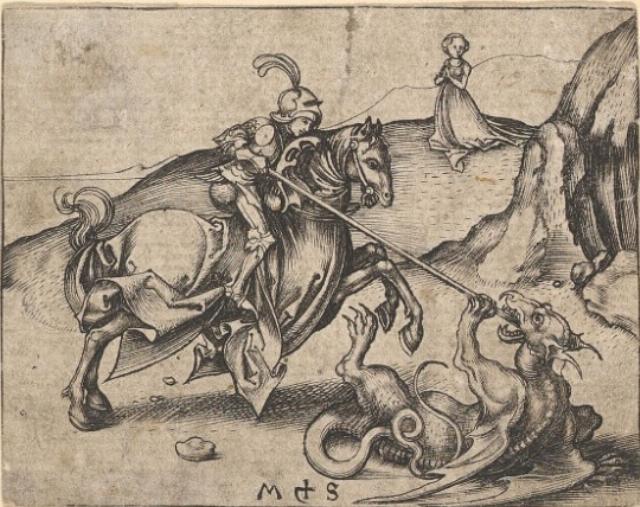
<img alt captext="Marton Schongauer” src=”https://conservativenewsbriefing.com/wp-content/uploads/2024/04/will-the-good-guys-win-the-ultimate-battle-between-good-and-evil.jpg”>
St. George slaying the dragon by Martin Schongauer. Met Museum (public domain).
In one sense, Metaxas dovetails with the groundwork laid by Rabbi Jonathan Cahn in his 2022 book, The Return of the Gods, showing chapter-by-chapter specifics of the infiltration and ugly effects of “gods” who have returned behind the scenes, as it were, to bring down America. In actual fact, however, Religionless Christianity is a pointed follow-up to Metaxas’ previous call-to-arms in 2022, Letter to the American Church.
Both of these books rely heavily on the life and times of Dietrich Bonhoeffer, which Metaxas covered extensively in his 2010 biography, Bonhoeffer: Pastor, Martyr, Prophet, Spy. Throughout Religionless Christianity, Metaxas highlights the gloomy and uncanny similarities between what happened in 1930s and 1940s Germany and what is happening in front of our eyes at this very moment in America.
What can and must be done?
Many Christians today feel that their primary task is to preach the Gospel. This, of course, is a good and worthy focus, but at this crucial hour, not only for this country but also for countries across the globe, we need to follow Bonhoeffer’s bold, unflinching example. He not only preached the Gospel in word but through every aspect of his life.
And for those who feel they are not necessarily stellar examples of a person living out his faith because they have made too many mistakes in life, Metaxas presents a chapter dedicated to “Bonhoeffer’s Moment of Failure.”
In the early days of Adolf Hitler’s chancellorship, Bonhoeffer made what was, in retrospect, an obviously cowardly decision not to deliver a sermon at the funeral of his twin sister’s father-in-law, who was Jewish. After soul-searching and an apology to his family, Bonhoeffer moved on. And it is possible that Bonhoeffer’s mistake and subsequent mea culpa only helped strengthen his resolve when the years ahead proved increasingly, unbearably difficult.
In the chapter titled “Some Religious Idols,” Metaxas deals with ideas that sound noble but can become entrapments for those who would otherwise get their hands dirty in messy arenas such as politics. For the sake of “purity” and “respectability,” some might not want to associate with those viewed as forceful and crude. A Christian’s “witness,” they might rationalize, should be spotless and his demeanor lighthearted, even whimsical, in order to attract others to the faith. To remain on the fence regarding the burning issues of the day can be seen as the best way to steer souls to the God of love. However, as Metaxas points out, “the devil owns the fence.”
Metaxas illustrates this point with a scorching description of Pastor Martin Niemoller’s two totally naive meetings with Adolf Hitler. In the first, before Hitler became chancellor, Niemoller was given a solemn guarantee from Hitler that the church was “safe” from governmental interference.
As Metaxas writes, “Niemoller was put at ease by Hitler’s assurances; he hardly could have imagined that Hitler was simply lying to him.”
However, it was not long after Hitler took power when the persecutions began against not only the Jews but the “Confessing Church,” those German churches unwilling to bend a knee to the Nazi’s takeover of the Evangelical Church. Niemoller again met with Hitler, convinced that they had an understanding and that the Fuhrer could be reasoned with. In that meeting, Hitler did not mince words. “I built the Third Reich!” the Fuhrer scolded Niemoller, “You just worry about your sermons.”
Martin Niemoller eventually survived eight years in concentration camps. Afterward, he wrote his famous poem warning others of the dangers of remaining silent. The lines of that poem are a short litany of those who were initially demonized and “canceled” in the Third Reich: “First they came for the Communists and I did not speak out—because I was not a Communist.”
At the end of the list of Hitler’s deplorables was Niemoller himself, but, as he concludes, “there was no one left to speak out for me.”
We need an army of “full-throated religionless Christians,” not Christians who are halfhearted about what they believe, to effectively do battle against the “secular religion” currently poisoning this great country of ours. If we do not all step up and do our part wherever we find ourselves in the war this election year, America may no longer be recognized as it once was, that shining beacon, that “city on a hill,” referred to in the Bible and acknowledged by President Abraham Lincoln.
At some point, the opportunity to fight and make a difference passes. For Bonhoeffer, who fought all his life knowing that when Jesus calls, it may not just be metaphoric but the unvarnished reality that “He bids a man to die.” However, Bonhoeffer knew as well—as all true believers must—that there really is an even better life after death.
Fortunately, through Metaxas’ potent reality check, Religionless Christianity wraps up with two very uplifting, motivational chapters, starting with “Be Greatly Encouraged.” Consider this: Does the God of Heaven still have exceptional plans awaiting this nation if we faithfully turn back to Him?
Metaxas leaves us with a truly inspired challenge:
“So the question before us now is whether we who call ourselves by God’s name will rise to this crisis with everything we have, living out our faith as though we actually believe it with our whole hearts.”
Since “We are in a war,” let us be bold and unwavering.
And let us win it.
Once the final page of Religionless Christianity is turned, a reader just may be joyfully ready to put on the full armor of their faith and engage in the battle. After all, at the end of the day, do we want to be counted among those who are “on the side of the angels”?
Albin Sadar is the author of Obvious: Seeing the Evil That’s in Plain Sight and Doing Something About It, as well as the children’s book collection Hamster Holmes: Box of Mysteries. Albin was formerly the producer of “The Eric Metaxas Show.”