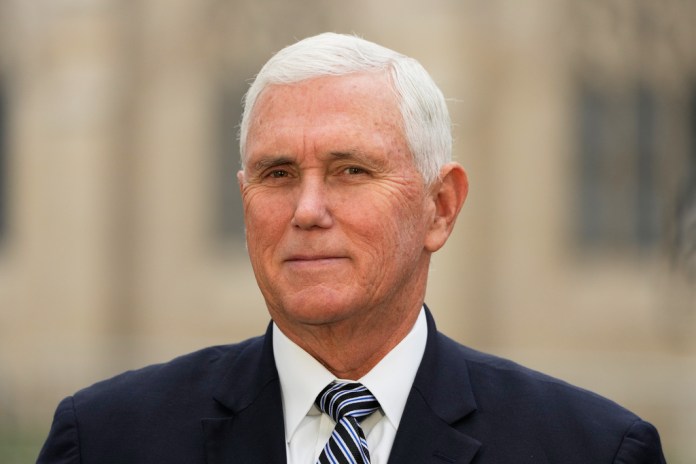
Former Vice President Mike Pence has suddenly found himself at the center of one of the biggest intraconservative fights of President Donald Trump’s second term.
Pence was once the bridge between Trump’s populism and an older strain of American conservatism dating back to Ronald Reagan’s administration when the two became the Republican presidential ticket in 2016.
As Trump’s original vice president, Pence was similarly his ambassador to a Republican congressional team that was led by Sen. Mitch McConnell (R-KY), who served as majority leader for most of the first Trump administration, and then-House Speaker Paul Ryan.
Together, they passed tax cuts, gutted Obamacare’s individual mandate, and built a 6-3 conservative majority on the Supreme Court that would eventually overturn Roe v. Wade in the summer of 2022.
But Trump ultimately broke with all three men, who would in his second, nonconsecutive term be replaced with Vice President JD Vance, Senate Majority Leader John Thune (R-SD), and House Speaker Mike Johnson (R-LA). While Jan. 6, 2021, loomed large for McConnell and Ryan as well, it was intensely personal for Pence, who was endangered by the rioters who stormed the Capitol (some of whom chanted, “Hang Mike Pence!”) as he voted to certify that Joe Biden defeated Trump in the 2020 presidential election.
When both men later attended former President Jimmy Carter’s funeral, Pence rose to shake Trump’s hand while his wife Karen sat stonefaced.
By then, Pence had reemerged as a more traditional Reaganite conservative seeking to resist Trump’s populist redefinition of both the movement and the broader Republican Party. The latest example is when more than a dozen high-profile Heritage Foundation staffers defected from the venerable conservative think tank to Pence’s D.C.-based advocacy organization Advancing American Freedom.
“Today, Advancing American Freedom added 13 of the most respected scholars and staffers in Washington, D.C.,” AAF President Tim Chapman told the Washington Examiner at the time. “Their work on the Constitution, economics, taxes, the Second Amendment, and banking, among other issue areas, totally and completely speaks for itself. There’s a lot of dust in the air, but what we are focused on here at AAF is building a principled public policy organization.”
Heritage, under the leadership of President Kevin Roberts, has gone in a different direction. The top conservative think tank has long sought to influence personnel and policy decisions in Republican administrations dating back to Reagan. Since Roberts took over, that has included trying to stay abreast of shifts in the party in the Trump era.
The Heritage Foundation took a leading role in Project 2025, a governing blueprint Trump disavowed during the 2024 campaign but embraced in part after returning to office in January 2025. Roberts has tried to bring the think tank more in line with Trump’s trade agenda and foreign policy.
Pence, by contrast, has tried to fight Trump on several fronts, including Ukraine and tariffs. But he hasn’t always been successful. Pence ran against Trump for the 2024 Republican presidential nomination, but was effectively an asterisk candidate and dropped out before the first primary.
The former vice president tried to block Robert F. Kennedy Jr.’s nomination for secretary of health and human services with a six-figure ad buy on Fox News, arguing against the longtime progressive and ex-Democrat on conservative and anti-abortion grounds. The Republican Senate majority confirmed Kennedy to serve in Trump’s Cabinet.
Thune and Johnson are arguably more in the Reaganite tradition themselves, but both Republican congressional leaders have been closer to Trump than McConnell or Ryan ever were. They, and most Republicans on Capitol Hill, recognize Trump’s purchase with the GOP grassroots.
Quiet grumbling at Heritage turned into an open revolt after Roberts defended Tucker Carlson’s interview with white nationalist podcaster Nick Fuentes. But Roberts has retained his leadership position while his internal critics have resigned.
Never Trump, which Pence balked at joining in 2016, was at least a somewhat influential force on the Right when the president first entered national politics. Now it is much diminished and its most powerful voices have largely relocated to the Left.
Vance, who is more of an ideological populist than even Trump, much less Pence, is a heavy frontrunner for the 2028 Republican presidential nomination. The incumbent vice president leads by 37.8 points, according to the latest RealClearPolitics polling average.
Pence, who has most conspicuously reopened his fight with Kennedy — and, by extension, Trump and Vance — on abortion, faces an uphill battle. But prior to serving as Trump’s first vice president, and then before that as governor of Indiana, Pence was a Republican congressman.
During Pence’s time in the House, which peaked with him chairing the Republican conference, he was a member of the conservative Republican Study Committee. That group often protested then-President George W. Bush from the right. Not on the Iraq War, as Trump later did, but on amnesty for illegal immigrants and big spending initiatives like Medicare Part D and No Child Left Behind.
TRUMP’S MOST IMPORTANT ACHIEVEMENT
The conservative resistance to Bush increased after Republicans lost control of the House in the 2006 midterm elections. Pence mounted an unsuccessful bid for minority leader afterward, losing to John Boehner, the Ohio Republican who would later become speaker. This conservative grumbling soon grew into the Tea Party movement, which upended the Republican establishment.
It remains to be seen what is possible if Trump’s grip on the party loosens after another midterm election loss 20 years later. There is still a long way to November 2026. Pence, who was once well positioned to be Trump’s successor, will have to await his next opportunity, should it present itself.