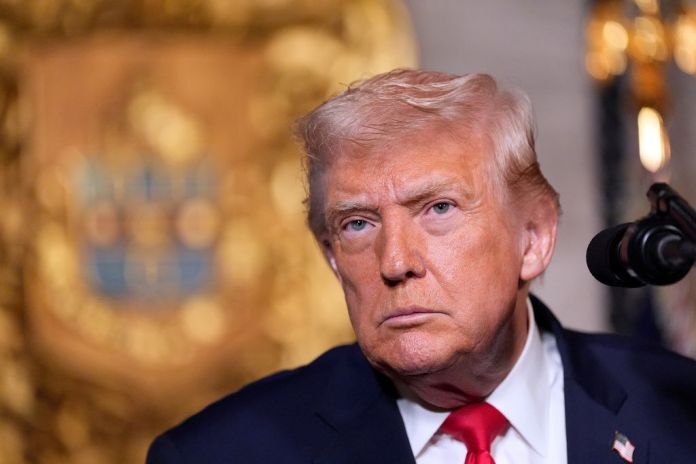
TEL AVIV, Israel — President Donald Trump and Israeli Prime Minister Benjamin Netanyahu are set to meet at a crucial moment for the ceasefire in Gaza, with Trump poised to push Netanyahu to prepare for Phase 2 of his 20-point peace plan despite lingering Israeli resistance.
The two leaders will meet at Mar-a-Lago, Trump’s private club in Palm Beach, Florida, at a relative low point in their long-standing relationship as Israel seeks to pump the brakes on the plan’s rollout without further assurances.
At the same time, Netanyahu has priorities of his own and wants the White House’s support for further military action against Iran.
During a press briefing in Tel Aviv, Israeli Deputy Foreign Minister Sharren Haskel told the Washington Examiner that Netanyahu is expecting to discuss Phase Two of the peace deal with Trump at Mar-a-Lago, but underscored he wants to better “understand how Hamas is going to be disarmed because none of the peace forces want to enter into Gaza before Hamas is disarmed.”
“Otherwise they’re going to collide,” Haskel said. “It needs to be a policy of the president and the prime minister of how the second stage is going to look like.”
The body of Staff Sgt. Ran Gvili, a 24-year-old Israel Police Special Patrol Unit volunteer from Meitar in southern Israel, remains in Gaza despite Hamas’s commitment to release all of the hostages, alive and dead, as part of Phase One of the deal.
At the same time, Israel has continued to conduct military operations in Gaza, including a single strike heard on Dec. 17 when the Washington Examiner was in Negev near the Israel-Gaza border. That strike followed an attack the previous weekend that killed Hamas Cmdr. Raed Saad.
Egypt, Qatar, and Turkey have implored the U.S. to stop Israel from striking Gaza, with Trump telling Netanyahu earlier this month that such strikes undermine the ceasefire agreement. However, Israel has countered that Hamas and another Iran-supported terrorist group, Hezbollah in Lebanon, have not disarmed despite the terms of the phase one deal.
Capt. Adi, an Israel Defense Forces spokeswoman who declined to provide her last name, citing safety concerns, called the ceasefire “fragile.”
“We have three dead soldiers since the beginning of the ceasefire, we have one hostage still in captivity, and Hamas is still in control over Gaza with the same amount of ammunition and weaponry that they had before,” she told the Washington Examiner. “If you’re asking us, so far, the goals of the war are not achieved yet. We want all of the hostages back. We want Hamas to not be in control over Gaza, so they won’t have the power to do what they did to us again.”
As Trump and Netanyahu consider Phase Two of the peace deal, which would give way to a transitional authority in Gaza and the further drawback of Israeli troops from the region, Netanyahu has raised concerns over the proposed International Stabilization Force, as well as a “Board of Peace” that would help oversee the transition while the Palestinian Authority undergoes reforms.
Netanyahu has expressed specific reservations related to Turkish President Recep Tayyip Erdogan‘s pitch to deploy 2,000 troops in Gaza through the ISF because of Erdogan’s support of Hamas.
Gallia Lindenstrauss, a Turkey analyst at the Institute for National Security Studies, suggested that Netanyahu would be more willing to accept ISF help from countries such as Italy, as well as Azerbaijan, Saudi Arabia, and the United Arab Emirates.
“At the end of the day, I think Trump will say to Netanyahu, ‘We achieved the major part we wanted in stage one and we should move forward,’” Lindenstrauss told the Washington Examiner. “I think definitely the U.S. is still working very hard to push forward the Israeli interests. Of course, the situation in Gaza is complicated and there is need for some compromises from the Israeli government, but I would say still this is a very strong relationship.”
Trump’s meeting with Netanyahu comes as Israel prepares for next year’s legislative elections and the political fallout stemming from the prime minister’s corruption trial. Though Trump appealed to Israeli President Isaac Herzog last month to pardon Netanyahu after he was indicted in 2019 for breach of trust, taking bribes, and fraud, the conflict in Gaza has tested an alliance that dates back to Trump’s first term in office.
Trump joined Israel in launching military strikes earlier this year that degraded Iran’s ability to develop a nuclear weapon, but Netanyahu plans to press Trump for further action, warning that Iran is expanding its ballistic missile program.
Israel is also grappling with the expansion of Israeli settlements and a rise in settler violence in the West Bank, a development that is further threatening its standing with the international community.
Last week, Israel’s Cabinet approved a proposal for another 19 settlements, increasing the number approved since 2022, when Netanyahu was reelected, from 141 to 210.
Elliott Abrams, a former President George W. Bush-era deputy national security adviser and Trump special representative for Iran and Venezuela, suggested that Trump wants Netanyahu “to prevent too much trouble, meaning continuing and expanding violence,” in the West Bank.
Two Palestinians, for example, were killed earlier in the month by IDF personnel in the northern West Bank.
“Bibi should do more to arrest and contain the small number of settlers who are involved and are true extremists, a number estimated at 200-400,” Abrams told the Washington Examiner. “That’s a small enough number for the police and army to handle, so I assume the failure to do so is political: some right-wing ministers do not want to confront the extremists.”
However, Netanyahu cannot “guarantee that there will be no settler violence,” according to Steven Cook, a senior fellow on the Middle East and Africa Studies at the Council of Foreign Affairs.
“They have created a problem, and now they are having a hard time getting it under control,” Cook told the Washington Examiner.
Nevertheless, Daniel Flesch, a senior policy analyst on the Middle East and North Africa at the Heritage Foundation, argued that the West Bank “is not a priority for this administration.”
“It largely rises to the attention of the president insofar as it helps or hinders his other regional objectives — bringing the Gaza Board of Peace into fruition and transitioning to the next phase of the ceasefire, expanding and deepening the Abraham Accords, stabilizing Syria and Lebanon,” Flesch, a former senior adviser to Israel’s Permanent Mission to the United Nations, told the Washington Examiner.
To that end, the more pressing test of Trump and Netanyahu’s relationship at the moment, aside from the peace deal, is a series of recent strikes by Israel in Syria, according to Cook, who described the prime minister’s actions as irking Trump because he “wants to give the Syrians a chance at rebuilding.”
Netanyahu conducted his deadliest raid in months in November in response to a militant group his government said had been planning attacks against Israel.
“He clearly sees what the Israelis are doing as counterproductive,” Cook said of Trump. “The ‘biggest’ test? I am not sure, but it is a big test.”
WHAT CAN JD VANCE DO TO STAY AHEAD OF THE PACK FOR 2028?
Trump’s optimistic position with respect to Syria’s new president, Ahmed al Sharaa, a former al Qaeda jihadist who helped topple his predecessor, Bashar Assad, last year, has ebbed somewhat after this month’s Islamic State attack that killed two U.S. service members and a civilian interpreter in Palmyra in central Syria.
Trump responded last week by ordering a strike comprised of more than 100 precision munitions against 70-plus targets, including ISF infrastructure or weapon sites, across central Syria.