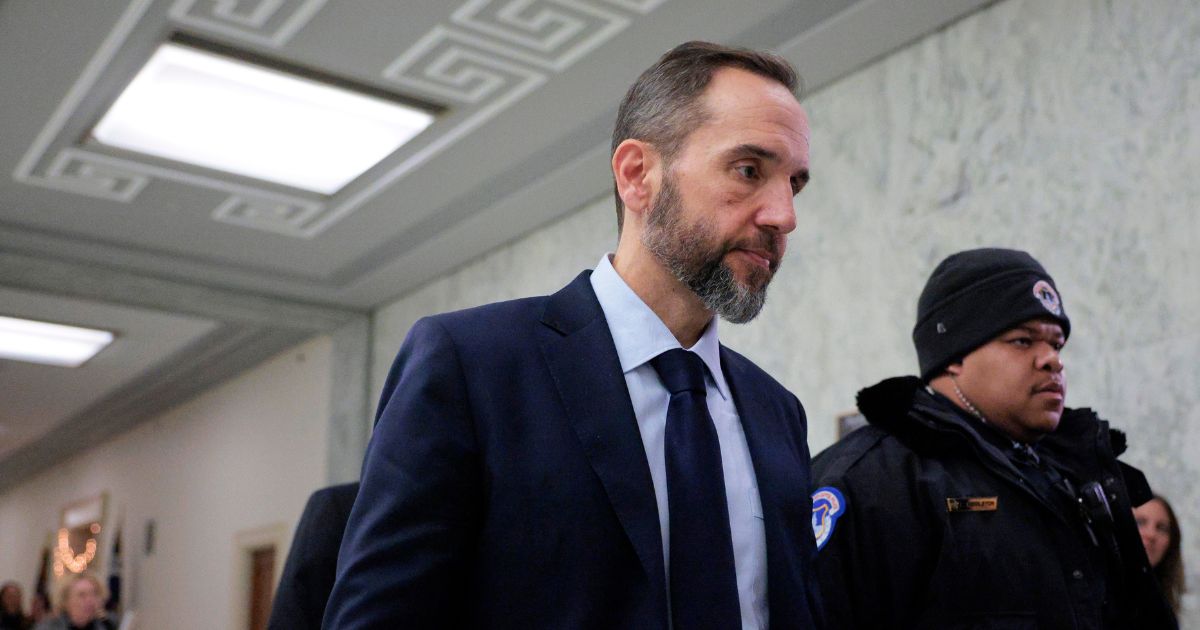
If Jack Smith’s goal was to demonstrate prosecutorial confidence in his Dec. 17 congressional testimony, his answer quite literally did the opposite.
Pressed with a straightforward question about evidence tying President Donald Trump to the Jan. 6 incursion, Smith delivered a response so circuitous it practically begged for translation. What should have been a yes-or-no moment instead became a cloud of abstractions, insinuations, and legal vapor.
Smith didn’t — or couldn’t — say Trump ordered anyone to storm the Capitol. He didn’t say Trump planned the violence. He didn’t even say Trump wanted it to happen.
Instead, he leaned on a far murkier claim: that Trump “caused” the violence by cultivating distrust, that he “exploited” events as they unfolded, and that what happened was somehow “foreseeable.” It was a theory of guilt built not on commands or coordination, but on vibes, emotions, and retrospective moral judgment.
That matters, because when the follow-up question came (the one that actually counts) the answer quietly collapsed. Asked directly whether there was evidence Trump instructed people to enter the Capitol, Smith responded with a word salad about rhetoric, anger, and belief. It was an answer that tried to sound like evidence without actually being any.
While the closed-door deposition itself happened weeks ago, on Wednesday, House Republicans released the transcript of what had happened, and it’s worth looking closely at what Smith had to — or tried to — say.
“So did you develop evidence that President Trump, you know, was responsible for the violence at the Capitol on January 6th?”
“So our view of the evidence was that he caused it and that he exploited it and that it was foreseeable to him,” Smith replied.
That sentence is a masterclass in prosecutorial sleight of hand.
“Our view of the evidence” is literally not evidence; it’s an interpretation, and a loaded one at that. Smith doesn’t point to an order, a plan, a signal, or even a tacit approval of violence. He substitutes causation with conjecture, collapsing responsibility into a vague moral chain where intent is assumed and outcomes are retroactively assigned. Saying Trump “caused” Jan. 6 without identifying a concrete act that did the causing simply isn’t a legal argument. If anything, it’s a narrative preference — nothing more, nothing less.
The rest of the claim only gets even shakier: “exploited it” is a political accusation, not a criminal one, and “foreseeable” is doing an enormous amount of work without earning any of it. If foreseeability is the standard, then any politician who speaks to an angry crowd becomes legally responsible for the worst actions of the most unhinged listener. Given the type of rhetoric frequently deployed by the likes of Alexandria Ocasio-Cortez or Zohran Mamdani, this probably isn’t a thread the Democrats want to pull too hard on.
Given how pathetic that initial response was, Smith was then asked: “But you don’t have any evidence that he instructed people to crash the Capitol, do you?”
To that, he answered with the sort of word salad that would make Kamala Harris blush: “As I said, our evidence is that he in the weeks leading up to January 6th created a level of distrust. He used that level of distrust to get people to believe fraud claims that weren’t true. He made false statements to State legislatures, to his supporters in all sorts of contexts and was aware in the days leading up to January 6th that his supporters were angry when he invited them and then he directed them to the Capitol.”
“He caused it … and exploited it”
Special Counsel Jack Smith about Trump’s role on Jan 6 pic.twitter.com/eIg6bYq3e4
— Scott MacFarlane (@MacFarlaneNews) December 31, 2025
That’s a heck of a lot of words to just say “no.”
When stripped of its rhetorical padding, Smith’s response never actually answers the question put to him. There’s no claim that Trump instructed anyone to breach the Capitol, no allegation of coordination, no evidence of a directive to engage in violence. Instead, Smith pivots to a theory of ambient guilt — that Trump is responsible not for what he told people to do, but for how they felt when they heard him speak.
Creating “a level of distrust,” persuading supporters of fraud claims, and making statements to legislatures may be politically controversial, but they are not acts of violence, nor are they illegal on their face.
If emotional agitation and disputed claims become prosecutable offenses, then the First Amendment is reduced to a conditional privilege, enforceable only when the government approves of the message. Smith’s framework openly warps the law.
Most telling is the final leap: that Trump “directed them to the Capitol.” That phrasing is doing an extraordinary amount of legal laundering.
Directing people where to assemble is not the same as directing them to riot, storm, or attack (and notice it’s a distinction Smith carefully avoids acknowledging). The answer relies on inference instead of proof.
And in doing so, it tacitly concedes the central point: there is no evidence Trump told anyone to crash the Capitol, only an argument that their presence, emotions, and later actions can be retroactively laid at his feet.
In the end, Smith’s case rests not on what Trump did, ordered, or even intended, but on a theory that speech creates guilt and emotion substitutes for evidence. That’s simply not how criminal law is supposed to work, and it’s certainly not how justice is preserved in a constitutional republic.
The fact that Jack Smith and the Democrats tried so hard to lower the bar for conviction should deeply concern all Americans, regardless of political ideology.
Because if that standard ever hardens into precedent, trust me, it won’t stop with Donald Trump.

Advertise with The Western Journal and reach millions of highly engaged readers, while supporting our work. Advertise Today.