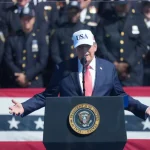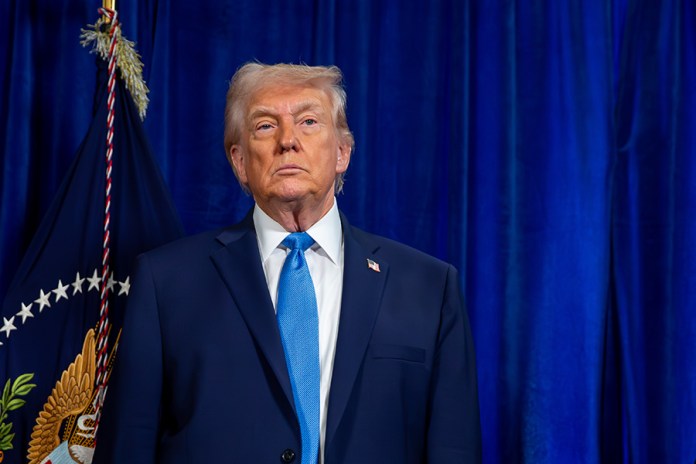
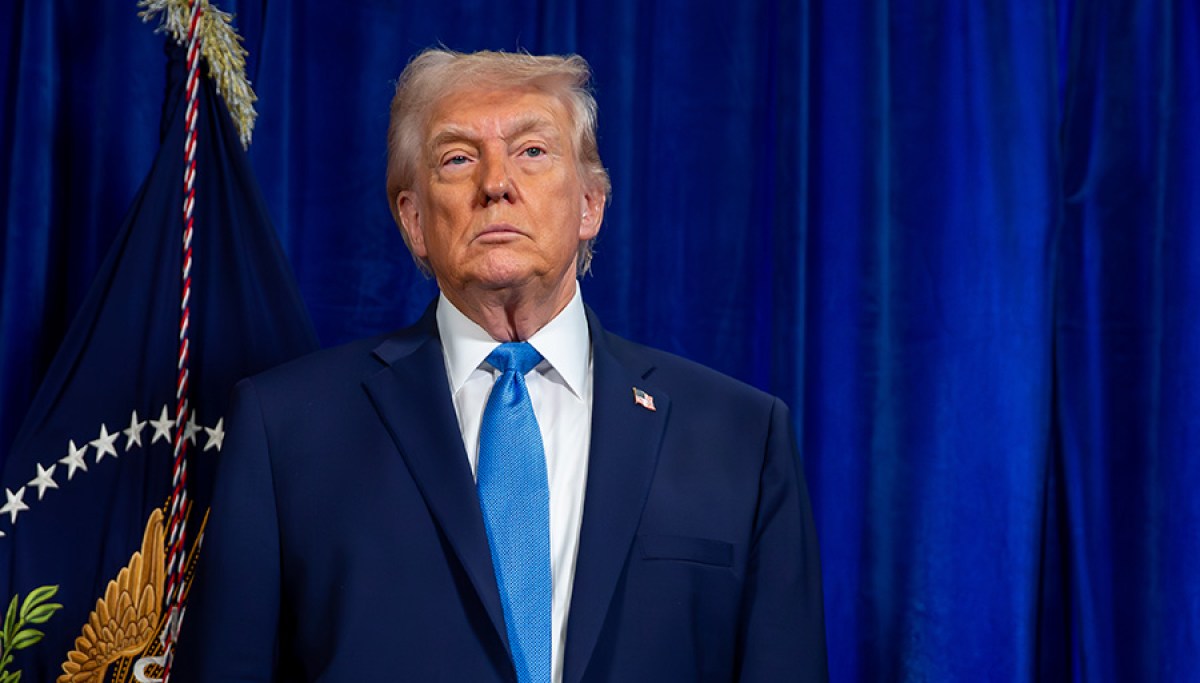
At a White House ceremony in April 2025, President Donald Trump triumphantly unveiled his “Liberation Day” reciprocal tariffs, a tactic intended to usher in a new era of U.S. prosperity and the resolution of trade imbalances.
But nine months later, the president has turned to a more aggressive tactic in bending foreign nations to his will: threatening U.S. military action.
Trump stunned the world in the first weekend of 2026 after U.S. forces captured former Venezuelan dictator Nicolas Maduro and brought him to New York. Trump has claimed the U.S. could control the Latin American nation for roughly 18 months. He also increased pressure on American allies by suggesting U.S. military forces could be sent into Colombia, Greenland, Cuba, Iran, Canada, and Mexico.
“We’re not afraid of boots on the ground,” Trump told reporters while speaking from Mar-a-Lago last Saturday. “We had boots on the ground last night at a very high level actually. We’re not afraid of it, we don’t mind saying it, but we’re going to make sure that that country is run properly. We’re not doing this in vain.”
The next day on Air Force One, Trump told reporters that the possibility of the U.S. taking action in Colombia “sounds good to me” and reiterated his desire to annex Greenland, a Danish territory.
White House press secretary Karoline Leavitt would not rule out the U.S. deploying troops on the ground in Venezuela when peppered by reporters.
TRUMP SAYS ONLY HIS ‘OWN MORALITY’ LIMITS PRESIDENTIAL POWERS, DISMISSING INTERNATIONAL LAW
“There are no troops on the ground in Venezuela, the president, of course, reserves the right to use the United States military if necessary,” Leavitt said during a press briefing Wednesday. “It’s not something he wants to do. Diplomacy is always the first option.”
Trump’s public threats against foreign nations led to a hasty call with Colombian President Gustavo Petro on Wednesday, which the president called a “great honor” and a future meeting between the two leaders at the White House.
Denmark and Greenland’s envoys met with White House National Security Council officials on Thursday in an attempt to convince the Trump administration to back away from attempts to acquire Greenland, which would upend the North Atlantic Treaty Organization.
But that has not stopped Trump. “A very big factor in this involvement will be the reduction of Oil Prices for the American People,” he wrote on Truth Social about Venezuela on Friday.
“We don’t want Russia or China going to Greenland, which, if we don’t take Greenland, you’re going to have Russia or China as your next-door neighbor,” Trump told reporters on Friday. “That’s not going to happen.”
As the threat of military action dominates Trump’s foreign policy, the White House is also dealing with the possibility of a Supreme Court ruling that could strike down the president’s use of emergency powers to impose his “Liberation Day” tariffs and pave the way for the Court of International Trade to require refunds to be paid to U.S. importers. The White House, however, has signaled it has other ways of imposing tariffs legally if the setback occurs.
Trump’s efforts to get U.S. oil companies to invest in Venezuela are another tacit nod that the effects tariffs have had on the supply chain and the lower costs of oil and gasoline have made it harder for the president to fulfill his “drill, baby, drill,” promise.
Still, the president sounded confident that his MAGA base stands behind him, even though he campaigned on an America First policy that was meant to pull the U.S. away from foreign entanglements.
“No, MAGA loves it. MAGA loves what I’m doing,” Trump told NBC News in an interview on Monday. “MAGA loves everything I do.”
Ford O’Connell, a GOP strategist, praised Trump’s willingness to deploy troops if necessary in an interview with the Washington Examiner.
“There is a reason why Donald Trump is the highest-rated foreign policy president of the 21st century. It’s because he doesn’t take any cards off the table,” O’Connell said. “And what’s so amazing about this approach of not taking any cards off the table is he’s invented something new, or rehashed something maybe from previous presidents, which is what I call quick strike diplomacy.”
Trump’s use of surprise attacks against foes, or the ‘quick strike diplomacy,’ extends back to the January 2020 assassination of Iranian military commander Qassem Soleimani, which Trump bragged about during his Saturday briefing in Mar-a-lago.
“And if you think about it, we’ve done some other good ones, like the attack on Soleimani. The attack on al-Baghdadi and the obliteration and decimation of the Iran nuclear sites,” he said, also referencing the attack on ISIS leader Abu Bakr al-Baghdadi.
Trump’s actions are likely sending a strong message to China and Russia that the U.S. will respond forcefully if provoked. “If you start messing around in my backyard, or you start with the axis of evil, Russia, China, Iran, guess what? I’m going to respond, because if I don’t respond and I try appeasement, the way that my predecessors tried it, the U.S. is going to get run over,” O’Connell said about Trump’s military threats.
Congress, however, is not as willing to escalate the U.S. military against foreign nations.
Five Senate Republicans joined with Democrats to issue a rare rebuke of Trump by advancing a measure to restrict further military operations against Venezuela without congressional approval. House lawmakers are also working on their version of a war powers resolution.
Democrats have denounced Trump’s actions against Venezuela as an “illegal war,” according to Sen. Chris Murphy (D-CT). North Carolina Democrat Richard Ojeda, who is challenging National Republican Congressional Committee Chairman Richard Hudson (R-NC), called Trump “a bully” and his opponent a “a Trump puppet” in an interview with the Washington Examiner.
“Donald Trump is trying to beat the drums of war, which means that sons and daughters of this country are going to find themselves going to places, and they’re going to be placed in harm’s way. For what?” Ojeda, a former U.S. Army major who served at Fort Bragg in Fayetteville, N.C., said. “So that we can rebuild Venezuela’s oil infrastructure, where Donald Trump gets a cut, and Exxon and places like that make all the money. What’s it do for us?
“This is just sending us into harm’s way, and with the Veterans Administration already being attacked, and people losing their jobs, it’s going to make it even harder for them to take care of these veterans when they come home, struggling with things like … post-traumatic stress disorder,” he said.
A recent Reuters/Ipsos poll showed that one in three Americans approved of the strike on Venezuela, with 65% of Republicans backing the military operation, compared to 11% of Democrats and 23% of independents.
Matthew Clary, a political science lecturer at Auburn University who studies national security policy, claimed that Trump’s unpredictable strategy risks fracturing long-term alliances the U.S. has with foreign partners.
TRUMP SAYS US COULD CONTROL VENEZUELA ‘MUCH LONGER’ THAN A YEAR
“His strategy is to be unpredictable. He’s a gambler, and so nobody knows what he’s gonna do next,” Clary said. “And so I will say that works well for the business environment, not so well in international relations. Because what ends up happening is when you’re unpredictable, and people are uncertain about your intentions, they immediately assume the worst of you.”
Trump appeared to downplay the NATO alliance’s reliability toward the U.S. in a Truth Social post on Wednesday. “I DOUBT NATO WOULD BE THERE FOR US IF WE REALLY NEEDED THEM,” he wrote after he had stoked fears surrounding Greenland.
Under Article 5 of NATO, an attack on one nation is akin to an attack on all nations, meaning if Greenland were seized by the U.S., other NATO countries would be required to defend Greenland. Any fracturing of NATO would upend world order, going back to when the organization was created in the aftermath of World War II.
The U.S. seizing another territory by force, whether it be Venezuela or another nation, would also end American moral authority on the global stage, end traditional international norms, and give more credence to Russia’s attack against Ukraine and China’s desire for Taiwan.
“If we lose that as a parameter for international relations, then we’re right back to where we were pre-World War II, where there were no rules, no international law,” Clary said. “It’s like the Wild West all over. There’ll be more conflicts, more wars, and we’re on the brink of World War III. And that’s not hyperbole.”