Advocates of hardball negotiations over Greenland in Europe have suggested stalling the ratification of the trade deal with the United States after President Donald Trump announced that America will impose tariffs on eight countries for opposing the United States acquiring the arctic island.
The post Europeans Threaten to Hold Up EU-U.S. Trade Deal, Boycott World Cup over Trump’s Greenland Tariffs appeared first on Breitbart.
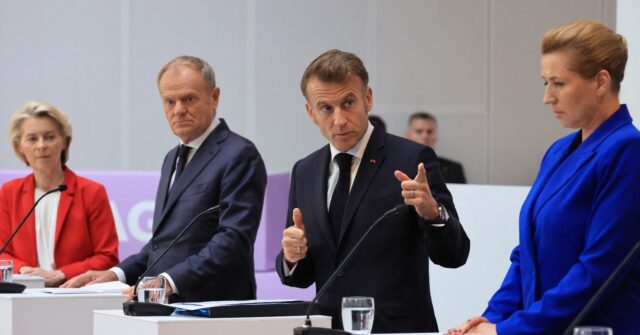
Advocates in Europe of hardball negotiations over Greenland have suggested stalling the ratification of the trade deal with the United States after President Donald Trump announced that America will impose tariffs on eight countries for opposing the United States acquiring the arctic island.
European leaders reacted with outrage and indignation over the move by President Trump to impose a 10 per cent tariff on Denmark, Finland, France, Germany, the Netherlands, Norway, Sweden, and the United Kingdom, all of whom have recently committed to sending troops to Greenland in an apparent show of force against Washington’s Monroe Doctrine-style demands that the island come under American control to ensure national and global security.
European Commission President Ursula von der Leyen asserted that the military exercises were “pre-coordinated” and do not pose a “threat to anyone”. Nevertheless, she reasserted Brussels’ support for Copenhagen and warned that “tariffs would undermine transatlantic relations and risk a dangerous downward spiral.”
“Europe will remain united, coordinated, and committed to upholding its sovereignty,” the German Eurocrat vowed.
To that end, Reuters reported that the ambassadors representing the 27 member states of the EU were summoned to meet for crisis talks on Sunday in Cyprus, which currently controls the bloc’s rotating presidency. The meetings are expected to take place at around 5 pm local time.
Some have already begun to suggest potential responses to the Trump tariffs. German MP and spokesman for Chancellor Friedrich Merz’s Christian Democrats (CDU), Jürgen Hardt, floated the idea of boycotting the upcoming World Cup, some of which will be hosted in the United States.
“Dropping out of the tournament would, however, only be considered as a last resort in order to get Trump to see sense on the Greenland issue,” he said per DW, noting that President Trump has placed a “high” level of importance on the World Cup being held in America.
Perhaps more impactfully, Member of European Parliament Manfred Weber, who leads the influential neo-liberal European People’s Party Group in Strasbourg, said that his party would not vote to ratify the EU–U.S. trade deal amid “Donald Trump’s threats regarding Greenland”.
Less likely was the course of action advocated for by radical Europhile and former Belgian Prime Minister, Guy Verhofstadt, who immediately used the spat to call for a reciprocal 10 per cent tariff on U.S. goods, an attack on American tech “monopolies”, and to “urgently establish a European Defence Union, including army.”
While the notion of an EU Army is increasingly favoured among globalist factions within the bloc, it would likely take years, if not longer, to build such a transnational fighting force, particularly given past failures by European governments to properly invest in their militaries.
This failure is the very reason the United States will have to act as the ultimate guarantor of the safety of British and French troops expected to be deployed as peacekeepers in Ukraine in the event of a peace deal. Indeed, as neither is likely to be able to fend off the Russian army, Washington has agreed to provide insurance for the Anglo-Franco force.
This has put both Britain and France in an awkward position during the Greenland debate, during which they have attempted to push back against the White House, without going so far as to anger President Trump to such an extent that he backs out from the commitment to protect British and French troops in Ukraine or to leave the negotiating table altogether.
For his part, French President Emmanuel Macron said on Saturday: “No intimidation or threat will influence us—neither in Ukraine, nor in Greenland, nor anywhere else in the world when we are confronted with such situations.
“Tariff threats are unacceptable and have no place in this context. Europeans will respond in a united and coordinated manner should they be confirmed. We will ensure that European sovereignty is upheld.”
British Prime Minister Sir Keir Starmer added: “Applying tariffs on allies for pursuing the collective security of NATO allies is completely wrong. We will of course be pursuing this directly with the US administration.”
In a bit of a break with tradition, the most level-headed response to the Greenland spat has so far come from Italy, with Prime Minister Giorgia Meloni refusing to send any troops to the island. She explained on Saturday that while President Trump was using “assertive methods”, they were meant to “highlight a serious problem”.
In an apparent dig at her counterparts in Denmark, which has controlled Greenland for centuries without providing much investment, Meloni admitted that there has been “an underestimation of an area” in recent years.
Her Defence Minister, Guido Crosetto, was a bit more open in deriding the response from fellow European nations, particularly the so-called show-of-force military exercises.
“The exercises have not started now, and certainly not 15 soldiers sent to Greenland. I wonder: to do what? A field trip? 15 Italians, 15 French, 15 Germans: it seems to me the beginning of a joke,” he quipped.