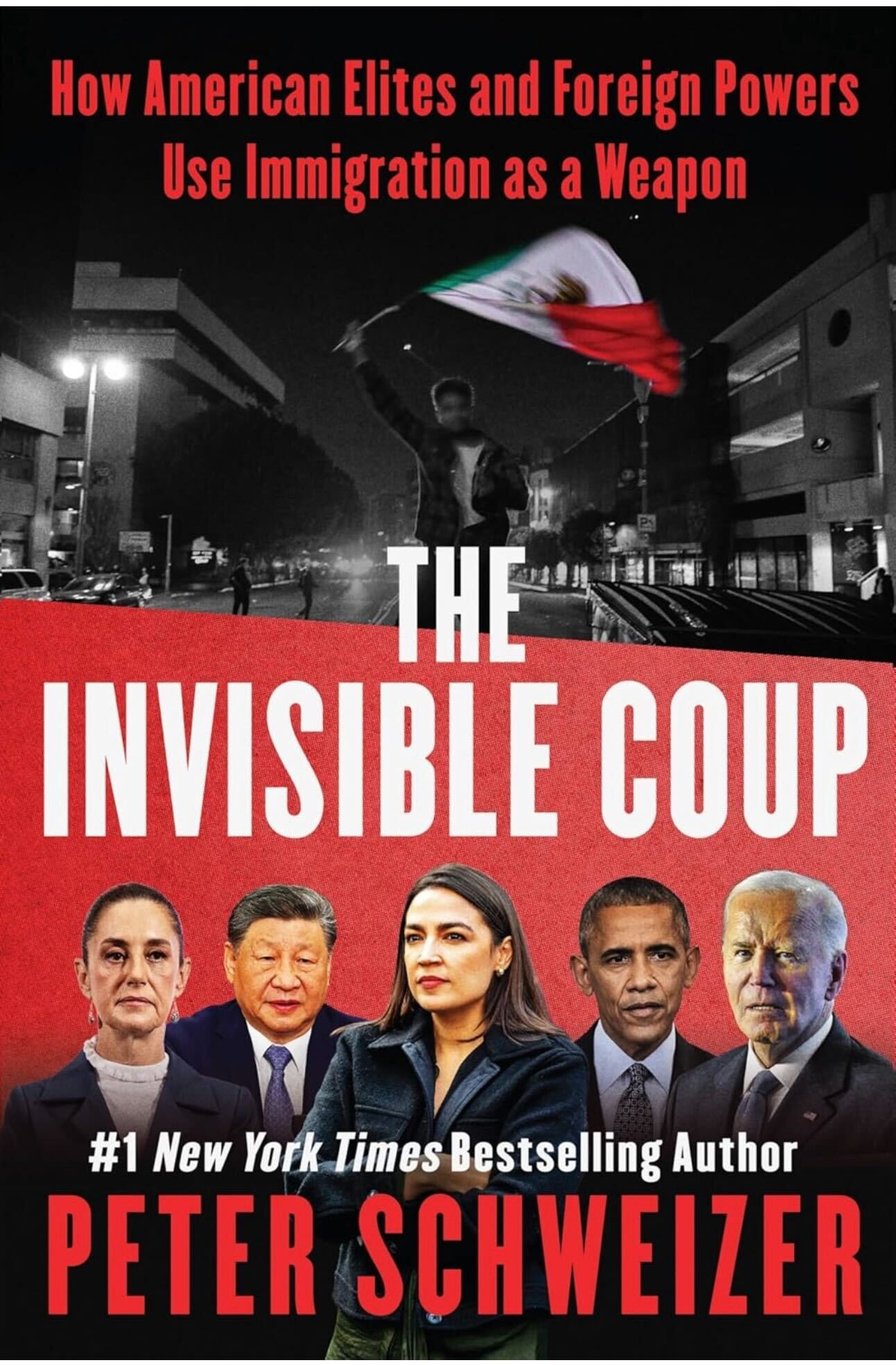
In his new book "The Invisible Coup: How American Elites and Foreign Powers Use Immigration as a Weapon," Peter Schweizer reveals how jihadist leaders treated mass migration as a means to penetrate, subvert, and ultimately remake the United States from within.
The post PILLAR OF JIHAD: Jihadist Leaders View Immigration as Key Component to Subvert the U.S. appeared first on Breitbart.
In his new book The Invisible Coup: How American Elites and Foreign Powers Use Immigration as a Weapon, bestselling investigative author and Breitbart News Senior Contributor Peter Schweizer documents that jihadist leaders — led by the Muslim Brotherhood and aligned Islamist movements operating both overseas and inside the United States — have long treated mass migration, now weaponized through the exploitation of modern immigration systems, not as a humanitarian phenomenon but as a deliberate strategy of conquest meant to penetrate, subvert, and ultimately remake the United States from within.
Schweizer grounds that conclusion in the movements’ own doctrine, tracing the strategy back to Islam’s origins while demonstrating how it is openly invoked and applied in the modern West.
The Muslim Brotherhood and its allies, he writes, look to the Prophet Muhammad himself for doctrinal justification for using migration as a tool of conquest — a religious obligation Muhammad called hijrah, which Schweizer describes as a foundational component of Islamic expansion.
Hijrah, Schweizer explains, was never merely about movement. Migration is “critically important” for da’wah — the effort to spread Islam by inviting others to understand and adopt it — and equally important in establishing an Islamic state or durable political power base inside a host society.
To illustrate how central that obligation is, Schweizer points to the year 622, when Muhammad migrated from Mecca to Yathrib, later renamed Medina — a moment he writes marked Muhammad’s transition from a wandering prophet into a political and military leader.
How significant was that hijrah? Schweizer answers pointedly: the Islamic calendar itself begins with that event.
From there, Schweizer writes, Islamists don’t merely cite history — they cite binding doctrine.
Several hadiths, sayings attributed to Muhammad and embraced by Islamist movements, explicitly frame hijrah as an ongoing obligation and an “important weapon” to be used against the West.
One hadith declares that hijrah ceases only when a place, community, or country has been “won over” and fath — occupation — has been achieved. Only then, it states, is there no more hijrah.
Another insists migration will continue “until the sun rises from the West,” and will not be stopped until repentance is cut off — language Schweizer presents as unmistakably civilizational in scope.
A further charge, as he quotes it, lays out the operational command: “to assemble, to listen; to obey; to immigrate; and to wage jihad for the sake of Allah.”
Schweizer then turns from doctrine to execution.
“Just as the radicals who ran the sanctuary city movement had a litmus test for Central American refugees coming to the United States with the goal of creating a revolutionary force,” he writes, “Islamists seek to import the revolution” — a model he argues they have studied and deliberately adapted.
One of the most consequential mechanisms for implementing that model, Schweizer documents, is the R-1 religious worker visa program, launched in 1990, which allows mosques and religious institutions to bring religious workers into the United States.
Schweizer writes that most U.S. mosques are now headed by imams who are not American-born and were trained overseas — and that some arrive with extremist views that are later propagated domestically.
Among the most notorious examples he cites is Sheikh Omar Abdel-Rahman, the so-called “Blind Sheikh” tied to the 1993 World Trade Center bombing, who entered the United States through an R-1 visa.
[embedded content]
Schweizer also highlights the Holy Land Foundation for Relief and Development case — in which the organization was convicted as a Hamas front group — noting that several employees arrived through the same visa pathway.
The vulnerability, Schweizer stresses, is documented.
He cites a Department of Homeland Security investigation in 2007 that found fraud within the R-1 program to be “excessively high,” particularly among applicants from predominantly Muslim countries.
In one case, a Pakistani man living in Brooklyn declared himself an imam and submitted two hundred religious-worker visa applications.
Schweizer argues the downstream effects are visible inside the United States.
From the Hadi Institute Youth Community Center in Dearborn, Michigan, Imam Usama Abdulghani, an immigrant from Iran, instructs his followers to “fight Western civilization.”
“We need to expose Western civilization,” Abdulghani declares. “The world needs to know this system is no longer a solution. These institutions are morally bankrupt. There is no other way, but God, or taklif — divine obligation-oriented, God-based resistance and rejection of the systems.”
Warnings about the exploitation of immigration channels, Schweizer notes, have come from within Muslim communities as well.
He cites Adnan Khan, former president of the Council of Pakistan American Affairs, who warned that individuals have used religious visas to preach “hardline and dangerous views,” then encouraged the vulnerable to travel abroad for further indoctrination — “and can potentially be used to harm the USA.”
Schweizer also points to a striking warning from 1999, when Muslim leader Muhammad Hisham Kabbani said extremists had “taken over 80 percent of the mosques” in the United States.
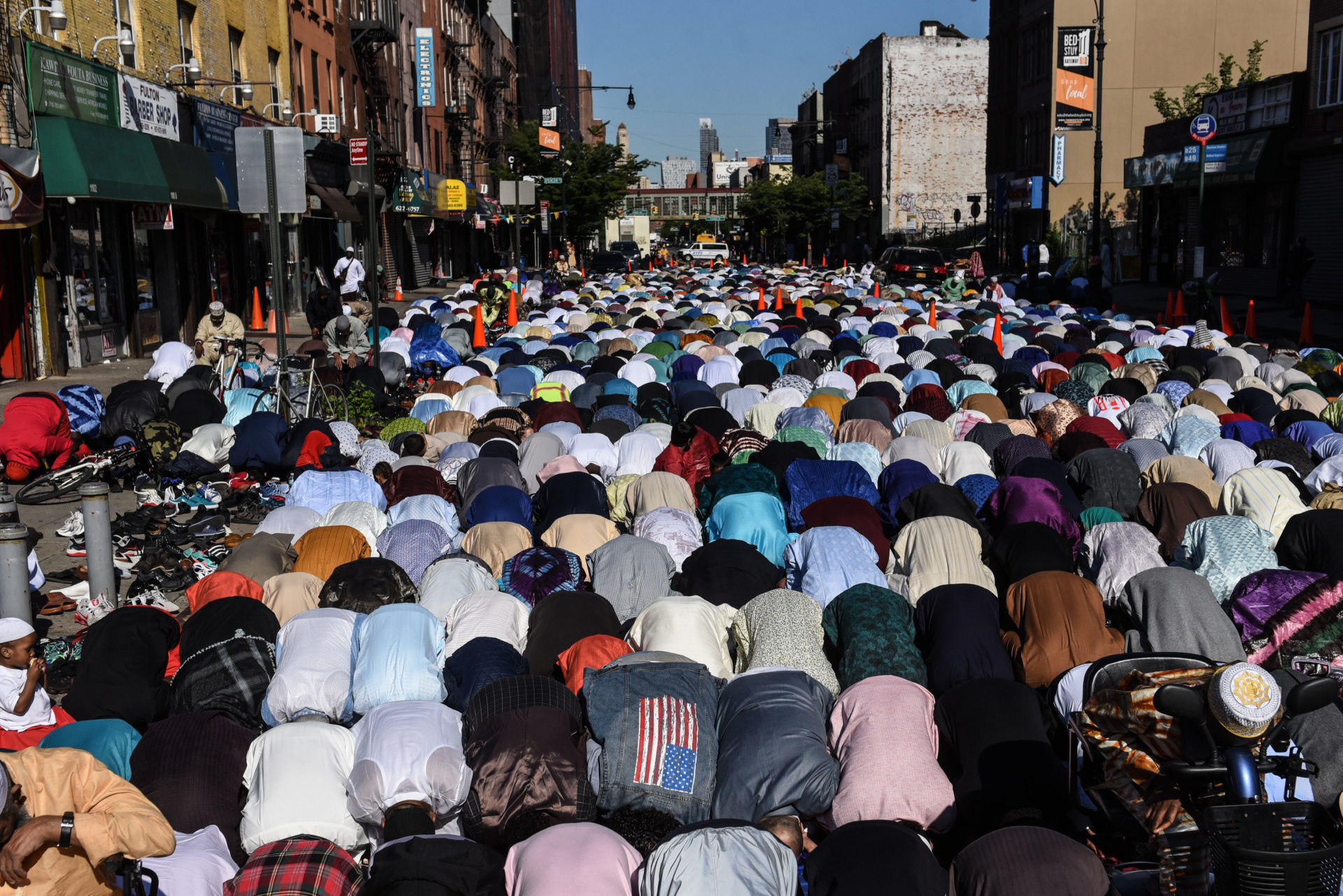
A man wears an American flag on his jacket while people pray outside of a mosque for Eid al-Fitr prayer on June 4, 2019, in the Brooklyn borough of New York City. (Stephanie Keith/Getty Images)
From there, Schweizer writes, Islamist leaders express confidence that infiltration and subversion will succeed.
During a 2015 sermon at Jerusalem’s Al-Aqsa Mosque atop the Temple Mount, Sheikh Muhammad Ayed urged Muslims in the West to be patient.
“This dark night will be over,” Ayed declared, predicting that “soon, we will trample them underfoot, Allah willing.”
Ayed gave the West no credit for accepting migrants out of compassion, instead framing migration as demographic warfare.
“We will breed children with them,” he said. “We shall conquer their countries — whether you like it or not, oh Germans, oh Americans, oh French, oh Italians.”
Schweizer situates those statements within a broader ideological framework.
He cites Professor David Bukay, who describes Islamist migration strategy as a step-by-step methodology designed to subdue host societies and culminate in the implementation of shari’ah, making the Islamization of non-Muslim territories “inevitable.”
Schweizer also quotes Sheikh Yusuf al-Qaradawi, longtime chairman of the International Union of Muslim Scholars and one of the most influential ideological figures associated with the Muslim Brotherhood, who predicted that Islam would return to Europe and the United States through da’wah, not open jihad — with Westerners themselves spreading Islam.
Schweizer then turns to what he describes as a parallel convergence inside the West.
American progressives, he writes, either do not understand these statements or ignore them out of “strategic convenience” — summed up by the logic that the enemy of my enemy is my friend.
Both camps, Schweizer argues, treat migrants as catalysts for radical social change.
He points to refugee advocates such as the Global Goals Foundation — backed by progressive donors, including the Bill and Melinda Gates Foundation and Google — which openly defines refugee policy as a tool for “driving social change” and “transforming” societies.

Bill Gates, co-chair of the Bill & Melinda Gates Foundation, attends a press conference announcing the programme for partnership in the “Our Global Goals” project in Tokyo on November 9, 2018. (TOSHIFUMI KITAMURA/AFP via Getty Images)
Why stable, prosperous, free societies like the United States require such transformation, Schweizer notes, is rarely explained. He argues America requires emulation and assimilation — not transformation.
Schweizer then cites a European warning he says Americans should not ignore.
He quotes Czech President Milos Zeman, who warned that the Muslim Brotherhood seeks to “gain control of Europe” through mass migration — not by conventional war, but by preparing a growing migrant wave and gradually seizing influence.
Zeman cautioned that while similar objectives may exist in the United States, they are not yet as far advanced, adding that his assessment was informed by conversations with the crown prince of the United Arab Emirates and the foreign minister of Morocco.
Schweizer cautions that the United States is earlier in the process — but not exempt from it.
Once the civilizational lens through which Islamists view their clash with the West is understood, he writes, acts of mass violence can be seen in their proper context.
On New Year’s Eve 2015, a massive wave of rape, sexual assault, and other violent crimes swept at least five European countries. Large groups of migrant men arrived together and assaulted women across Germany, Austria, Sweden, Finland, and Switzerland. Officials later said the coordinated attacks were preplanned and unprecedented in scale.
German Justice Minister Heiko Maas declared at the time: “Nobody can tell me that this was not coordinated or prepared.”
Schweizer argues the attacks were not random criminality but a demonstration of how migration, when weaponized, can be used to wage civilizational warfare. Citing European analysts, he writes that the coordinated assaults were designed not only to terrorize women but to humiliate men and degrade Western societies themselves — the deliberate use of rape as an instrument of war.
In that context, Schweizer says, the violence must be understood not as isolated disorder but as part of a broader ideological confrontation with the West.
“Immigration,” Schweizer concludes, “is often used as a weapon deployed against Western civilization — that cannot be in doubt.”
The unresolved question, he writes, is how long the progressive–Islamist alliance can last — and whether these strange bedfellows can maintain peace long enough to accomplish their shared objectives.
Schweizer points to comments by Ibraheem Samirah, then a member of the Virginia legislature and a former senior advisor to Rep. Rashida Tlaib (D-MI), who characterized the partnership as a deliberate echo of Muhammad’s strategy of forming alliances with his enemies.
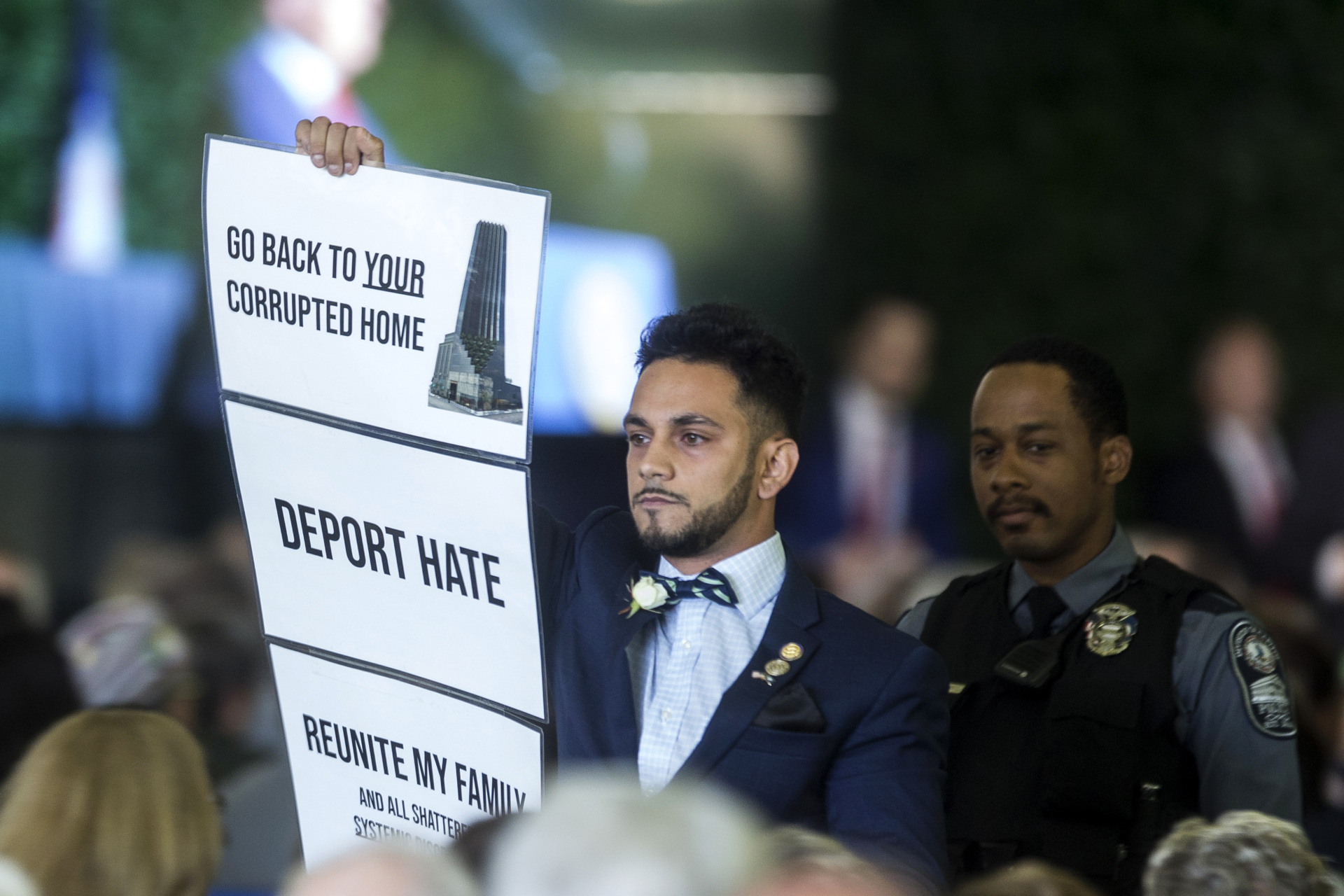
Virginia Del. Ibraheem Samirah (D-Fairfax) holds up a sign as President Donald Trump delivers remarks during the 400th anniversary celebration of the first representative legislative assembly at Jamestown on July 30, 2019, in Jamestown, Virginia. (Zach Gibson/Getty Images)
The leader of the Islamic faith, Samirah said, “had to form alliances with people who weren’t necessarily believers of his message — people who would later on become his enemies,” a framework Schweizer presents not as history, but as a strategic model still being applied today.
Schweizer’s The Invisible Coup: How American Elites and Foreign Powers Use Immigration as a Weapon will be released by HarperCollins on January 20 and is available for pre-order here.
Joshua Klein is a reporter for Breitbart News. Email him at [email protected]. Follow him on Twitter @JoshuaKlein.