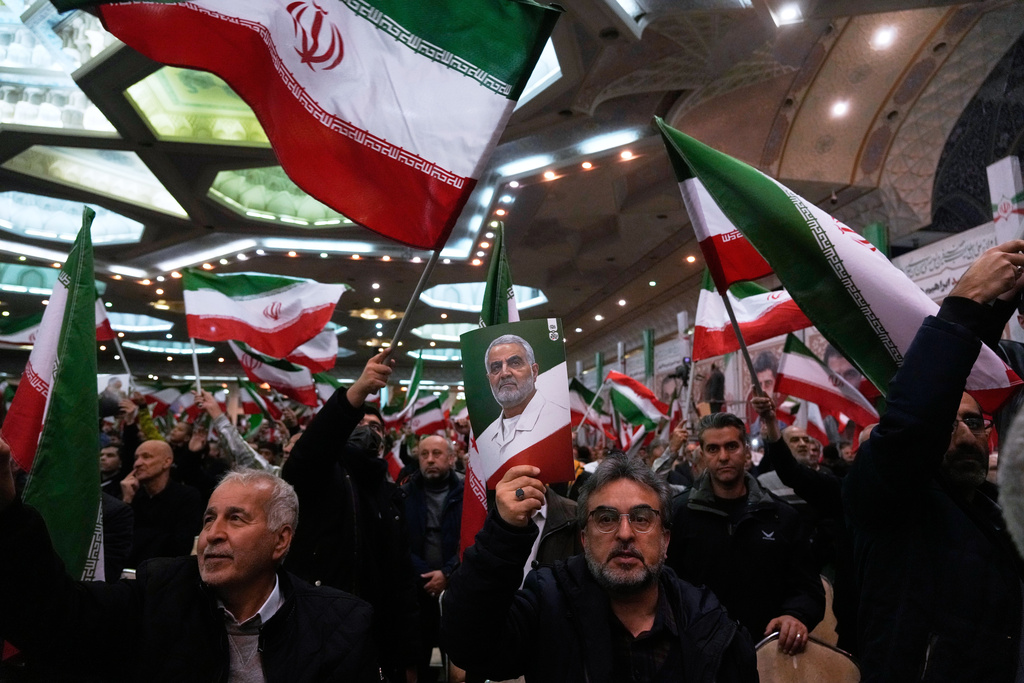
Ayatollah Ali Khamenei is in a perilous position as government crackdowns in Iran seek to violently quash demonstrations against his regime.
President Donald Trump called the Iranian supreme leader a “sick man” in a Sunday interview, saying it is “time to look for new leadership in Iran.” It was only the latest in a series of veiled and explicit threats to decapitate the Iranian government, as protest-related deaths are estimated to exceed 5,000 people.
But Khamenei does not rule alone — standing behind him at the nation’s levers of power is the Islamic Revolutionary Guard Corps, a military organization with massive influence over the country’s internal and foreign affairs.
If the supreme leader is assassinated, there are almost certainly mechanisms in place for the Guard to fill the power vacuum. And even if the Guard itself is ousted from Iran, its complex network of foreign terrorist cells and proxy affiliates provides ample footholds for the organization to regroup.
Guard ‘transnational’ network is more than military support for Iran
The Guard was founded immediately following the Iranian Revolution in 1979 by Mohsen Sazegara, a postrevolution government official who later broke with the Khamenei government in the early 2000s and now lives in exile as a dissident.
Originally intended to safeguard the theocratic ideology of the revolution, it ballooned into an all-encompassing institution of control increasingly distinct from the ayatollah.
“The IRGC is so much more than just a military institution in Iran,” Nicolas Carl, the assistant director of the Critical Threats program at the Institute for the Study of War, told the Washington Examiner. “It performs a range of domestic functions ranging from propaganda to economic management … but it also has a regional role.”
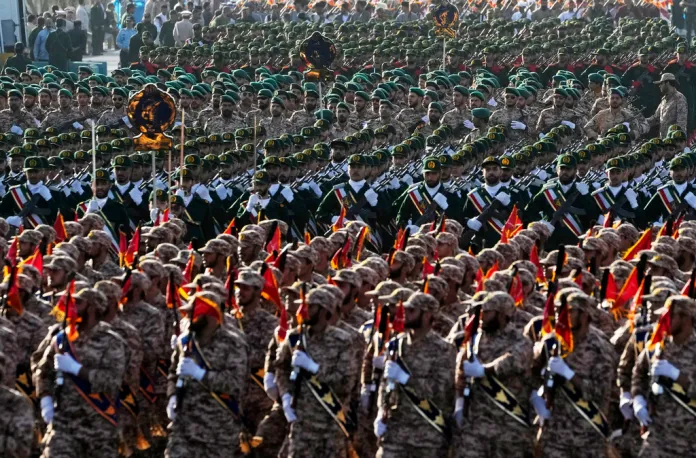
“When we talk about the IRGC, we need to appreciate that it’s not just a military,” Carl continued. “It is a transnational smuggling and terror network. It has networks abroad, stretching well beyond the Middle East.”
The Hudson Institute characterizes the Guard as a “self-financing power structure that fuses battlefield experience, economic capture, and regional penetration into a single system of rule” that has “steadily accumulated power, filling the vacuum left by pious exhaustion.”
In an interview published last weekend in the Times, Sazegara lamented how the military organization he helped create was intended to “be like the National Guard in the United States” but ultimately “turned into a monster — a dragon with many heads.”
The Guard contains many specialized branches under its command, including standard military outfits such as Ground Forces, a Navy, and an Aerospace Force. There is also an Intelligence Organization and the Basij Organization, a paramilitary volunteer militia that has been mobilized in recent weeks to aid suppression of protests.
Quds division of the Guard has operatives ‘all over the world’
Perhaps the most infamous of the Guard’s divisions is the Quds Force — an elite and clandestine branch of the Guard dedicated to exerting influence abroad and supporting proxy groups.
Quds, Arabic for “Jerusalem,” operatives furnish foreign Islamic terrorist groups in regions such as Afghanistan, the Palestinian territories, Lebanon, and Iraq with material and logistical support. Training, financial resources, and strategic counsel are all provided by the Guard and its Quds Force through informal arrangements.
The most famous of these foreign influence projects is the “Axis of Resistance,” a confederation of loosely aligned military and political organizations across the Middle East, such as Hamas, Hezbollah, the Houthis, and others.
“If you look at the structure of the Quds Force, it has different regional directorates — so it has one for Iraq, it has one for Syria, it has one for Lebanon, one for Africa, one for the Americas,” Carl said. “The IRGC Quds Force has a global presence, it has operatives all over the world.”
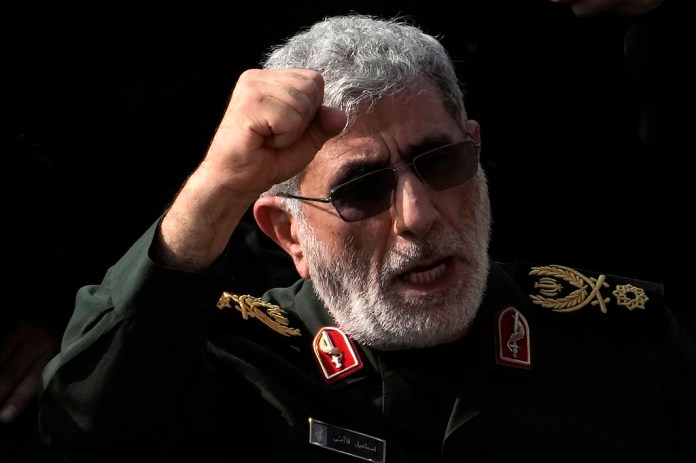
Combatting the spread of this Quds-led influence of the Guard has been a chief concern for Western nations, particularly in areas of the Middle East and Latin America.
Over the weekend, Argentinian President Javier Milei signed a decree designating the Quds Force as a foreign terrorist organization, saying his government is “determined to reverse the decline of recent decades and align itself with Western civilization.”
The U.S. State Department applauded the move, calling it an “important step” that “strengthens the global effort to counter Iranian-backed terrorism and support the Iranian people.”
Israeli Foreign Minister Gideon Sa’ar also commended Milei’s decree, expressing hope that “more countries should follow Argentina’s example” and combat the spread of Quds, an organization that “continues to export terror to the Middle East and all over the world, while terrorizing its own people.”
Last month, Israel announced the targeted killing of Quds operative Hussein Mahmoud Marshad al Jawhari in southern Lebanon. The Israeli government asserted that Jawhari was responsible for organizing terrorist attacks against security forces in the region.
If Khamenei falls, Guard could go ‘stateless’
This “dragon with many heads” presents a unique challenge to global powers seeking to decapitate and overhaul the government of Iran. If Khamenei were to be neutralized, an act that would be “tantamount to a full-scale war,” according to Iranian President Masoud Pezeshkian, the Guard would be well-equipped to activate its own military dictatorship.
And even if a systematic campaign ousted the Guard from within Iran, those foreign footholds would remain.
Dr. Jacob Olidort, director for American Security and chief research officer at the America First Policy Institute, told the Washington Examiner that there is potential for the Guard to survive total regime collapse as a global terrorism network.
“In the event that regime collapse also results in the removal of the IRGC from governance, it is not inconceivable that the IRGC (or more purist elements within it) makes a determination to pursue its terror activities beyond Iran’s borders as a stateless global terror network,” Olidort told the Washington Examiner.
The Guard suffered a massive blow in 2020 when President Donald Trump ordered the assassination of Quds Force Commander Qasem Soleimani, the chief architect of its terrorism network. Additionally, Iranian-backed proxy groups sustained tremendous losses in recent years by clashing with Israel in conflicts such as the 12-Day War.
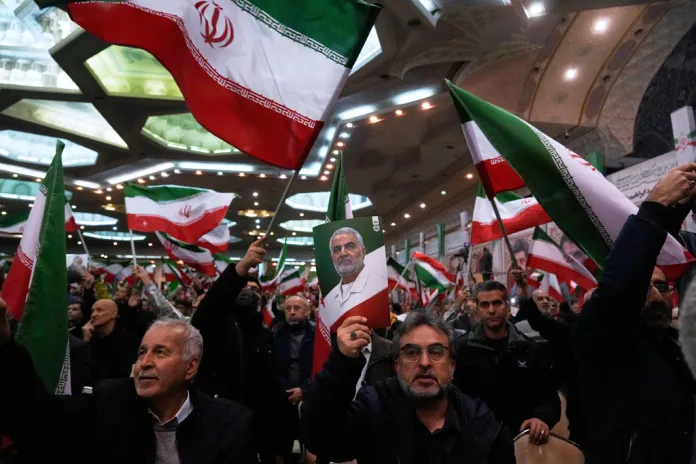
These losses were felt at home in Iran as well, with Israeli strikes severely damaging Guard infrastructure, killing high-ranking commanders, and compromising the Iranian arsenal.
In this time, however, reports show Guard-aligned groups expanded their global footprint, seeking to bolster their positions in places such as Iraq and the West Bank.
The Quds Force has also been active in Africa, reportedly undertaking a slew of projects such as providing material support to the Islamic Movement of Nigeria, training rebel militants in Chad, and conscripting terrorist operatives in countries such as Senegal and Uganda.
Carl told the Washington Examiner that while a hypothetical collapse of the Iranian regime and ousting of the Guard would be a “significant blow” to the organization, he believes “that network is still going to exist” even if “some of the top-level IRGC officials are decapitated.”
“I think that a far more likely scenario is one wherein the IRGC still exists as some form of latent network stretching across, primarily, the Middle East, but also the world, and continues to collaborate with its Axis of Resistance members,” Carl told the Washington Examiner.
The loss of a sovereign state would force the Guard to fundamentally transform itself, but there is an abundance of stateless terrorist organizations that provide a model of how such a poststate organization could operate.
The Islamic State group once held functional sovereignty over swathes of Iraq and Syria, exploiting central and local governments’ inability to effectively combat their presence. Its leadership was concrete and centralized around the self-proclaimed caliph, Abu Bakr al Baghdadi.
That control was beaten back by U.S.-led efforts to uproot the organization. Baghdadi was killed in a raid by the U.S. military in 2019, as were three successive caliphs designated by the Islamic State group’s central leadership.
An alternative, less centralized path for the Guard can be observed in al Qaeda, a pan-Islamist network that once operated under a rigid command hierarchy but ultimately devolved into a global confederation of regional, quasi-independent branches.
A 2024 report from the Congressional Research Service claims “ties between [al Qaeda] leadership and groups that have pledged allegiance to it” have become muddled as the organization has “shifted away from centrally directed plotting.”
IRAN STATE TV HACKED AND AIRS MESSAGE FROM EXILED CROWN PRINCE URGING PROTESTS TO CONTINUE
For now, it seems the Guard remains determined to hold on to power inside Iran. International observers are waiting to see if the protests will survive the latest round of crackdowns rolled out over the weekend, which seemed to smother the demonstrations that have raged since late December 2025.
As of Monday morning, the death toll was estimated to be around 4,000, according to the U.S.-based Human Rights Activists News Agency. An Iranian official, speaking to Reuters on condition of anonymity, told the outlet that between law enforcement and protesters, deaths exceed 5,000.
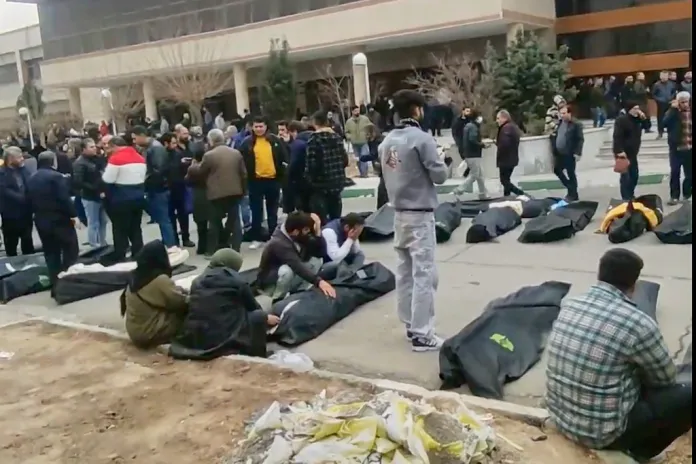
Ebrahim Azizi, head of the Iranian parliament’s National Security and Foreign Policy Committee, announced Monday that the nationwide blackout on internet service could be phased out “as soon as security conditions are appropriate.”
The regime did suffer a blow to its image on Sunday when state television was successfully hacked, broadcasting speeches from Trump and exiled Iranian Crown Prince Reza Pahlavi.