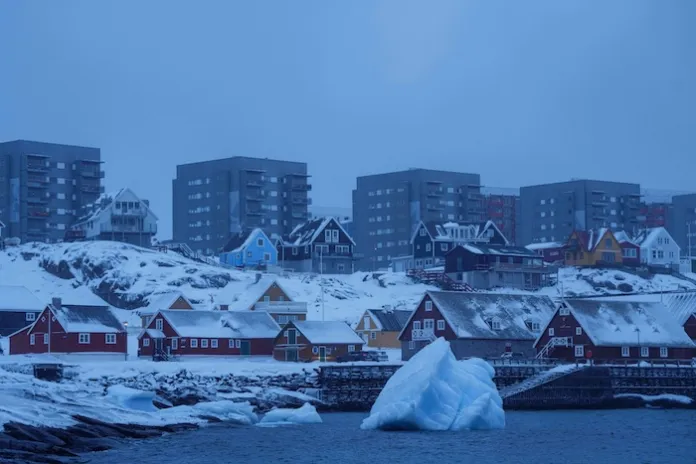
President Donald Trump refused to say on Monday whether he would use military force to acquire Greenland from Denmark, the latter of which is a NATO ally that fought alongside U.S. forces in the Middle East following 9/11.
The president’s recent musings about acquiring Greenland, and his refusal to rule out military action, pose significant questions and challenges to the NATO alliance, which has been the preeminent Western alliance since the end of World War II.
Trump said earlier this month that “ownership” of Greenland, an autonomous territory within Denmark, “gives you things and elements that you can’t get from just signing a document, that you can have a base,” and he has since added, “We are going to do something in Greenland, whether they like it or not, because if we don’t do it, Russia or China will take over Greenland, and we’re not going to have Russia or China as a neighbor.”
How does this tear at the fabric of NATO?
Any sort of military operation from the United States would divide NATO because Denmark is also a member of the alliance. The alliance’s Article 5 clause states that an attack on any member is viewed as an attack against them all, and the only time it has been invoked in the history of the alliance was in the aftermath of 9/11 in the U.S.
Should the U.S. carry out military operations to conquer Greenland, “NATO would no longer exist the way we have seen NATO,” former Ambassador Alan Leventhal, who served as U.S. ambassador to Denmark from 2022 to 2025, told the Washington Examiner. “It’s the most powerful military alliance in the history of the world for more than three quarters of a century, it’s protected a billion people, and NATO would no longer be the organization that it was.”
European leaders have rallied behind Denmark and Greenland, noting that they are allied with the U.S. and have the same objectives in the Arctic and that the use of military force should be unnecessary to achieve them.
European Union leaders are to hold an “extraordinary meeting” this week, where European Council President Antonio Costa said they would discuss “territorial integrity and national sovereignty,” as well as “readiness to defend ourselves against any form of coercion.”
Multiple European countries have also deployed troops to Greenland this week.
“We are willing to cooperate much more but, of course, in mutual respect. And if we cannot see that, it will be very difficult to have a good and reliable partnership,” Greenland’s Prime Minister Jens-Frederik Nielsen said this week.
Instead of trying to work with the alliance to bolster the security infrastructure in Greenland for the mutual benefit of NATO, the administration has upset Greenlanders, Denmark, and most of its NATO allies, who say Greenland is not for sale, while the traditional U.S. adversaries such as Russia have been overjoyed at the brewing fissuring of the alliance.
Trump administration officials have cited Greenland’s proximity to the Arctic as a primary reason behind their push to acquire the frozen island, even though their current partnership, which dates back to a 1951 U.S.-Denmark treaty, already allows for a U.S. military presence, one that could be increased if desired.
“If the ostensible reason why the administration wants control of Greenland is to be able to ensure Arctic security, the best way to do that is through NATO and the Greenlanders and the Danes are willing to give us everything we need on the island in terms of basing infrastructure investments,” Michael Carpenter, the former U.S. Ambassador to the Organization for Security and Cooperation in Europe, told the Washington Examiner.
Greenland’s location is significant for Trump’s interest. Not only does melting ice in the Arctic make way for new possible maritime routes through the region, but it also provides growing access to the region’s virtually untouched fossil fuel and mineral reserves.
Former U.S. Ambassador to Denmark Carla Sands, who served in the position during Trump’s first term, told the Washington Examiner she believes the situation will have “zero” impact on the alliance, adding, “If anything, they’re going to make sure they they pony up that 5% because they don’t want a strong U.S. president calling them out and embarrassing them,” referencing the increased defense spending minimum requirement.
She also predicted that the president would ultimately get his way in acquiring the Arctic island.
“I think he’s going to push fast because they’re gonna try to wait him out,” Sands said. “So I think he’ll push fast. He’ll accelerate the timetable, he’ll put pressure, and I think he gets it done, because he has been so out in front on this, it’s become like a red line, and Trump doesn’t like to lose in a deal.”
The U.S. currently has one base in Greenland, Pituffik Space Base, which houses approximately 150 U.S. military members, a Space Force spokesperson told the Washington Examiner.
The president also announced over the weekend that the U.S. would put a 10% tariff on all goods exported to the U.S. from Denmark, Norway, Sweden, France, Germany, the U.K., the Netherlands, and Finland starting on Feb. 1 and warned that if the situation is not resolved by June 1, it would jump to 25%.
If the relationship between the U.S. and Europe continues to deteriorate, it could ultimately lead to the U.S. military giving up both its military role in NATO and even possibly bases located in several European countries.
Trump has had a complicated relationship with the NATO alliance since his first term, long accusing allies of relying on U.S. support and publicly adding speculation as to whether the U.S. would come to the defense of a NATO partner in the event there is an Article 5 situation.
During Trump’s first year in his second term, he pushed the alliance to increase its minimum spending on defense benchmark from 2% of gross domestic product to 5%, though another major factor that prompted European leaders to increase their defense spending is Russia’s war in Ukraine, which is the largest battle on European soil since WWII and is on the verge of hitting its fourth anniversary.
Russia ’emboldened’
Russian leader Vladimir Putin has long criticized the NATO alliance, alleging it poses a threat to Moscow, and Kremlin officials have celebrated the fracture between the U.S. and the rest of its NATO partners.
Kremlin spokesman Dmitry Peskov said Trump could “go down in history” if the U.S. acquires Greenland.
Carpenter added, “Russian state media is celebrating Trump’s comments about Greenland. They see this as a win because, as they themselves are saying, it’s dividing the Alliance. So dividing NATO has always been one of Russia’s top foreign policy games, and they’re seeing it happening now.”
Similarly, Levanthal warned that Moscow “would be emboldened” to carry out acts of aggression if NATO becomes a shell of itself and suggested that Beijing is likely watching closely “particularly in terms of things that they want to do in Asia, [and] how they think about Taiwan.”
Even if the current situation regarding Greenland is resolved without bloodshed, there could be lasting mistrust between America and Europe that would raise questions about the tenability of maintaining NATO. Alternatively, it could be a strategy to get Europe to invest more in Arctic security.
A Nobel connection
The president, over the weekend, also tied his aggressive posture toward Greenland with his perceived slight after the Nobel Peace Prize gave this year’s award to Venezuelan opposition party leader Maria Corina Machado instead of him.
WHAT IS EUROPE’S ‘TRADE BAZOOKA’ BEING FLOATED AS AN ANSWER TO TRUMP’S GREENLAND THREATS?
“Considering your Country decided not to give me the Nobel Peace Prize for having stopped 8 Wars PLUS, I no longer feel an obligation to think purely of Peace, although it will always be predominant, but can now think about what is good and proper for the United States of America,” Trump said to Norwegian Prime Minister Jonas Gahr Støre over the weekend.
Machado, who visited the White House last week, gave her award to the U.S. president, which he kept.
“So to me, that is a false pretense here. I think this is ultimately a vanity project for the president,” Carpenter said. “[Trump] wants to preside over something that would be seen by future generations as akin to the Louisiana Purchase. And, I understand that, but I think in the process, he’s essentially going to destroy NATO, even if he doesn’t formally pull out of the Alliance. I think the damage that is done to our relationships with our European allies is already so immense.”