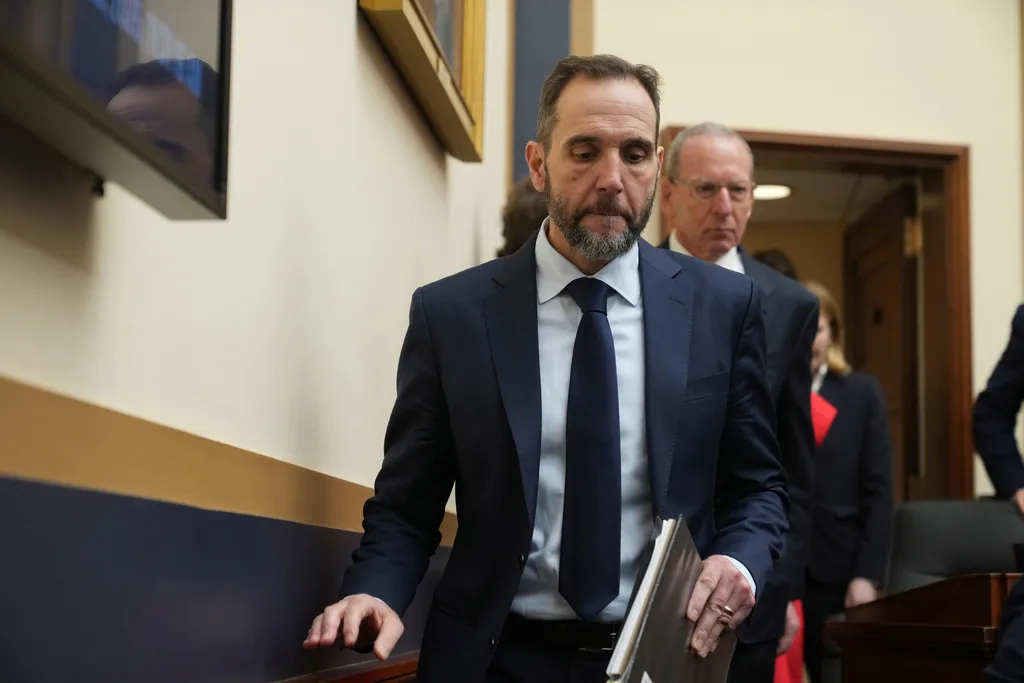
Former special counsel Jack Smith, who brought two now-defunct criminal cases against President Donald Trump, defended the integrity of his investigations during a combative House Judiciary Committee hearing on Thursday.
Making his first public appearance before lawmakers, Smith pushed back against claims that he acted as a partisan prosecutor, as the hearing devolved into a sharp political clash over Trump’s conduct after the 2020 election and the Justice Department’s pursuit of him.
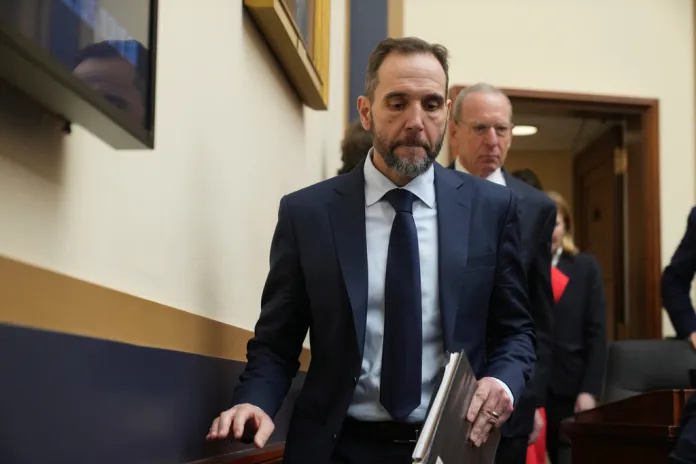
“I am not a politician, and I have no partisan loyalties,” Smith told the committee. “My career has been dedicated to serving our country by upholding the rule of law. I stand by my decisions as special counsel, including my decision to bring charges against President Trump.”
While Smith was testifying, Trump escalated his attacks, calling Smith a “deranged animal” in a social media post and saying he hoped Attorney General Pam Bondi was “looking at” Smith’s conduct because “a big price should be paid.”
Former Special Counsel Jack Smith opening statement: “I stand by my decisions as Special Counsel, including the decision to bring charges against President Trump. Our investigation developed proof beyond a reasonable doubt President Trump engaged in criminal activity.” pic.twitter.com/TGimYokf1q
— CSPAN (@cspan) January 22, 2026
From 2022 to 2025, Smith led the DOJ’s special counsel investigation into Trump’s efforts to overturn the 2020 election and his handling of classified government documents after leaving office. Smith ultimately filed federal charges in both cases but withdrew them following Trump’s 2024 election victory, citing long-standing DOJ policy barring the prosecution of a sitting president. A judge had already thrown out the case involving the classified documents by the time Trump won the election.
Here are the key takeaways from Smith’s five-hour testimony before Congress.
Republicans blast Smith over secret phone records subpoenas
Rep. Kevin Kiley (R-CA), who sat in a competitive district that was redrawn during the California redistricting process, zeroed in on Smith’s use of nondisclosure orders to obtain phone toll records belonging to sitting members of Congress during the Jan. 6 investigation.
“You didn’t even tell those judges that it was members of Congress whose records you were going after,” Kiley said. “Now, if you sought to do that today, would you be able to get away with asking the judges for a nondisclosure order without telling them these are members of Congress?”
Rep. Kevin Kiley exposes Jack Smith’s abuse of the law:
“That statement was also echoed by SCOTUS in a unanimous opinion…where the court overturned convictions that you had pursued against a former governor, criticizing your boundless interpretation of the federal criminal… pic.twitter.com/9CIYwDJIG8
— RNC Research (@RNCResearch) January 22, 2026
Smith responded that the subpoenas were issued under the DOJ rules in effect at the time. “When we secured these toll records via subpoena, it was done consistent with department policy,” he said. “You’re correct in that that policy has since changed.”
Kiley immediately pushed back. “They changed the policy based upon the actions that you took,” he said.
Smith defended the practice as routine at the time when he was still special counsel, telling lawmakers that toll records are “common practice in complex investigations” and noting they reflected call data, not content. The fact that the targets of the subpoenas were sitting lawmakers raises unique separation-of-powers questions; however, given that lawmakers enjoy the protections of the Speech or Debate Clause.
The former special counsel also said he pursued the records because he was concerned about obstruction of justice, claiming Trump was “targeting witnesses” [and] had a duty to protect witnesses” who the DOJ had a duty to defend.
Smith questioned over First Amendment and potential ‘Speech or Debate’ violations
Gill said Smith obtained a nondisclosure order that kept McCarthy from being notified and suggested the special counsel team leaned on a claim that McCarthy posed a “flight risk” to justify that secrecy. Smith pushed back that “with respect to a nondisclosure order, the risks aren’t necessarily associated with the subscriber to the phone.” Gill responded that Smith was “using this clearly in reference to Speaker McCarthy, and you were using clearly false information.”
Rep. Brandon Gill destroys Crooked Jack Smith on his sham investigation that wasted millions of your hard-earned money.
GILL: “You walked all over the constitution throughout this entire process, spying on members of Congress, and you know it. It’s absolutely disgraceful.”
— RNC Research (@RNCResearch) January 22, 2026

Gill broadened the attack to the Constitution’s Speech or Debate Clause, warning that Smith’s office subpoenaed at least eight sitting senators for similar records and also secured nondisclosure orders during the Arctic Frost phase of the investigation. The clause generally shields lawmakers from legal exposure arising from official legislative acts, and Republicans argued that the subpoenas risked sweeping up protected legislative activity.
Later, Rep. Troy Nehls (R-TX) delivered a scorched-earth rebuke, accusing Smith of trying to “criminalize political speech” and “spy on Republican members of Congress in violation of the Speech and Debate Clause, including the sitting Speaker of the House.”
Nehls cited even the “far left Washington Post” as having criticized Smith’s approach and argued the prosecution was “politics from Day One,” rather than justice. He capped his criticism by pointing to Trump’s 2024 win as “proof beyond a reasonable doubt” that voters rejected the “witch hunt, loud and clear.”
Jim Jordan presses Smith on Cassidy Hutchinson
House Judiciary Chairman Jim Jordan (R-OH) pressed Smith on why his office had previously considered using Cassidy Hutchinson as a witness, despite a GOP Jan. 6 report concluding her most dramatic testimony was not corroborated. Smith acknowledged as much during a closed-door deposition last year.
Hutchinson testified to the Democrat-led Jan. 6 committee that she heard Trump lunged for the steering wheel of the presidential SUV on the day of the riot and clashed with a Secret Service agent — a claim disputed by other witnesses who were actually present.
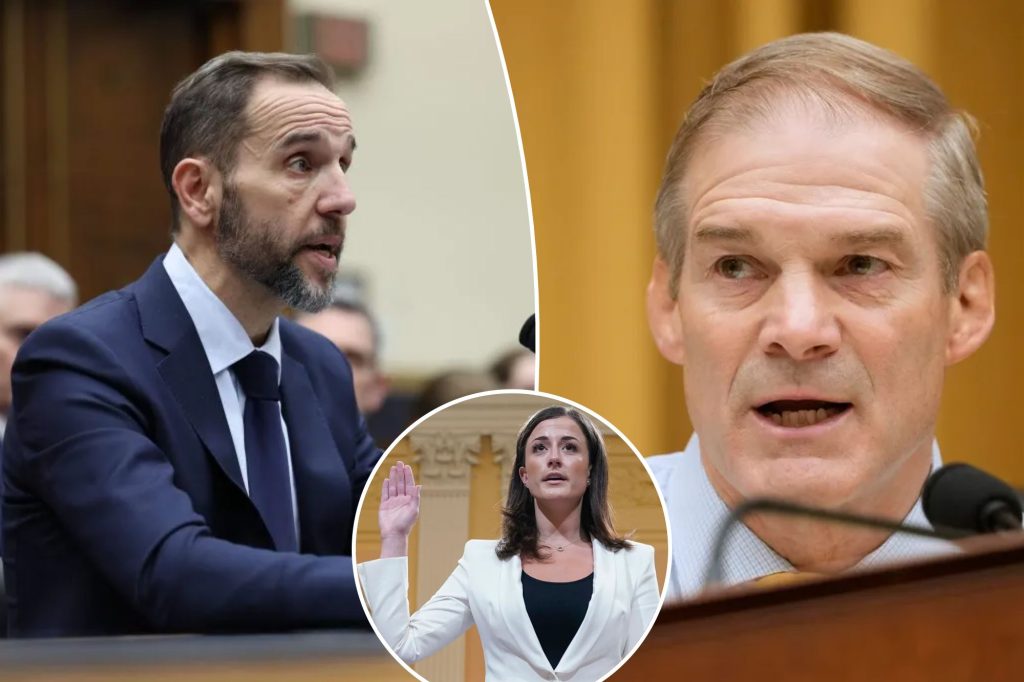
“Did you ever confirm that story?” Jordan asked.
Smith declined to answer directly, saying he would not discuss internal prosecutorial assessments. Jordan continued pressing, asking whether Smith believed Hutchinson’s account.
Smith again refused to say.
“Someone the whole country knows wasn’t telling the truth, and you were still considering putting her on the witness stand,” Jordan said. “Because you had to get President Trump.”
Smith rejects error, only regrets not thanking staff more
Despite repeated references to court setbacks, orders that were narrowed by judges, and internal DOJ concerns, Smith declined to acknowledge that he made any substantive mistakes.
“If I have any regret,” Smith said, “it would be not expressing enough appreciation for my people who worked for me, exactly, just doing their job.”
The response underscored the sharp divide that defined the hearing: Republicans arguing Smith’s tactics forced the DOJ to make policy changes and raised lasting constitutional concerns, and Smith insisting his investigation was lawful, justified, and improperly second-guessed after the fact.
Democrats praised Smith for his integrity and work as a public servant
Democrats praised Smith during their allotted five-minute questioning periods throughout the hearing.
Rep. Eric Swalwell (D-CA), who is running to be California‘s next governor, praised Smith, telling him to “lean in” because he has “nothing to be ashamed of.” Swalwell went on to read praises of Smith from former colleagues, including one who said he had “no idea what Mr. Smith’s political beliefs are, because he’s completely apolitical.”
The California Democrat asked whether Smith regrets being a special prosecutor, to which Smith promptly responded that he does not.
“I think you’re a great American, and you came out of this as being somebody who people can respect and look up to in a fashion that we should be instilling people’s desire to go into justice, to go into law, and to go into government,” Rep. Steve Cohen (D-TN) said in the hearing. “You’re an example of the type of person they should follow.”
House passes amendment to repeal Senate ‘Arctic Frost’ provision
The House unanimously passed an amendment Thursday to a government funding bill stripping senators swept up in the “Arctic Frost” investigation of the ability to sue the federal government for $500,000 in damages.
The FBI’s Arctic Frost operation was initiated in 2022 and served as the predicate not only for Trump’s prosecutions but also for several secret subpoenas Smith sought against GOP lawmakers as he conducted his investigation into the then-former president. The amendment coincided with Smith’s testimony before the committee, making for an uphill battle when the bill reached the Senate.
The upper chamber included the lucrative provision in a government funding bill last year that ended the longest government shutdown in history. It allows senators to sue the federal government for upwards of $500,000 if their phone records were collected as part of Smith’s investigation into efforts to overturn the 2020 election.
House Democrats seek second hearing on classified documents case
Shortly after the hearing concluded, House Democrats issued a formal notice to Jordan that they would seek a second public hearing focused on the classified documents case dismissed by a Trump-appointed judge in June 2024.
“In light of the order by Judge Aileen Cannon restricting his ability to testify concerning Volume Il of his report, his testimony during the January 22, 2026, hearing was necessarily incomplete,” Democratic Reps. Jamie Raskin (MD), Jerry Nadler (NY), Zoe Lofgren (CA), and Steve Cohen (TN) wrote in a brief letter.
HOUSE TUCKS REPEAL OF $500,000 SENATE ‘ARCTIC FROST’ BENEFIT IN GOVERNMENT FUNDING BILL
U.S. District Judge Aileen Cannon is currently mulling a request by Trump to keep Smith’s final report about the case under seal. The indictment from Smith charged Trump and two co-defendants with over 40 felony counts related to his alleged mishandling of classified documents after his first presidency.
Cannon ultimately found that Smith was unlawfully appointed by former Attorney General Merrick Garland, leading to the dismissal of the case in the summer of the previous general election year.