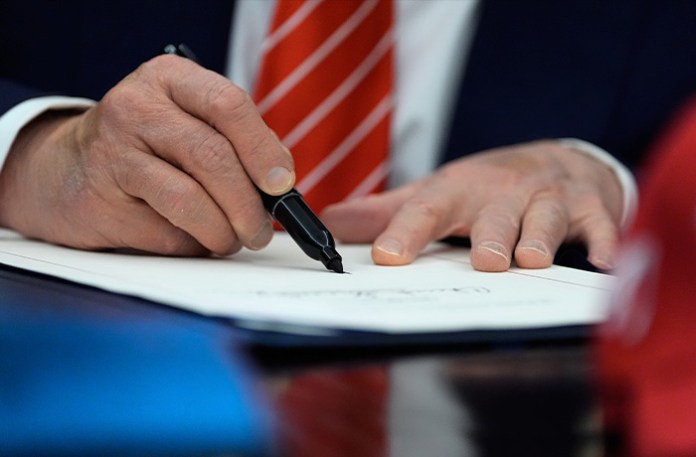
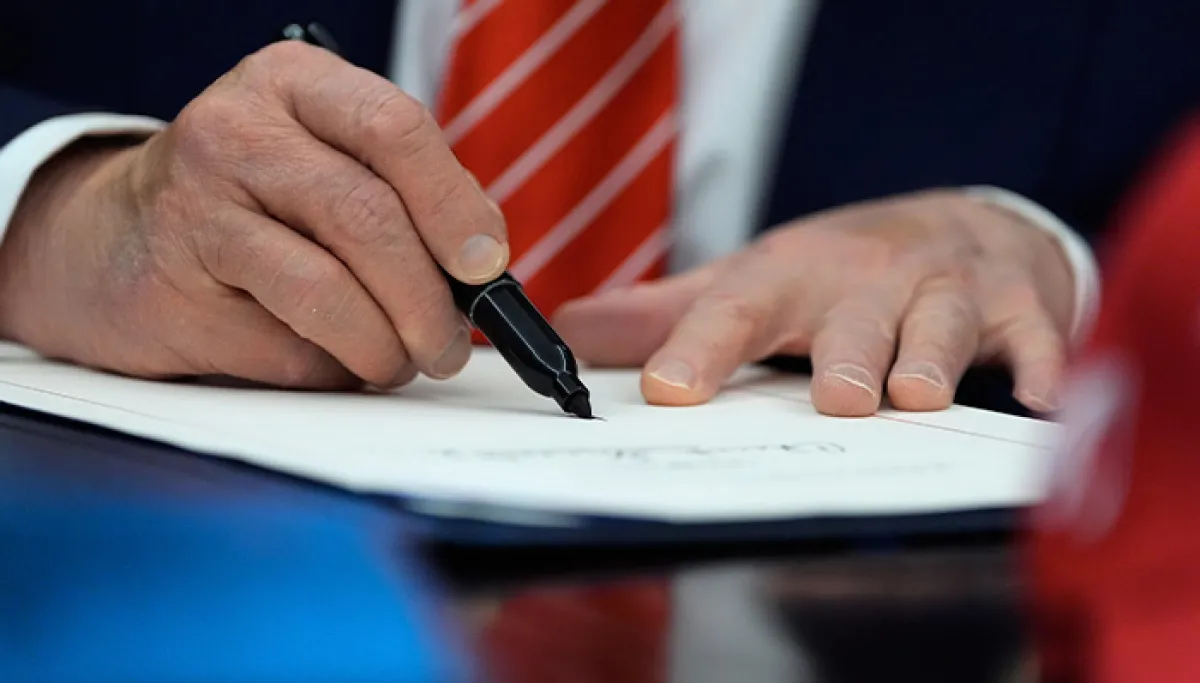
President Donald Trump recently signed $174.7 billion spending legislation. The White House said little upon signing the Commerce, Justice, Science; Energy and Water Development; and Interior and Environment Appropriations Act, 2026.
The move, however, signaled its support for Congress on the long-titled bill in a Jan. 7 statement.
“The Administration urges every Member of Congress to support this fiscally responsible bill, which is a win for the American taxpayer,” it said.
Trump’s budget team highlighted the legislation’s provisions to achieve “energy dominance” and to “reduce violent crime, root out fraud in Government programs, and address the past weaponization of the Department of Justice and the Federal Bureau of Investigation.”
Republican lawmakers claimed victory with the bill’s enactment during a low-key signing ceremony at 1600 Pennsylvania Ave.
“This is another major win for the American people that implements President Trump’s America First agenda,” Rep. Hal Rogers (R-KY) declared. “We are dismantling the drug trafficking networks that have tried to poison our communities for profit. At the same time, we are reviving our coal communities and setting the stage for energy independence.”
Democrats also found a lot to like in the legislation. Rep. Rosa DeLauro (D-CT), ranking Democrat on the Appropriations Committee, said, “This package makes meaningful investments to bring down costs for utility bills and provides substantial funding for clean energy. It makes our communities safer by increasing funding for Violence Against Women Act and other public safety grants.”
The House passed the bill by a vote of 397 to 28, and the Senate supported it 82 to 15. Democrats supplied 206 votes in the House and 35 votes in the Senate.
Left unmentioned in any of these cheerful official statements was that the minibus legislation carries 3,030 community project funding grants, also known as earmarks, according to the National Taxpayers Union. This may be a large reason why Democrats and Republicans were able to come together to support the bill.
Many of the earmarks will fund infrastructure repair or replacement. The statute’s Interior and Environment section has hundreds of line items for upgrading sewer lines and drinking water systems. Similarly, the Energy and Water Development will use federal funds for energy development projects and for U.S. Army Corps of Engineers projects to improve shipping ports and channels.
The law’s Commerce, Justice, Science section is a veritable smorgasbord of local projects. Funds will flow to universities for research on semiconductors, fentanyl detection inventions, and cancer cures. Local communities will receive dollars for crime prevention, including new police cars, helicopters, and radios. A Brevard County, Florida, school will get “$2,000,000 to establish the Space Coast Jr./Sr. High School’s new Aviation Assembly and Fabrication Program, giving students hands-on training and preparing the next generation for careers in the aerospace workforce,” thanks to Rep. Mike Haridopolos (R-FL).
Per tradition, Republicans, who hold the majority in both chambers, clearly brought home more bacon than Democrats, although a final tabulation is not yet available. Not every earmark was partisan. Sens. John Fetterman (D-PA) and David McCormick (R-PA), for example, partnered to secure earmarks to improve wastewater treatment and to mitigate flooding.
Members of the appropriations committees did especially well. Rep. Chuck Fleischmann (R-TN), who chairs the subcommittee that wrote the energy and water portion of the minibus, directed $213 million to upgrade the Chickimunga Lock. Senate Appropriations Committee Chairwoman Patty Murray (D-WA) secured $331.4 million in funds for infrastructure and natural resource restoration projects.
The earmarks eruption came after Congress enacted hardly any of them for two years. Legislators’ inability to pass annual funding bills in 2024 and 2025 necessitated enacting continuing resolutions, which typically do not include new directed spending requests.
Congress brought back earmarks five years ago after a lengthy moratorium. New rules were adopted in the early 2000s to prevent scandalous dealings, which sent one legislator, a few congressional staff members, and some lobbyists to prison. Community project grants, as earmarks are formally called, can no longer go to private corporations. All spending requests must be posted online by legislators, and the Government Accountability Office will audit some funded projects.
Members of the House Freedom Caucus, which has regularly criticized earmarks, were among the few voices on Capitol Hill to criticize the spending.
“The continued inclusion of earmarks in appropriations bills is flatly unacceptable,” Rep. Eric Burlison (R-MS) posted on X. “The federal government is drowning in debt. Republicans should be leading the effort to reverse this culture, not accommodating it.”
TRUMP SPLITS REPUBLICANS WITH ABOUT-FACE ON ALEX PRETTI SHOOTING
But not all caucus members heaped scorn on earmarks. Rep. Andy Harris (R-MD) crowed over the projects he won for his district, including $40 million to acquire a vessel to dredge his state’s eastern waterways.
Capitol Hill seems very unlikely to swear off earmarks any time soon. Congress is attempting to enact another minibus spending bill to fund the Labor, Health and Human Services, and Homeland Security departments, among others. It appears to carry 4,581 earmarks amounting to $7.8 billion in spending.
Kevin R. Kosar (@kevinrkosar) is a senior fellow at the American Enterprise Institute and edits UnderstandingCongress.org.