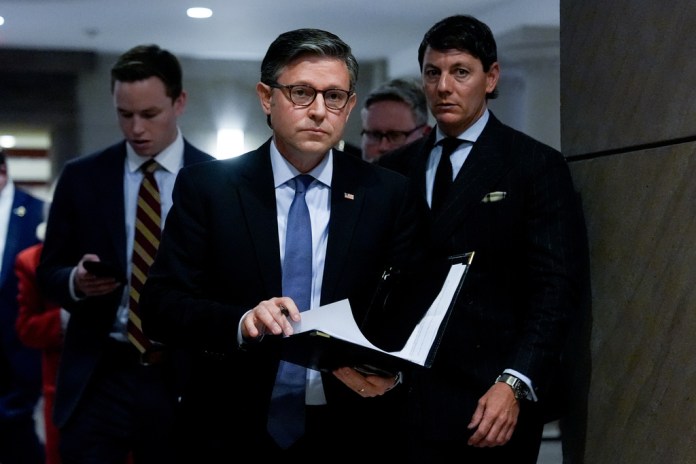
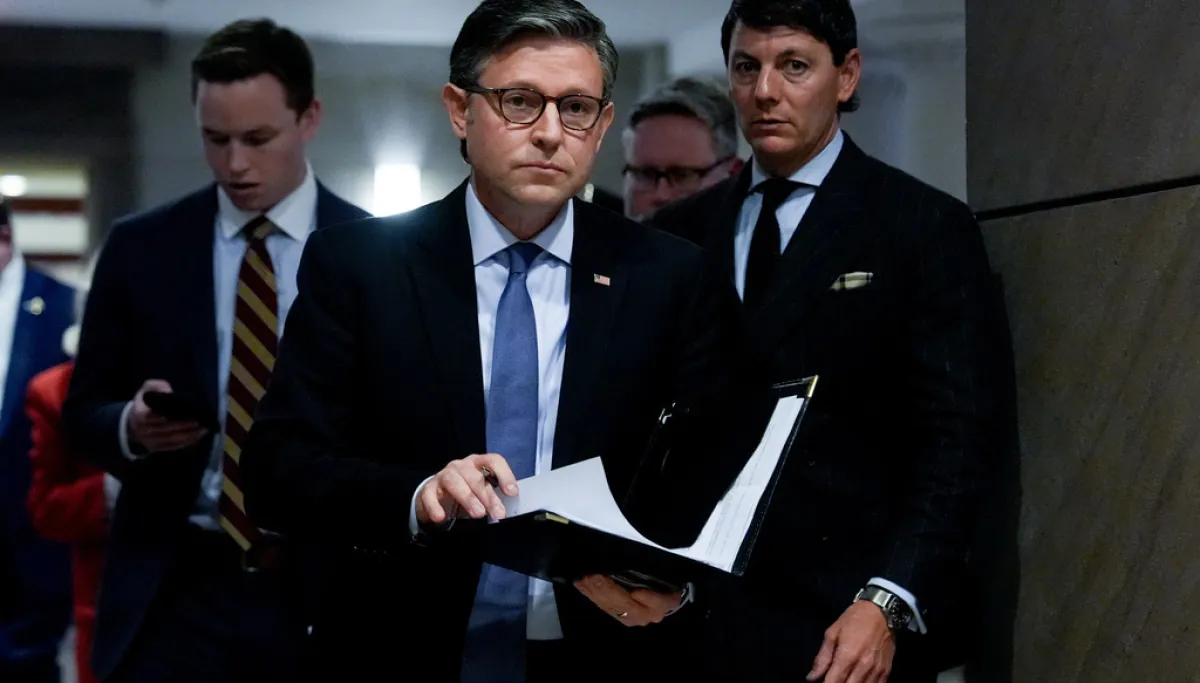
Speaker Mike Johnson (R-LA) faced a major setback on the House floor on Tuesday night after a handful of Republicans tanked a party-line vote to block resolutions looking to repeal President Donald Trump’s tariffs.
The House failed to pass a procedural measure, called a “rule,” on a slate of bills that included language extending the prohibition of members calling up bills to repeal the administration’s tariffs through July 31. The measure failed 214 to 217, with three Republicans — Reps. Thomas Massie (R-KY), Don Bacon (R-NE), and Kevin Kiley (R-CA) — joining all Democrats in voting against it.
This is a blow to leadership and Johnson, making this the seventh rule failure he’s faced since taking the speaker’s gavel. He had narrowly avoided a rule failure multiple times over the last six months, often by flipping a handful of GOP holdouts by actively whipping them on the floor. Before Tuesday, the most recent party-line vote failure occurred in July involving cryptocurrency and appropriations bills.
The vote on Tuesday sought to extend previous language that blocked tariff repeal resolutions from getting a vote, which expired at the end of January. But Democrats and some Republicans have numerous bills disapproving of Trump’s tariffs, ready to go once the prohibition is lifted, which is why GOP leadership rushed this week to try to reinstate the ban.
Because of Tuesday’s rule failure, any bills tucked into that measure sit at a standstill. The rules committee voted Tuesday night immediately after voting to pass another measure that would advance the GOP’s voter ID bill, the SAVE America Act.
Johnson told reporters he does not plan to put the tariff ban language nor the other bills included in Tuesday’s rule on the floor again on Wednesday, wanting to focus on the SAVE America Act.
“This is life with a small majority,” the speaker said. “I need unanimity every day, and we didn’t get it tonight.”
Johnson can only afford to lose one vote to still pass a bill along party lines, and he faced at least two Republican detractors heading into the vote. Votes in the House were delayed from Tuesday afternoon to the evening as leadership sought to convince nearly half a dozen GOP holdouts to vote for the measure.
The speaker successfully staved off opposition from Reps. Tom McClintock (R-CA), Victoria Spartz (R-IN), or Mike Turner (R-OH), who have previously pushed back against tariffs.
Reps. Zach Nunn (R-IA), Dan Newhouse (R-WA), and Spartz withheld their votes for a time, but all three ultimately voted “yes.” This came after Spartz said throughout the day on Tuesday that she was opposed to the measure, eventually flipping her vote as she has done on several other contentious bills this Congress.
GOP attendance also proved to be an issue, with Rep. Greg Murphy (R-NC) not voting this week. He has been recovering from surgery and has missed several votes since the start of the year. But Rep. Wesley Hunt (R-TX), who has missed several votes while campaigning in the Texas GOP Senate primary, was present on Tuesday night and voted for the rule.
The vote was held open for nearly an hour, with Democrats calling on Republicans to close it after it was clear that Massie, Bacon, and Kiley were not returning.
Massie’s opposing vote was unsurprising, as he often votes against party-line measures. He told the Washington Examiner that leadership “didn’t try” to whip him.
“You’re gonna have to quit spending millions of dollars against me,” Massie said, “before I’ll even consider compromising my principles.”
Kiley had told reporters earlier in the day that he would only vote for the measure if the tariff restriction language was removed.
“My main issue here is, this isn’t the purpose of a rule,” Kiley said. “The rule is meant to bring a bill to the floor, set the parameters for debate. It’s not meant to smuggle in unrelated provisions that expand the power of leadership at the expense of our members. That’s the reason I oppose it. I don’t understand why this keeps coming up.”
Bacon voted no and quickly left the Capitol. He told reporters he was not swayed by pressure from leadership.
“I have to answer to Article 1,” Bacon said.
He later said in a post to X that he doesn’t like stalling the House, but “Congress needs to be able to debate on tariffs.”
“Article I of the Constitution places authority over taxes and tariffs with Congress for a reason, but for too long, we have handed that authority to the executive branch,” Bacon said. “It’s time for Congress to reclaim that responsibility. I also oppose using the rules votes to legislate. I want the debate and the right to vote on tariffs.”
Johnson has tried to avoid, as much as possible, putting contentious bills on the floor that could be politically damaging during the 119th Congress, particularly ahead of a competitive midterm election year. But a bill to undo Trump’s tariffs against Canada passed the Senate in a bipartisan manner in October 2025.
REPUBLICANS LOOK TO USHER THROUGH VOTER ID LEGISLATION FOR THIRD TIME WITH SAVE AMERICA ACT
Democrats are expected to force a vote to repeal tariffs on Canada on Wednesday. A resolution to repeal tariffs on Mexico “ripens,” or is allowed to be called up for a vote, on Wednesday, and a resolution to repeal tariffs on Brazil ripens next week.
Trump would almost certainly veto any measure to repeal his tariffs, putting GOP leadership in both chambers in a difficult position.
Lauren Green contributed to this report.