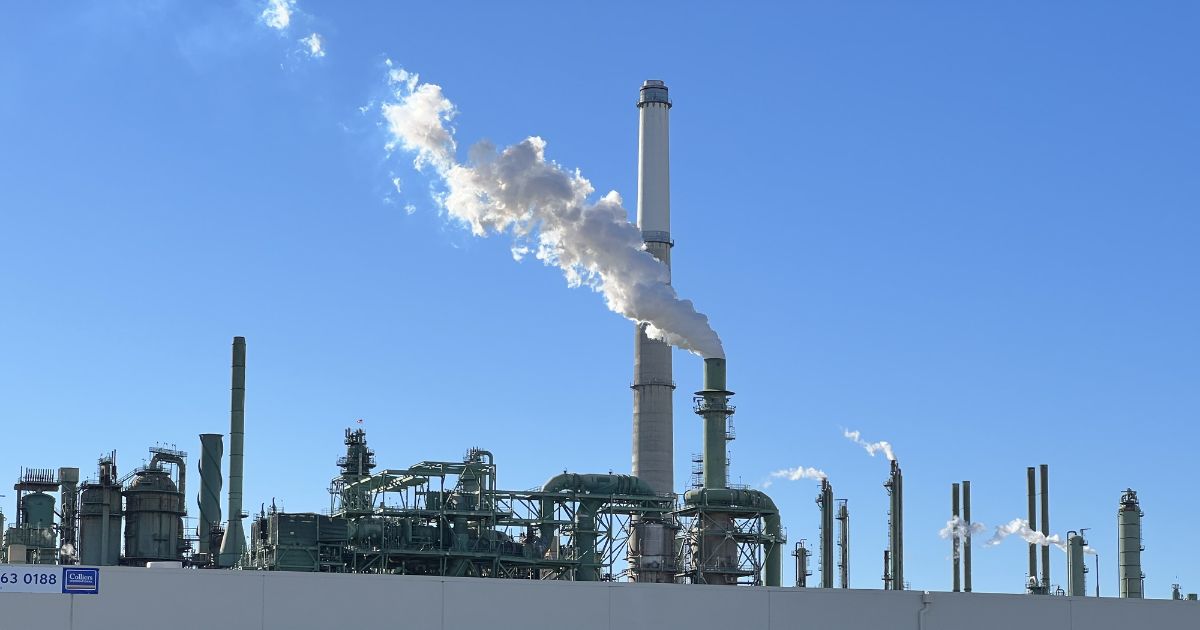
California is having to rely on gasoline shipped in from the Bahamas as more refineries close in the state due to its strict environmental policies.
And the restricted in-state refining capacity is causing gas prices to surge.
The current average for regular gasoline is $4.59, up from $4.21 last month, according to the American Automobile Association.
The New York Post reported, “Valero’s Benicia refinery — a key Northern California supplier — is in the process of sunsetting operations. The move follows other major pullbacks, including the closure of Phillips 66’s Los Angeles refinery, steadily reducing California’s ability to produce its own gasoline, and driving up costs at the pump.”
“California sucked in more gasoline imports last November than at any point in its history — and a staggering 40%-plus of it came from the Bahamas — all that means more cost at the pump for drivers,” the news outlet added.
Desperate California shipping oil from the Bahamas using bizarre loophole as state grapples with highest US gas prices https://t.co/W4EaEs3x9Q pic.twitter.com/NDeTR3AIQO
— New York Post (@nypost) February 16, 2026
Cal Matters reported in September that in 1982, California, which has rich oil reserves, imported about 6 percent of its needs from foreign sources. As of last fall, the percentage had climbed to 64 percent.
Further, “In 2000, the California gas price was approximately $0.25 higher than the national average, but by 2025 the difference increased to $1.50,” Bulat Gafarov, an assistant professor of agricultural and resource economics at UC Davis, wrote in a July 2025 study.
Bloomberg explained why the Bahamas has become such a large source of California’s gasoline, though the oil itself originally comes from the U.S. Gulf Coast.
“Under the Jones Act, any goods shipped between US ports must travel on US-built, owned and operated vessels. Those tankers are in short supply and expensive to charter. There are about 55 Jones Act-compliant oil tankers worldwide, compared with more than 7,000 oil tankers globally.
As a work-around, the gasoline is shipped to the Bahamas, and then reloaded onto other foreign-flagged ships that are not subject to the Jones Act to continue on to California.
“The Bahamian trade route, which began picking up steam in the early months of 2025, has become a key piece of California’s troubled supply chain. Already this year, two tankers carrying gasoline have arrived in California from the Bahamas, according to customs data,” Bloomberg said.
“This is a trend we have seen become ingrained on the US East Coast: barrels are shipped from the US Gulf Coast via the Bahamas as a way of avoiding using Jones Act vessels,” Matt Smith, lead oil analyst at Kpler, said. “It makes sense that this is increasingly happening to the US West Coast given refinery retirements and outages — and is a trend we expect to persist.”
It’s not that California lacks oil; it’s just a shortage of refining capacity for its population of approximately 40 million.
According to the Institute for Energy Research, as of 2024, California was the eighth-largest crude oil producer in the country.
Its known oil reserves are 1.7 billion barrels, making up 3.1 percent of the country’s total.
“However, due to the lack of incentive to explore all potential leads, other estimates place the potential reserves far higher, upwards of 30 billion barrels, as reported by Californians for Energy and Science,” the entity said.
California gas prices surge 40 cents in just 2 weeks as impact of refinery closures weighs https://t.co/2Jde2DXVra
— FOX Business (@FoxBusiness) February 16, 2026
Michael Mische, an associate professor at the University of Southern California’s Marshall School of Business, wrote in the Cal Matters piece that “the Legislature should consider the repeal of regulations limiting production and pipeline use in more counties, assess the powers of agency bureaucrats who force higher prices on the backs of Californians, and a new regulatory strategy that will provide a more hospitable business environment for refiners and producers.”

Advertise with The Western Journal and reach millions of highly engaged readers, while supporting our work. Advertise Today.