During the September 1863 Battle of Chickamauga, Union General George Thomas doggedly held his ground and covered the federal retreat. For that act of heroism amid a Confederate rout, Thomas earned the nickname “The Rock of Chickamauga.”
Such rearguard actions, of course, become necessary only when one expects defeat.
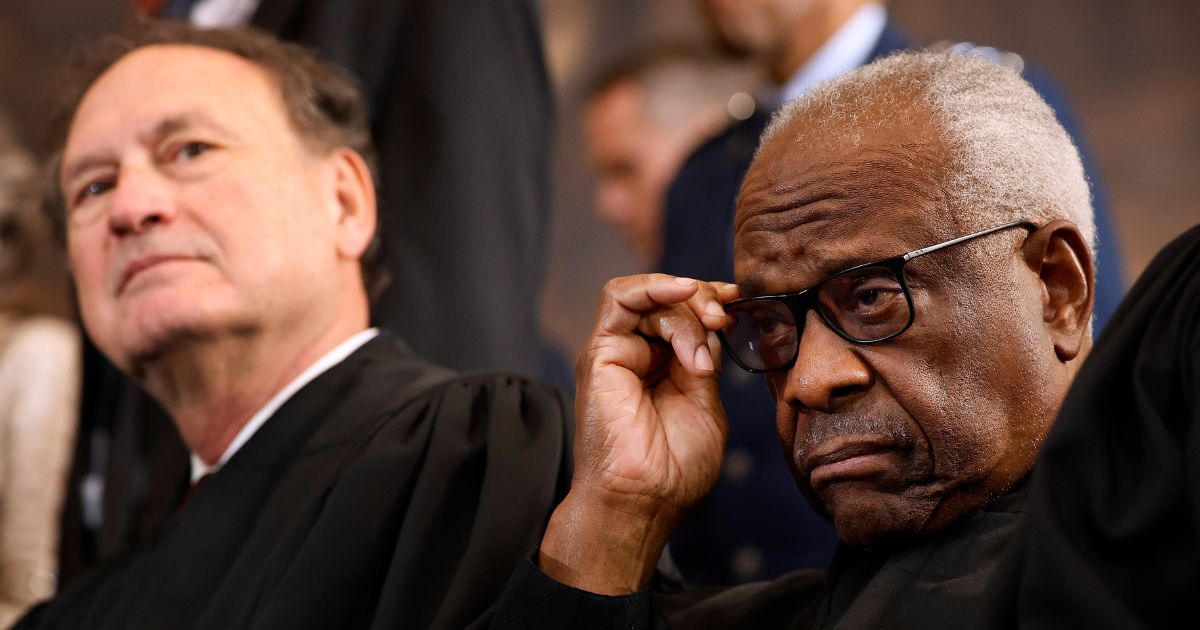
According to USA Today, legal observers have begun to speculate that conservative Supreme Court Justice Samuel Alito might perform a rearguard action of his own by stepping down from the high court before the 2026 midterm elections, thereby affording Republicans an opportunity to replace him while they still control the Senate.
Georgetown University law professor Steve Vladeck, for instance, noted the October publication date for Alito’s forthcoming book, which Vladeck called “a pretty big tell since one can’t exactly go on a book tour during the first argument session of the term.”
Likewise, New York University law professor Melissa Murray, co-host of the “Strict Scrutiny” podcast, observed that Alito has spent 20 years on the Supreme Court, and she called that “usually a very good milestone on which to retire.”
Naturally, that kind of speculation has us wondering about Alito’s next move.
In other words, will the reliably conservative 75-year-old justice continue serving on the Supreme Court beyond 2026? Or, will he follow General Thomas’ example and provide cover in case the anticipated GOP midterm retreat materializes?
The dilemma, of course, is as follows: assuming Republicans lose the Senate in 2026 — not a foregone conclusion but certainly a possibility — President Donald Trump would not be able to secure confirmation of a truly conservative Supreme Court nominee in 2027 and beyond. Should a vacancy arise, therefore, Trump would have to nominate a comparative moderate to win confirmation in a Democrat-controlled Senate.
On the other hand, the president has a mixed record anyway when it comes to Supreme Court nominations. Justice Neil Gorsuch, of course, has proven largely reliable to conservatives. But Justice Brett Kavanaugh, and especially Justice Amy Coney Barrett, have too often voted with the liberal minority.
Thus, would we really want the conservative superstar Alito to retire just in case Republicans lose the Senate? And do we have any assurances that Trump, however well intended, would nominate a younger version of Alito? What if we get another Kavanaugh or Coney Barrett?
Either way, the questions have relevance because the GOP’s situation looks dire at the moment. We might as well tell the truth about it, since sugar-coating it only brings false comfort.
On Saturday, pollster Quantus Insights published the results of a poll conducted Thursday and Friday.
Among respondents in the 18-44 age group, Trump earned 27 percent approval compared to 72 percent disapproval.
Now, we all know that in three consecutive elections, the president outperformed his poll numbers. Thus, if he happened to dismiss these numbers as “fake polls,” who could blame him?
This time, however, things feel very different. Popular unrest, particularly in light of the Trump administration’s botched handling of shocking and sickening files pertaining to notorious sex offender and accused sex trafficker Jeffrey Epstein, seems palpable online.
Indeed, Mark Mitchell of the historically accurate (and Trump-friendly) pollster Rasmussen Reports gasped at the results of the Quantus poll.
“DEAR GOD,” Mitchell wrote Saturday on the social media platform X.
DEAR GOD https://t.co/hRjB1srdjR
— Mark Mitchell, Rasmussen Reports (@honestpollster) February 15, 2026
No doubt Mitchell reacted that way in part because the same Quantus poll from August showed younger people almost evenly split on Trump. Since then, the president’s approval from the 18-44 age group has shifted 43 points to the negative.
In other words, the GOP has a long-term problem that seemed unfathomable less than a year ago.
Speaking of long-term, conservative stalwart Justice Clarence Thomas will turn 78 on June 23. Chief Justice John Roberts, a much less reliable conservative, turned 71 last month. And on the liberal side, Justice Sonia Sotomayor will turn 72 in June. All other justices seem likely to serve well into the next decade.
In short, calls for Alito or Thomas to perform their own rearguard action before the midterms likely will multiply.
We should not forget, however, that General Thomas’ heroism at Chickamauga cost him neither his life nor his career. He lived to fight another day, and the Union eventually prevailed.
In this case, to carry the analogy further, we have no guarantee that a sacrifice of that kind from either of the two staunch conservative justices would produce the desired outcome.
Besides, General Thomas fought to cover a retreating army. Alito and Justice Thomas, should either of them sacrifice their seats in hopes that conservatives may fight and win another day, would merely provide cover for a GOP that cannot seem to get its act together.
Better, therefore, that Alito and Thomas should keep their seats than that conservatives should trust elected Republicans to solve a political problem of their own making.

Advertise with The Western Journal and reach millions of highly engaged readers, while supporting our work. Advertise Today.