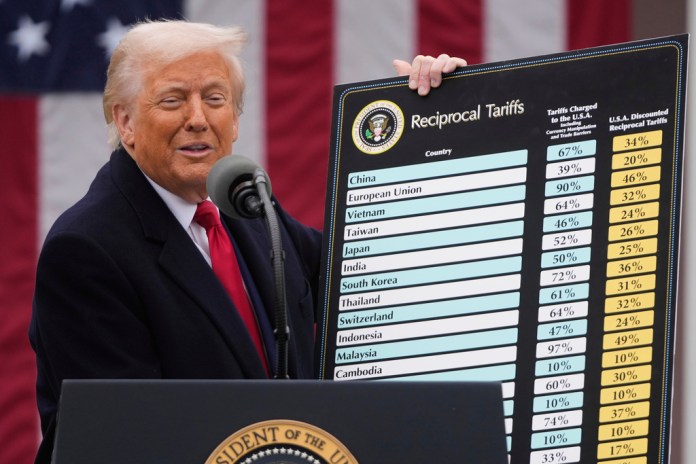
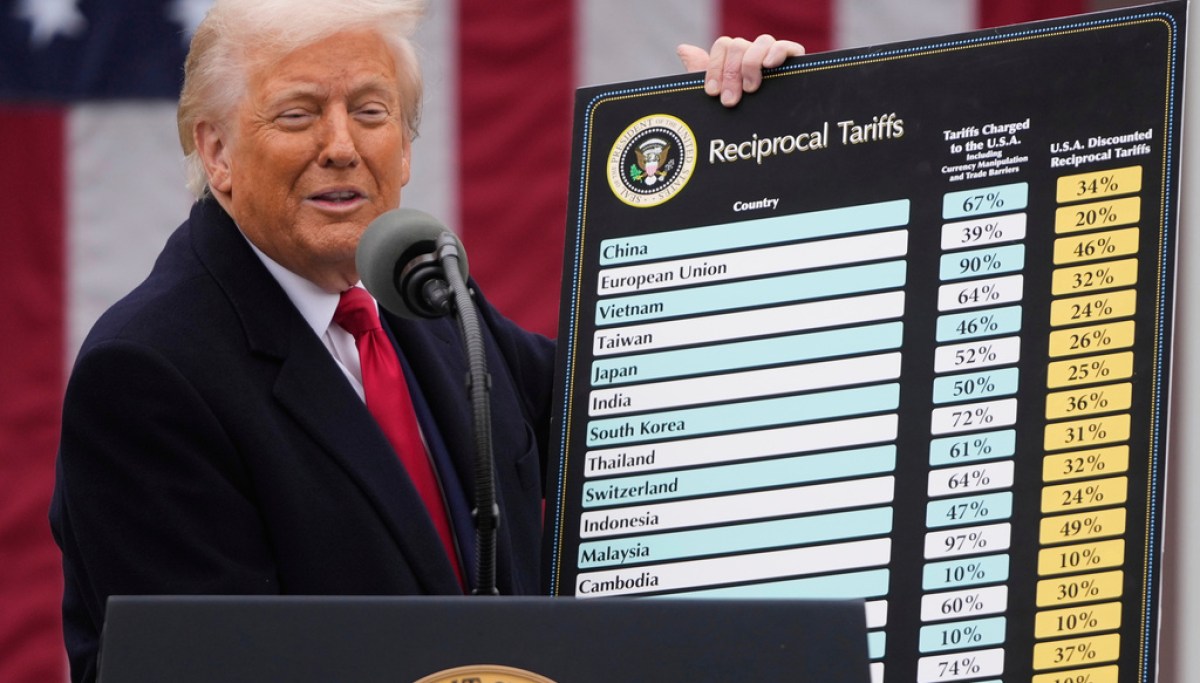
The United States’s global trade partners had their ears to the door on Friday, responding quickly after the Supreme Court decided to strike down President Donald Trump’s “Liberation Day” tariffs.
From the European Union to neighboring Canada, U.S. trade partners responded with cautious optimism to the ruling that invalidated tariffs made with the International Emergency Economic Powers Act on Friday. The nations signaled they were waiting for the Trump administration’s actual policy response before celebrating the ruling.
The EU has been subject to a 15% “reciprocal” tariff on most export goods after reaching a deal with the U.S. last summer. That tariff is part of the swath declared invalid by the Supreme Court‘s Friday ruling. Olof Gill, a trade spokesman for the EU, said Europeans are “carefully” analyzing the ruling as they remain in contact with the U.S. about the path forward and continue to advocate lower tariffs.
“We remain in close contact with the U.S. administration as we seek clarity on the steps they intend to take in response to this ruling,” the EU spokesman said. “Businesses on both sides of the Atlantic depend on stability and predictability in the trading relationship. We therefore continue to advocate for low tariffs and to work towards reducing them.”
Canadian Minister of International Trade Dominic LeBlanc wrote on X that the Supreme Court’s ruling validates Canada’s position that Trump’s IEEPA tariffs “are unjustified” and signaled that Canada is planning for further talks with the U.S. over the steel, aluminum, and automobile tariffs still in place.
“While Canada has the best trade deal with the United States of any trading partner, we recognize that critical work lies ahead to support Canadian businesses and workers who remain affected by Section 232 tariffs on steel, aluminum and automotive sectors,” LeBlanc wrote.
Across the pond, where the United Kingdom had a lower 10% reciprocal tariff rate, a spokesperson for 10 Downing Street told the Guardian that British officials are “working with the U.S. to understand” how the ruling affects the U.K. but that they expect their “privileged trading position with the U.S. to continue.”
William Bain, the head of trade policy for the British Chamber of Commerce, argued that the British government should keep in trade negotiations with the U.S., saying, “The concern is what’s next.”
“For the U.K., the priority remains bringing tariffs down wherever possible,” Bain said. “It’s important the U.K. government continues to negotiate on issues like steel and aluminium tariffs and reduces the scope of other possible duties.”
As global trade partners cautiously waited for the other shoe to drop on Friday, Trump announced a 10% global tariff under Section 122 of the Trade Act of 1974. He also said during the press conference that he would be keeping all national security, non-IEEPA tariffs in place, like those initiated under Section 232 and 301.
“Today, I will sign an order to impose a 10% global tariff under Section 122, over and above our normal tariffs already being charged,” Trump said. “And we’re also initiating several Section 301 and other investigations to protect our country from unfair trading practices of other countries and companies.”
In response to questions over whether the U.S. would renegotiate tariff rates with other countries, Trump pointed to the investigations his administration will conduct.
“We are doing the various investigations necessary to put fair tariffs — or tariffs, period — on other countries,” Trump said. “So we’re doing that.”
TRUMP ACCUSES FOREIGN INTERESTS OF INFLUENCING SUPREME COURT ON TARIFF DECISION
“But we’re immediately instituting the 10% provision, which we’re allowed to do,” Trump continued. “And in the end, I think we’ll take in more money than we’ve taken in before.”
Trump used the IEEPA to issue his reciprocal “Liberation Day” tariffs and his fentanyl-related tariffs against China, Mexico, and Canada.