President Trump moved hours after the Supreme Court struck down his emergency tariffs to invoke a separate trade authority, imposing an import surcharge on most goods that takes effect February 24.
The post Trump Responds to Supreme Court by Invoking New Tariff Authority—And Cranking It to The Max appeared first on Breitbart.
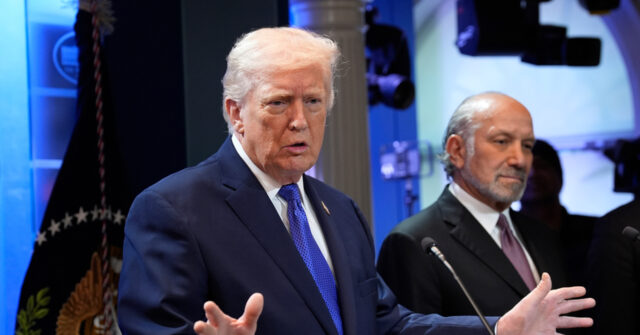
President Trump moved hours after the Supreme Court struck down his emergency tariffs to invoke a separate trade authority, imposing an import surcharge on most goods that takes effect February 24. He initially set the rate at ten percent, then raised it the next day to fifteen percent—the maximum allowed under the statute—saying in a social media post that the increase followed a “thorough, detailed, and complete review” of the court’s ruling.
Sweeping exemptions, many of them familiar from the prior tariff regime, covering energy, automobiles, pharmaceuticals, semiconductors, critical minerals and other major categories mean the levy will fall on a narrower slice of imports than the headline rate suggests. Even at the statutory maximum, however, the new tariff structure does not fully restore the effective tariff rates that prevailed before the court’s decision.
The proclamation was issued Friday evening under Section 122 of the Trade Act of 1974, following a 6–3 ruling that Trump exceeded his authority under the International Emergency Economic Powers Act in imposing reciprocal tariffs on nearly all U.S. trading partners. Chief Justice John Roberts wrote for the majority.
Section 122 is designed for what the statute calls “fundamental international payments problems,” including “large and serious” balance-of-payments deficits. In the proclamation, Trump cited the size and persistence of the U.S. trade deficit, a widening current-account deficit, and a deteriorating net international investment position as evidence that such problems exist and that import restrictions are “required” to address them.
The new tariff carries a built-in deadline. Section 122 limits any surcharge to 150 days absent an act of Congress, setting up a July 24 expiration date and forcing either legislative action or a fresh confrontation over how far the administration can go to keep a broad-based tariff in place.
Familiar carve-outs, new statutory wrapper
The most notable feature of the Section 122 order may be how closely its exemption structure tracks the one the administration had already assembled under IEEPA. The original “Liberation Day” executive order of April 2, 2025, excluded a large set of product categories from reciprocal tariffs, including energy, pharmaceuticals, semiconductors, critical minerals, copper, lumber, and products already subject to Section 232 national-security duties. The administration expanded that list later in 2025. The Section 122 proclamation preserves most of those carve-outs, repackaging them under a different statutory authority rather than building a new exemption framework from scratch.
Petroleum, natural gas, coal and electrical energy are exempt. So are passenger vehicles, light trucks, medium- and heavy-duty vehicles, buses and many auto parts. The pharmaceutical exemption extends from key chemical inputs through finished drugs, vaccines, insulin and diagnostic reagents. A long list of critical minerals and related inputs are carved out as well, including various rare earths and industrial metals.
The exemptions also extend to agricultural products not commercially produced in the United States, including bananas, coffee, cocoa, tea, coconuts, cashews, and a range of tropical fruits and spices.
To avoid stacking duties, the order excludes articles already subject to Section 232 tariffs and specifies that the surcharge is not to apply “in addition” to Section 232 duties. Canada and Mexico goods that qualify for duty-free treatment under the U.S.-Mexico-Canada Agreement are exempt, as are qualifying textiles and apparel from several Central American nations covered by CAFTA-DR.
The new tariff schedule also contains narrow product exclusions, including items used in religious observance—such as palm leaves Christians use for Palm Sunday, etrogs and certain plant materials—along with other specialized articles.
What remains subject to the surcharge is concentrated in broad consumer and general merchandise categories: apparel, footwear, furniture, housewares, toys, ceramics, paper products, and non-exempt machinery and electronics.
Effective rates: closer to the old regime, but not all the way back
Because the exemptions largely mirror what was already in place under IEEPA, the biggest change is the rate applied to the goods that remain covered. Under IEEPA, the reciprocal tariffs were country-specific and in some cases reached fifty percent. The Section 122 surcharge replaces that structure with a flat rate—initially ten percent, now fifteen—on covered goods.
To gauge the real-world impact of tariff policy, economists track the effective tariff rate—the average duty actually paid across all U.S. imports, including those that enter duty-free. Before the Supreme Court ruling, that rate stood at about sixteen percent, according to Yale’s Budget Lab. The ruling wiped out most of that overnight, dropping it to about 9.1 percent.
Budget Lab estimates that a fifteen percent Section 122 surcharge would push the effective rate back up to about 13.7 percent while the Section 122 tariffs apply. If the surcharge expires on schedule in July, Budget Lab estimates the year-end effective rate would return near 9.1 percent.
The Tax Foundation estimates the Section 122 surcharge applies to about $1.2 trillion in annual imports, or 34 percent of U.S. goods imports. On its estimates, a fifteen percent surcharge in effect for 150 days would generate about $43 billion in direct tariff payments, or roughly $33 billion in net revenue after offsets, compared with about $33 billion in direct payments and $25 billion in net revenue at ten percent.
The Tax Foundation also tracks both an “applied” tariff rate—reflecting statutory rates on covered imports while a tariff is in force—and an “effective” tariff rate for the full calendar year that reflects partial-year policies. On its estimates, the applied rate was about 13.8 percent under the pre-ruling IEEPA regime, would be about 10.3 percent with a ten percent Section 122 surcharge in effect and about 12.1 percent at fifteen percent, then would fall to about 6.7 percent after the Section 122 surcharge expires. Because the surcharge runs for only part of the year, the Tax Foundation estimates the full-year 2026 effective tariff rate would be about 6.0 percent with 150 days of a fifteen percent surcharge (5.6 percent at ten percent), compared with roughly 10 percent under the pre-ruling regime.
The exemptions also limit the surcharge’s reach in raw dollar terms. Energy imports, vehicles and auto parts, pharmaceuticals, USMCA-qualifying goods, Section 232 products, and critical minerals together account for a large share of U.S. goods imports. That leaves the surcharge falling most heavily on broad consumer and general merchandise categories—apparel, footwear, furniture, housewares, toys, and other non-exempt manufactured goods—where the per-item duty is smaller than under the prior country-specific rates but applies across a wide range of products.
A legal bridge—and a political clock
The proclamation’s architecture appears designed to match the statute’s limits. Section 122 authorizes a surcharge of up to fifteen percent for up to 150 days when the president determines there is a “large and serious” balance-of-payments deficit or an imminent threat of a disorderly decline in the dollar. By moving immediately to the statutory ceiling, Trump has deployed the full extent of the authority in a single step, leaving no room for further escalation under this provision.
The order frames the action as macroeconomic stabilization rather than industrial protection and includes an expansive severability clause intended to keep the surcharge operative even if particular exemptions are struck down.
Because Section 122 has not previously been used by a president, its boundaries are largely untested in court. The 150-day limit creates an immediate political question: Congress can extend the surcharge beyond that period, but the statute does not provide a mechanism for the president to do so unilaterally. Whether an administration could allow the tariff to lapse and then issue a new proclamation to restart the clock is an open question that could become the next battleground if the White House tries to make the policy durable.
Trump’s social media post signaled that the administration is already looking past the 150-day window, promising that “the Trump Administration will determine and issue the new and legally permissible Tariffs” in “the next short number of months.” That language suggests work is underway to identify a more durable statutory basis for a permanent tariff regime—or to seek congressional authorization.
Meanwhile, the Supreme Court ruling leaves the government facing the practical question of what happens to tariff revenue collected under the invalidated IEEPA regime, including the prospect of refunds to importers. The timing and mechanics of any refund process remain uncertain.
Trump’s rapid pivot to Section 122—and his equally rapid move to the statutory maximum—makes clear the administration’s message to markets: the legal theory behind the tariffs changed in a day, but the tariff strategy did not.