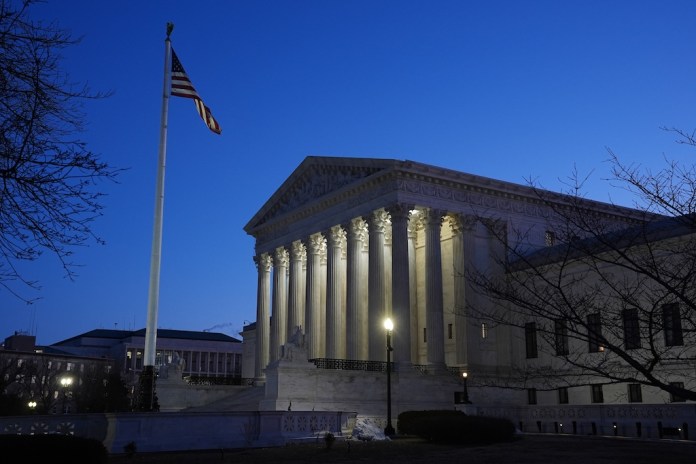
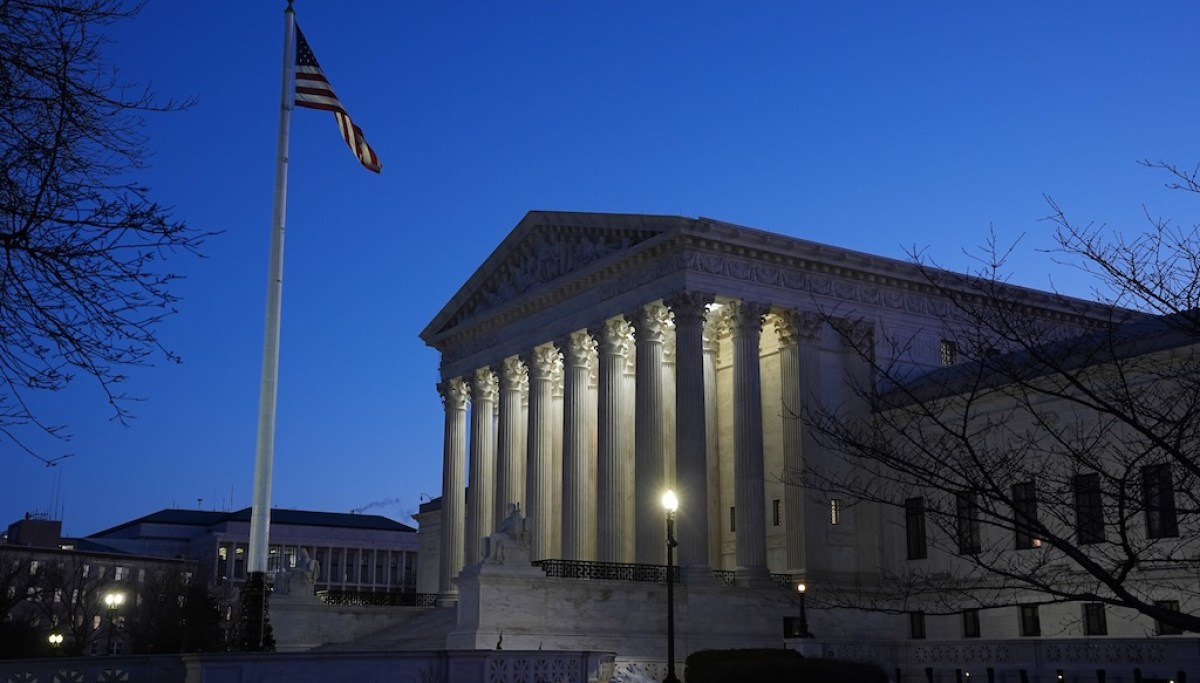
The Supreme Court grappled on Wednesday with what constitutes a “fair” home auction to pay off unpaid taxes, after a family sued for additional compensation after a Michigan county sold their home for less than half its market value to pay a tax debt.
The high court heard arguments in Pung v. Isabella County, which deals with whether a family’s constitutional rights were violated when their seized property was sold for well under its market value as part of a tax foreclosure. Isabella County took the Pung family’s home to pay $2,242 in unpaid taxes, penalties, and interest. The county then sold the property at auction for $76,008 despite its fair market value of $194,400 at the time. The county gave the net profit back to the family.
Justices appeared skeptical of the argument from the Pung family’s lawyer, Phillip Ellison, that they should be entitled to the property’s net market value, rather than only the net profit from the auction.
Justice Sonia Sotomayor questioned whether Ellison could point to any instance in which a court has awarded damages based on the market value rather than the auction price of a property.
“Give me a holding from a court in our 250-year history where we have said that the measure of damages on a tax foreclosure is fair market value, not the auction price,” Sotomayor questioned Ellison.
Ellison responded that while there was no “specific holding in this Court’s history,” there have been cases with “parallel” circumstances. Sotomayor said the fair market value of a property is not as relevant to an auction as it is to a traditional sale.
“An auction is a different, forced sale, and so it will yield a different measure,” Sotomayor said.
Chief Justice John Roberts asked whether, if the auction was fairly conducted, the net profit from that auction would be sufficient compensation for the property.
“If you’re satisfied with the fairness of the process and it comes out with something below what you think is fair market value, is that just too bad?” Roberts asked.
Roberts further questioned Ellison about the fairness of the auction and what would have to go wrong before someone could seek damages for an “unfair” auction. Most of the justices had questions about what the standard for “fairness” in an auction should be as they weighed the Pung family’s claim.
SUPREME COURT COULD DECIDE THE FATE OF FORECLOSURE SALES FOR UNPAID TAXES
The Supreme Court is expected to release an opinion in Pung v. Isabella County by the end of June, when the high court’s current term concludes.
The high court is set to hear oral arguments next week in a high-profile gun case, United States v. Hemani, regarding laws that ban drug users from owning guns. Later next month, the justices will hear a case involving late-arriving mail ballot laws, Watson v. RNC, and in April, the Supreme Court will hear a case over the legality of President Donald Trump’s birthright citizenship order, Trump v. Barbara.