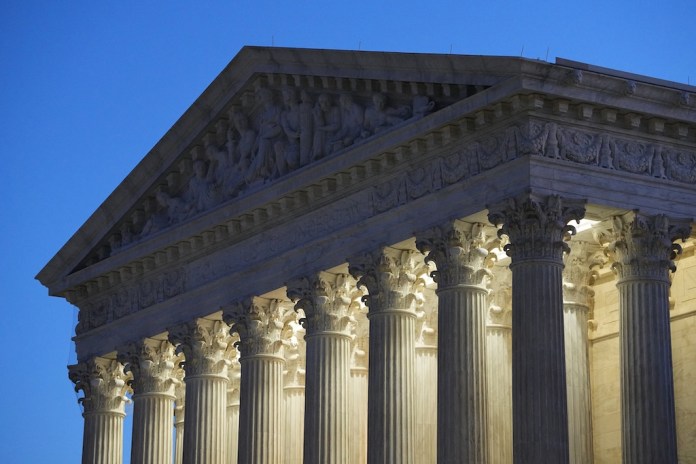
The Justice Department asked the Supreme Court on Thursday to lift a lower court’s block on ending temporary protected status for people from Syria, marking the third time the DOJ has had to ask the justices to lift an order blocking the removal of TPS.
Solicitor General D. John Sauer stressed that lower courts have continued to “impermissibly bypass” federal law that explicitly strips courts of their ability to second-guess TPS decisions made by the Department of Homeland Security. Sauer asked the justices to lift a block on the revocation of TPS for Syrians, as they have done twice before when lower courts have wrongly blocked the Trump administration from lifting TPS for immigrants from other countries.
“This application marks the third time that the government has been compelled to seek a stay from this Court after lower courts have baselessly blocked the Secretary of Homeland Security’s determinations regarding Temporary Protected Status (TPS) just before they took effect,” Sauer wrote.
“The lower courts’ arrogation of core Executive Branch prerogatives irreparably harms the government, and respondents’ alleged harms were inherent in the temporary nature of the program that Congress designed,” Sauer added.
Sauer argued that the ruling in the U.S. District Court for the Southern District of New York blocking TPS for Syria from being revoked was a “spurious” objection to DHS Secretary Kristi Noem’s reasoned analysis, which was that the Middle Eastern country no longer met the criteria for TPS.
Sauer also asked the justices to consider taking up the case for full merits arguments as the legal war over TPS revocations rages on, noting they could put an end to “cross-cutting challenges to TPS terminations so this cycle does not repeat a fourth, fifth, or sixth time.”
The Trump administration’s efforts to end TPS for various countries have been met with legal battles at every turn, with various district courts halting efforts to end the status despite the DHS’s inherent statutory ability to do so.
The battle over revoking TPS for Venezuela made it to the Supreme Court two times last year, and both times the high court sided with the Trump administration over its decision to revoke TPS, although the justices offered no reasoning in their majority opinions. That lack of an explanation in the pair of TPS emergency docket orders has left the door open for additional district courts to continue halting TPS revocation despite the Supreme Court giving the green light twice.
While several lower courts have continued to hand Trump losses in TPS cases, there have been lower courts that have allowed the revocation of TPS to go forward for various countries, including Nepal, Honduras, and Nicaragua.
TRUMP KEEPS LOSING TPS TERMINATION CASES AT LOWER COURTS DESPITE HIGHER COURT WINS
The Trump administration has suffered lower court losses in TPS cases for a pair of reasons: judicial overreach by district court judges and, in some instances, the administration’s failure to follow proper procedure. In the legal battle to revoke TPS for Haiti, for example, the administration opened itself up to firm legal challenges because of comments officials have made about the country and Haitian nationals. A judge struck down the revocation of TPS for Haitians on claims of unlawful animus.
At the Supreme Court, the Trump administration has had a largely successful record on the emergency docket since returning to the White House last year. The administration suffered a key loss on the high court’s merits docket last week, when President Donald Trump’s sweeping “Liberation Day” tariffs were struck down in a 6-3 ruling.