U.S. and Israeli intelligence agencies are scrambling to determine who is actually running Iran after the regime’s newly installed “supreme leader” Mojtaba Khamenei — who has not been seen or heard from publicly since the opening strikes of the war that killed his father — again failed to appear publicly for Nowruz, the Persian New Year, with officials warning there is “no proof that he is taking the helm” and describing the situation as “beyond weird.”
The post Who Is Running Iran? CIA, Mossad Search for Signs of Unseen Supreme Leader Mojtaba Khamenei — ‘No Proof He’s at the Helm’ appeared first on Breitbart.
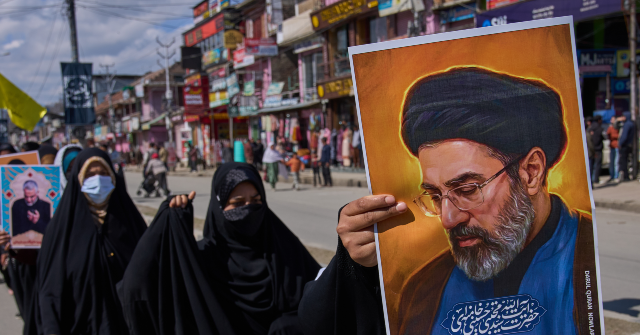
U.S. and Israeli intelligence agencies are scrambling to determine who is actually running Iran after the regime’s newly installed “supreme leader” Mojtaba Khamenei — who has not been seen or heard from publicly since the opening strikes of the war that killed his father — again failed to appear publicly for Nowruz, the Persian New Year.
Officials are warning there is “no proof that he is taking the helm” and describing the situation as “beyond weird.”
The uncertainty has intensified as the CIA, Mossad, and other intelligence bodies step up efforts to assess Mojtaba’s condition, whereabouts, and role in Iran’s wartime command structure, according to a report by Axios, which noted the question has surfaced repeatedly in intelligence briefings for President Donald Trump as officials attempt to identify who is issuing orders in Tehran.
“We have no evidence that he is really the one giving orders,” a senior Israeli official said.
RELATED: Trump — U.S. Media Companies Putting Out False Info on Iran Is Very Dangerous
“It’s beyond weird,” a U.S. official added, emphasizing, “We don’t think the Iranians would have gone through all this trouble to choose a dead guy as the supreme leader, but at the same time, we have no proof that he is taking the helm.”
The alarm was heightened Friday when Mojtaba broke with longstanding precedent by failing to deliver a televised Nowruz address — a moment traditionally used by Iran’s leadership to project authority and continuity — instead issuing only a written message on Telegram alongside still images whose timing U.S. officials are working to verify.
“We would have expected to see Mojtaba too in some form,” a U.S. official said, calling the absence “a big red flag.”
Mojtaba was elevated to supreme leader on March 9 after hardliners rallied behind him following the killing of Ayatollah Ali Khamenei in the opening wave of U.S.-Israeli strikes on February 28.
Since then, he has remained entirely out of public view.
His first message after assuming power was delivered not by him, but read aloud on state television, and subsequent communications have followed the same pattern — reinforcing speculation about his physical condition after reports he was wounded in the strike.
Defense Secretary Pete Hegseth said Mojtaba was “wounded and likely disfigured,” while Director of National Intelligence Tulsi Gabbard has indicated the severity of his injuries has contributed to disarray inside Iran’s leadership.
Other assessments from U.S. and Israeli officials suggest Mojtaba is alive and functional but not exercising anything close to the centralized authority his father maintained.
That distinction has become central to the intelligence assessments.
While officials point to indicators that Mojtaba remains alive — including efforts by Iranian officials to arrange in-person meetings with him, which have reportedly failed due to security concerns — there is still no clear evidence he is directing the regime.
The uncertainty has deepened as Israel continues to systematically eliminate senior Iranian leadership.
U.S. and Israeli intelligence had identified security chief Ali Larijani as a de facto decision-maker until he was assassinated last week, further expanding what officials describe as a widening power vacuum.
“Their leaders are all gone. The next set of leaders are all gone. And the next set of leaders are mostly gone,” President Trump said Friday. “We are having a hard time. We want to talk to them but there is nobody to talk to … and you know what, we like it that way.”
Multiple assessments indicate the vacuum is increasingly being filled by the Islamic Revolutionary Guard Corps.
“The more likely scenario is that the Revolutionary Guards are controlling him, not the other way around,” one source familiar with the situation said, according to Israeli media reports.
Officials in both Jerusalem and Washington have similarly assessed that Mojtaba’s authority, if it exists, is limited, with the IRGC — long dominant across Iran’s military, political, and economic systems — now effectively steering the regime.
“The IRGC are taking over Iran and they are crazy,” a senior Arab official warned. “They are highly ideological and are ready to die and meet Khamenei Senior.”
Prime Minister Benjamin Netanyahu questioned this week who is governing Iran, saying, “I’m not sure who is currently running Iran,” while noting that Mojtaba “has not been seen in public” and that Israel cannot confirm what is unfolding inside the regime.
Behind closed doors, CIA Director John Ratcliffe and Defense Intelligence Agency Director Gen. James Adams told lawmakers in a classified House Intelligence Committee hearing that Iran is facing a deepening command-and-control crisis, though they cautioned there are no signs of imminent collapse.
The regime’s public posture has only reinforced those concerns, further deepening questions about its leadership structure and internal coherence.
As Breitbart News reported on Friday, Iranian state media released an undated video purportedly showing Mojtaba teaching a religious class, offering no context for when it was filmed and raising further doubts about its relevance to his current condition.
The Wall Street Journal reported that Iranian messaging surrounding Mojtaba has relied heavily on curated imagery and voice-over narration rather than direct appearances, further fueling uncertainty about his status.
Analysts have long noted that Mojtaba, who held no formal government position prior to his elevation, operated largely behind the scenes as a powerful figure within his father’s inner circle — raising broader concerns, highlighted in Israeli analysis, about the legitimacy of a hereditary transfer of authority at a moment of acute instability.
That legitimacy gap is now colliding with a rapidly deteriorating command structure, as officials point to the continued removal of senior figures and the absence of clear centralized authority.
As senior leadership figures are removed and Mojtaba remains unseen, U.S. and Israeli officials continue to confront a central unresolved question — not simply where Iran’s new supreme leader is, but whether he is actually in control of the regime he was selected to lead by Iran’s Assembly of Experts.
Joshua Klein is a reporter for Breitbart News. Email him at [email protected]. Follow him on Twitter @JoshuaKlein.