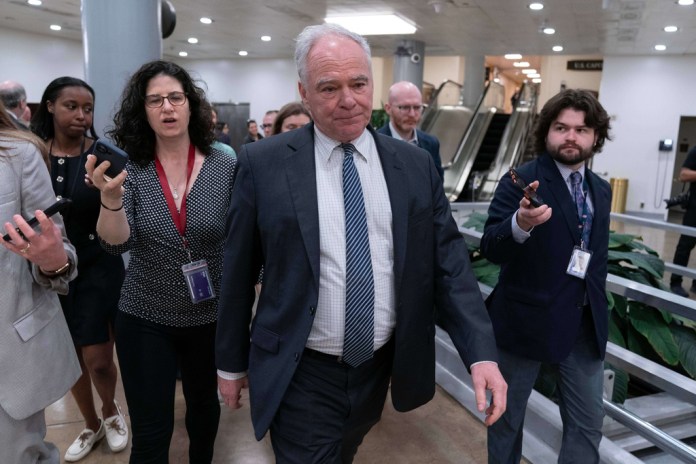
Senate Republicans on Tuesday blocked a Democrat-led effort to halt U.S. military involvement in Iran, defeating a war powers resolution for the third time since the conflict began nearly a month ago.
The measure, introduced by Sen. Tim Kaine (D-VA), sought to require President Donald Trump to seek congressional authorization before continuing military operations against Iran.
It failed on a 47-53 vote, largely along party lines, with most GOP senators opposing the resolution. Sen. Rand Paul (R-KY) again broke with his party to support the measure, while Sen. John Fetterman (D-PA) voted against it.
The vote marks the latest attempt by Democrats to reassert Congress’s constitutional authority over decisions to go to war. The resolution invoked the 1973 War Powers Resolution, a law designed to limit a president’s ability to involve U.S. forces in hostilities without approval from Congress.
Republican leaders argued that Trump, as commander in chief, has the authority to conduct military operations to counter threats from Iran. They have largely backed the administration’s handling of the conflict, framing it as necessary to deter Iran’s nuclear ambitions.
Democrats, meanwhile, have warned that the escalating conflict risks drawing the United States into a prolonged war without a clear strategy or congressional oversight. They repeatedly point to the Constitution’s provision granting Congress the sole power to declare war.
Tuesday’s vote follows two earlier failed efforts in the Senate to advance similar resolutions, underscoring the deep partisan divide over the conflict.
House Democrats have also sought to force a vote on a war powers resolution on Iran, with Minority Leader Hakeem Jeffries (D-NY) on Tuesday reaffirming the minority’s determination to pass such a resolution, saying, “When we present something on the floor, it’s our determination to win.”
Despite the repeated setbacks, Kaine and other supporters of the resolution have vowed to continue forcing votes, arguing that lawmakers must go on record over U.S. involvement in the conflict.
Lawmakers have been briefed by the State Department and the Pentagon in a classified setting, and the Senate Foreign Relations Committee and Armed Services Committee have yet to hold hearings on the war.
The Democrats’ failure falls against a backdrop of a war in Iran that continues to escalate.
Thousands more troops have been deployed to the Middle East as peace talks with Iran begin.
At least 1,000 soldiers from the Army’s elite 82nd Airborne Division have been given orders to deploy to the Middle East. They will be joining thousands of Marines from the 31st Marine Expeditionary Unit and elements of the 11th Marine Expeditionary Unit also on their way to the Middle East.
TRUMP TO DEPLOY AT LEAST 1,000 AIRBORNE TROOPS TO MIDDLE EAST AMID IRAN PEACE TALKS
Trump previously said the United States would hold off on strikes targeting Iranian power plants because the two sides had begun holding indirect conversations about possible de-escalation, which Iranian officials have denied.
Vice President JD Vance, Secretary of State Marco Rubio, White House special envoy Steve Witkoff, and Jared Kushner, Trump’s son-in-law, are leading the U.S. delegation involved in peace talks with Iran.