British military officers are embedded with CENTCOM in preparation for a long-term Strait of Hormuz freedom of navigation mission.
The post Answering America’s Call, Britain to Lead Hormuz Coalition of Nations Sending Warships to Keep Strait Open appeared first on Breitbart.
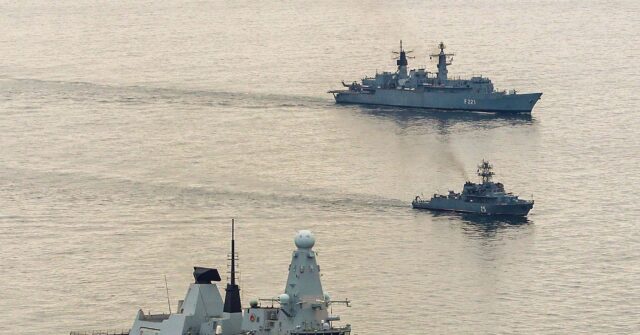
British military officers are embedded with CENTCOM in preparation for a long-term Strait of Hormuz freedom-of-navigation mission, and meetings have already taken place with like-minded allies, including France, Canada, and Japan, a report states.
The United Kingdom will lead a multinational coalition to re-open and then maintain the Strait of Hormuz “as soon as the conditions are right” — likely meaning not while a war is still going on — it is claimed. The Times cites unnamed British defence officials who say meetings between partner nations have already taken place, and more are planned, suggesting that while the coalition of Western nations is in no hurry to deploy to the region, they are also heeding President Donald Trump’s call to answer their own national interests by ensuring oil flows through one of the world’s most strategic waterways.
Whether the Strait is actually presently closed in any meaningful sense is up for debate: the United States has hit Iran hard for weeks, destroying its navy, air force, and land-based missile launch infrastructure. While the prospect of Iran mining the Strait has been feared for decades, alleged intelligence reports state there are at most a dozen mines in the whole area at present, a fraction of what military planners long worried Iran could unleash. And positive noises from apparent peace talks continue to grow.
Technically closed or not, the shipowners of the world will not wilfully return to the region and recommence carrying crude oil until it has been demonstrated that the path is clear and safe. British Prime Minister Sir Keir Starmer remains wedded to his position on the war in Iran, that the country won’t be drawn into the conflict, so this is not to come until “conditions are right”, apparently meaning until after a ceasefire, a peace, or the total exhaustion of Iran’s ability to offer resistance.
The mission will mean clearing the Straits of Hormuz of any lingering dangers, such as mines, and, once that has been demonstrated to be safe, providing ongoing reassurance to passing oil tankers with warships standing by or, as required, more actively engaged.
The British Chief of the Defence Staff has already chaired a meeting with his defence chiefs from France, Germany, Italy, the Netherlands, Japan and Canada last week, The Times states, demonstrating Canada’s arrival at that rank of named nations involved in the previous update on contributors. A further meeting is reported to be happening in the coming days for a much broader group of 30 countries, doubtless including Gulf states.
The point of these meetings, and the British officers embedded with CENTCOM, is to create a “viable, collective plan”, the defence sources are claimed to have said, according to The Guardian. They are reported to have stated that “in order to build this coalition and develop momentum so that as soon as the conditions are right, we’re able to open a safe route through the strait and provide that reassurance to merchant shipping… [Britain has] world leading capabilities in terms of autonomous mine hunting, as well as fantastic destroyer capability with our Type 45s, and also the development of hybrid navy concept, which provides us with opportunities to avoid putting people into harm’s way to help secure the strait”.
The UK’s alleged “world leading” mine-hunting capability, as claimed in the statement, is something of a sore spot with the United States, which has called on London to do its part in the Gulf against Iranian mines, only for Britain to have no mine-hunting ships on hand to deploy.
Counter-mine warfare was one of Britain’s key contributions to the NATO alliance during the Cold War, a competence so finely honed that the country at times had over a hundred counter-mine ships, allowing the U.S. Navy to run down its own mine-hunting capability to focus on other priorities. The UK also kept a mine-hunting squadron in the Gulf nonstop for decades, but ran down the outpost to the point that the final minehunter was returned to the United Kingdom at the beginning of this year.
Britain has been somewhat embarrassed in recent weeks as a long-honed and well-earned reputation as a fearsome naval power was squandered by the impression that, far from staying out of the Iran conflict through choice, Sir Keir Starmer may simply have had no ships to commit. At least part of this is down to the now decades-long habit of Britain’s finance ministry of capability-gapping the military to shave off fractions of defence spending.
While this strategy has been notorious in the past, with Britain’s aircraft carriers having no planes for years as the treasury forced the Royal Navy to retire its older generation of carrier-borne fighters to save money before introducing the next, the UK has essentially gotten away with it until now, as those capability gaps have not coincided with unforeseen wars. Yet it has now happened: Britain is presently in a mine hunting capability gap, with the country transitioning from manned mine warfare ships to unmanned counter-mine drones, but being caught short by the Iran war just as the old capability is scrapped and before the new is brought online.
The experimental new system may be “world leading”, as the military says, but it is a prototype, there aren’t many of them, and they aren’t yet proven. “The situation is frustrating”, said former mine warfare officer Tony Carruthers last year, before the Strait of Hormuz even hit the table. The British government is now capability gapping the Royal Navy’s frigate force, retiring the flexible and hard-working ships years before their replacements are due to be commissioned, and this at a time when the government professes to be moving the country to a war footing in the face of a worsening global security situation.
The obvious question, therefore, is what capability Britain will be able to bring to this Hormuz alliance. It has already sent a single Type 45 Destroyer, HMS DRAGON, to the Eastern Mediterranean, and this could be involved. But the nation’s destroyer force, already cut to the bone with just six ships — and most of those in refit or otherwise out of action — can’t possibly give any more after decades of the treasury always choosing welfare spending.
A mothership for the new autonomous mine-hunting may yet be a converted warship — as the original submarine tenders were — a Royal Fleet Auxiliary, although that fleet has crushing issues of its own, or a ship ‘taken up from trade’, in other words, a converted merchantman.