The Senate took the first step toward reopening the Department of Homeland Security on Friday, approving legislation that funds all of the agency except its most controversial function: immigration enforcement.
The Coast Guard, Transportation Security Administration, and a host of other subagencies under DHS will be funded under a bill the Senate passed overnight via voice vote.
Separate legislation that would have reopened Immigration and Customs Enforcement and parts of Customs and Border Protection was blocked by Democrats. Republicans plan to fund those two departments at a later date using reconciliation, a party-line budget process that does not require Democratic votes.
The outcome amounts to lawmakers walking away from weeks of negotiations over how to reform DHS after the death of two Minneapolis protesters at the hands of federal immigration agents. It also represents a pressure release valve after more than 40 days of congressional gridlock.
The House must still pass the bill, but Republicans have already begun to ease the worst effects of the shutdown. Hours earlier, President Donald Trump announced that he would sign an executive order to pay TSA workers amid chronic staffing shortages at airports across the country.
In one sense, Democrats got what they wanted Friday on DHS funding. For more than a month, Republicans resisted their efforts to reopen the agency in a piecemeal fashion, but ended up doing exactly that after negotiations sputtered out.
But Democrats also lost any leverage to extract concessions from Republicans, who spent weeks inching toward their demands on ICE — only to bring to the floor legislation that had none of them.
By mid-March, the White House was offering to require visible identification for officers, increased congressional oversight of detention facilities, and other reforms meant to professionalize ICE operations.
Negotiations began to fall apart this week, however, after Republicans took most of those concessions off the table in exchange for leaving a portion of ICE, specifically its removal operations, unfunded.
Democrats then tried to revive the demands and others that Republicans said were nonstarters.
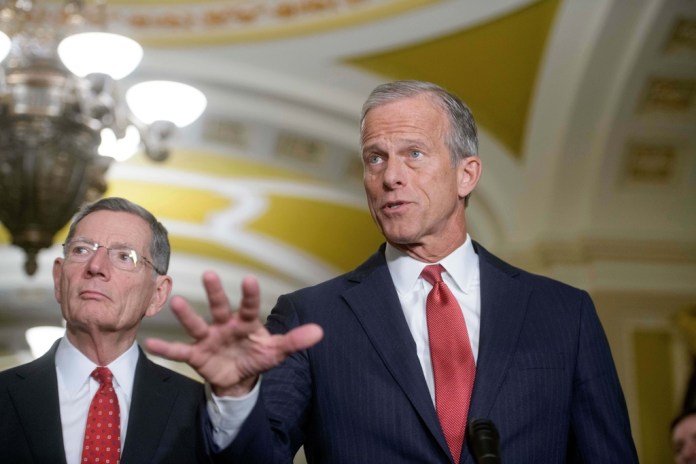
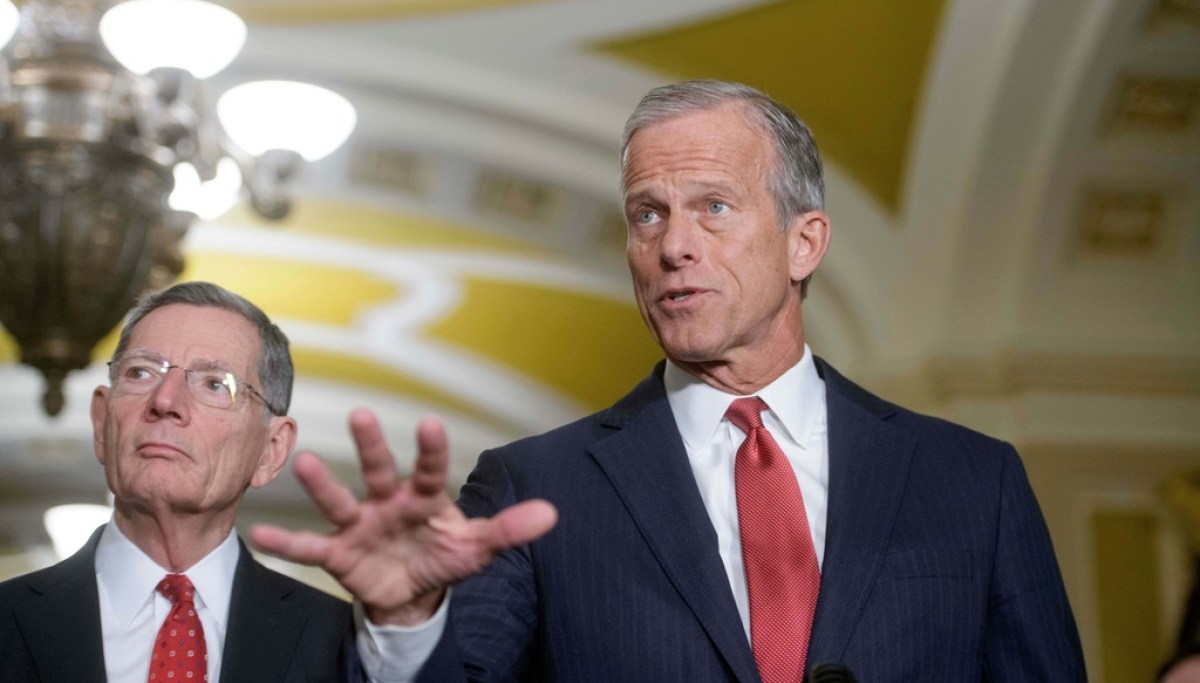
In a floor speech, Senate Majority Leader John Thune (R-SD) accused Democrats of refusing to “take yes for an answer.”
“The White House made offer after offer, putting forward a robust list of additional reforms, and Democrats just kept moving the goal posts,” he said.
Senate Minority Leader Chuck Schumer (D-NY) said Democrats would continue to “fight” for those changes and praised his caucus for holding “firm in our opposition that Donald Trump’s rogue and deadly militia should not get more funding without serious reforms.”
“I’m very proud of our Democratic caucus. Throughout it all, Senate Democrats stood united — no wavering, no backing down. We held the line,” Schumer added.
Speaker Mike Johnson (R-LA) was noncommittal Thursday when asked if House Republicans would move a funding bill that excludes money for ICE. But he told reporters that reconciliation was still an option in the event negotiations faltered.
SENATE GOP TO MAKE ‘DOWN PAYMENT’ ON SAVE AMERICA ACT WITH PARTY-LINE BILL
In the meantime, ICE is staying afloat with money Republicans previously set aside in the One Big Beautiful Bill Act. The administration has also used discretionary funds to pay the Coast Guard during the shutdown.
Sen. Lindsey Graham (R-SC), the chairman of the Senate Budget Committee, said Thursday that he would move “quickly and efficiently” to help usher another party-line bill through the Senate. In addition to ICE funding, Republicans are expected to use reconciliation to pass money for national defense and some version of Trump’s election legislation, the SAVE America Act.