It is an open question whether there will be a Europe in 50 years' time, a European Parliament conference on civil war heard this week.
The post EU Parliament Conference Hears Continent ‘On Track For Civil War’ appeared first on Breitbart.
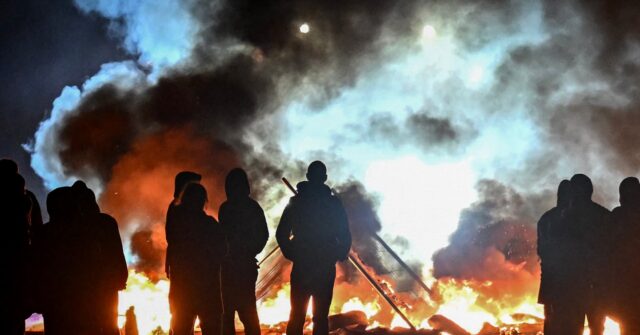
Many government officials already perceive the horrific implications of Europe’s nation states losing their self-belief and descending into polar factionalism, with the continued existence of Europe or its constituent parts in question, but understand that speaking of it openly remains career suicide, a conference at the European Parliament has heard.
It is “a possibility that is quite close” that the British people will pass into history “like the Canaanites or the Arcadians”, and it is an open question whether there will be a Europe in 50 years’ time, a European Parliament conference heard from a panel of expert speakers.
Hosted by French populist-right firebrand Marion Maréchal — the granddaughter of National Front founder Jean-Marie Le Pen — and Sweden Democrats Member of the European Parliament Charlie Weimers, the Civil War: Europe at Risk? conference launched a new report on the now-widespread phenomenon of “no-go zones” and platformed thinkers on political instability. Marechal opened the conference by reflecting that formerly peaceful and stable societies are “rapidly transforming before our eyes into societies of violence and mistrust”, stating that “the main basis of trust between citizens is cultural homogeneity”, which is now fast eroding.
Europe is already under a great strain of “diffuse guerrilla activity”, she said, which takes various forms, including “riots, looting, random attacks, anti-white racism, and terrorist attacks”. These remarks were echoed by conference co-host Weimers, who noted the impact of mass migration on cultural cohesion. The Swedish populist-right politician reflected: “Western democracies that were once relatively homogenous societies have become deeply fragmented. Newcomers often share little in common with the indigenous population. More alarmingly, many have no intention of assimilating.”
Both politicians said they were driven to hold the conference by the hope of finding political answers to these problems and to prevent “the horror of civil war” from occurring at all.
Anglo-Canadian academic Professor David Betz of King’s College London, who has rapidly gained prominence in European security discourse over his whistle-blowing on the eroding of British and European democracy, society, and social cohesion, was blunt in his remarks, telling the European Parliament meeting that: “Europe is on track for civil war”.
Observing that while “it took a long time to break the foundations of Western self-belief, prosperity, and competency”, the job was now done and although a society like the United Kingdom is not quite at the point of total breakdown, nevertheless it is experiencing polar factionalism, which has led to outbursts of violence and leaves the country vulnerable to a sudden downward spiral towards chaos. Professor Betz said:
…we are on a track for a peasant revolt. A conservative uprising in which the ruled seek to punish their rulers for violating their obligations under the social contract, and for changing the rules of the game against their wishes. It will look something like Italy’s Years of Lead, the ‘dirty wars’ of Latin America, or maybe The Troubles of Northern Ireland, but on a larger scale.
What is already a guarded society will become a radically more heavily fortified society as elites seek more protection with more walls, guards, and surveillance. It will be bloody… the Balkanisation of British life along ethnic lines [is underway]. What I call assortative movement is already occurring, quite obviously in some places like Tower Hamlets in London, Sparkhill in Birmingham which are already ethnic enclaves, zones of negotiated policing with parallel legal systems, alternative economies, and… zones of endemic and large-scale out-group sexual predation… this ought to be more generally frightening.
In government there are plenty of people who understand fully the gravity of the situation, although it is, career-wise, terminal to speak of it openly.
Austrian political scientist Dr Ralph Schoellhammer, who also spoke on the panel, didn’t use the language of civil war but rather pointed to Europe’s history of bloody revolutions. Discouraging the ever-present habit in left-wing discourse and the media of comparing the present political situation to the 1930s, with persistent allusions to the rise of fascism, he instead pointed to parallels in the years leading up to the French Revolution, which he noted were characterised by failed harvests and rapid inflation
As observed by more than one participant of the conference, whether European peoples survive both migratory pressure in the first instance and the prognosticated civil war that is said to follow it in the second, to exist as distinct social, political, and ethnic groups at the end of this century, is an open question. Professor Betz, for instance, pointed to the peoples of once great empires in the classical world, whose civilisations and peoples simply vanished.
He said:
Where does Balkanisation lead us? … it leads to the extinguishment of Britain in the sense of a coherent cultural entity dominated by people genuinely sharing the titual identity of ‘British’… it leads to large scale and widespread civil war… it is very possible that the Britons end up like the Canaanites or the Arcadians, a people of historic interest, their monuments visible here and there in some sort of ruination, of interest to archaeologists and historians. This would be a tragedy, but that is a very viable option in front of us, and in fact it is a possibility that is quite close.
MEP Weimers asked, even more bluntly: “Where will Europe be in 50 years? Will there be a Europe in 50 years?”
Revisiting some of his previous public comments over the past year, Professor Betz — a recognised expert on the fortification of modern urban spaces against asymmetric warfare — also reflected on the specifics of how a future, theoretical “civil war” in the West would look. This, inevitably, would be defined by the apparent propensity of new migrant arrivals to gravitate to urban areas and create their own cultural enclaves, he said, which could make them vulnerable targets for would-be saboteurs.
He said:
…[this would be] the siege of urban areas but with a few 21st century twists. In many ways it will be reminiscent of the siege of Sarajevo, but much more dominated by paramilitary actors using system disruption tactics. Most importantly, infrastructure attack to degrade and destroy the life support systems of urban, non-native enclaves.
The political object is very simple, it is to compel non-natives to leave. The strategy is to create conditions of life in the cities so intolerable that leaving is preferable to staying… it’s not an implausible theory of victory because its central premise, the instability of the modern urban condition, at the best of times is something scholars of urban studies have been warning against for 50 years already.
… fuel systems are easy to attack, they are flammable if not explosive by definition, they are difficult to repair, and expensive to replace. In fact they are impossible to replace in civil war conditions where no insurance is available.
Moreover, disruption of fuel has very rapid knock-on effects of everything else logistically, most importantly the food distribution system which is the traditional weapon of siegecraft.
Breitbart London reported earlier this week on the new paper published during Maréchal and Weimers’ European Parliament conference on the accelerating issue of so-called no-go zones. The report used public data on factors like crime rates, sexual violence, youth gangs, unemployment, the proportion of school finishers, antisemitism, homophobia, the number of mosques, attacks on firefighters, and the presence of charities and NGOs to rate neighbourhoods across Europe on their level of integration in the common culture.
By these metrics, the report stated it had identified up to a thousand no-go zones.