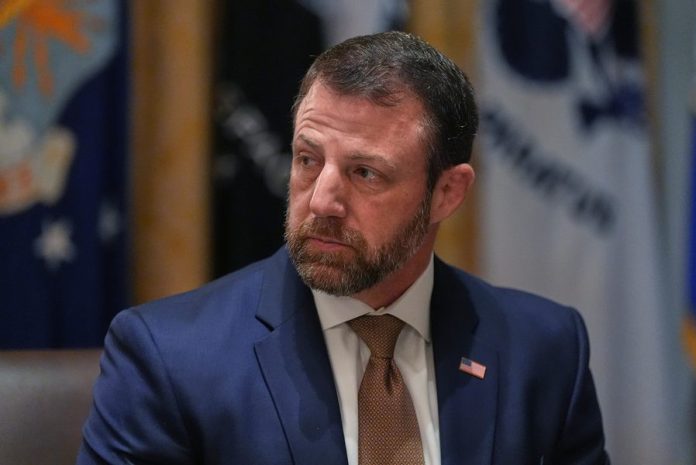
Mullin replaced President Donald Trump’s first DHS secretary, Kristi Noem, and was an unexpected pick to lead the department given his lack of background on related issues.
However, in his two weeks atop the third-largest federal department following Kristi Noem’s ouster, Mullin has begun to take the department in a new direction, including by holding sanctuary cities accountable, addressing the federal contracting process, and getting the entire homeland security workforce paid as the department’s longest-ever shutdown lags on.
1. Cutting customs at airports in select cities
The Trump administration has attempted to punish sanctuary cities, or jurisdictions that refuse to work with federal immigration authorities, since 2017, but Mullin has a new idea on how to do that.
Mullin divulged in an interview on Monday that he is looking into cutting back customs screening for incoming foreign travelers to the United States at airports in sanctuary cities.
“If they’re a sanctuary city and they’re receiving international flights, and we’re asking them to partner with us at the airport, but once they walk out of the airport, they’re not going to enforce immigration policy — maybe we need to have a really hard look at that,” Mullin told Fox News’s Bret Baier in an interview on Monday.
U.S. Customs and Border Protection’s Office of Field Operations is responsible for inspecting all people, vehicles, and goods that seek admission to the country. OFO officers are assigned to seaports and land ports of entry along the Canadian and Mexican borders, as well as international airports nationwide.
All travelers are screened upon landing, including U.S. citizens. Pulling customs personnel would greatly lengthen wait times for airline passengers and potentially prompt them to fly into airports that have not been affected.
Mullin told Baier that he is looking at Los Angeles International Airport and John F. Kennedy International Airport, among others. His targeting of sanctuary cities could go further than airports, as he has told Baier that he believes sanctuary cities are illegal to begin with.
Mullin: I believe sanctuary cities is not lawful. Some of these cities have international airports. If they are a sanctuary city, should they really be processing customs into their city? We need to have a really hard look at that.
Baier: So you are saying that big cities that… pic.twitter.com/UAJxWFZtZI
— Acyn (@Acyn) April 6, 2026
2. All DHS employees paid amid shutdown
Approximately 100,000 employees across the DHS had not been paid for working during the seven-week partial government shutdown, DHS spokeswoman Lauren Bis told the Washington Examiner last month.
On April 3, Trump signed a memorandum that directed the DHS to use existing funds to pay all employees who had worked for a month and a half without pay. The move came shortly after Mullin took over the department.
“This amounts to $1 BILLION in unpaid wages each month,” Bis said. “Thanks to the Democrats’ DHS shutdown, these men and women are being forced to work without pay and many cannot pay their rent, buy food or gas or other essentials. The DHS shutdown must end now.”
In a memo to employees, DHS said employees will be paid by April 16 for all days worked since Feb. 14, according to Government Executive.
Mullin said he has spent much of his time as secretary on ensuring the department’s workers are paid.
“I’m spending the majority of my time working with members in the House and the Senate and the White House, and by the way the president is fully engaged trying to get our great employee at DHS paid,” Mullin said in a video posted to his X account late last week.
For 49 days, the Democrats have held our DHS employees hostage with their political theatre. It has to stop.
Grateful for the leadership of @POTUS and the great men and women of @DHSgov working every day to keep Americans safe.
We’re continuing to fight for you. pic.twitter.com/MhXG9GZ8iU
— Secretary Markwayne Mullin (@SecMullinDHS) April 3, 2026
DHS is made up of nearly two dozen agencies and offices, most of which are required to continue working without pay during the department’s shutdown.
Law enforcement employees at ICE and other agencies have been paid during the shutdown, but support staff have not. Employees from the Transportation Security Administration, the Federal Emergency Management Agency, the Cybersecurity and Infrastructure Security Agency, DHS offices, and others have worked without pay.
Congressional Democrats have refused to fund the department until the Trump administration and Republicans agree on reforms to rein in DHS and one of its most controversial agencies, U.S. Immigration and Customs Enforcement.
3. Paused ICE plans to buy warehouses
In an about-face from Noem’s plans, Mullin had ICE pause all purchases of warehouses that were intended to be converted into detention facilities for illegal immigrants in deportation proceedings.
Mullin ordered the move, according to the Associated Press, days after taking office, in an effort to investigate each of the 10 efforts to lock down warehouses across the country amid reports that, under Noem’s leadership, ICE dramatically overpaid for the facilities.
In one example, the Atlantic reported on Tuesday that the federal government spent $145 million purchasing a Utah warehouse valued at $97 million.
Aaron Reichlin-Melnick, a senior fellow at the American Immigration Council in Washington, said ICE received such an excess of funding in last year’s One Big, Beautiful Bill that it has the money to spend exorbitantly.

“ICE can afford to overpay $50 million for a warehouse because Congress saw fit to hand it essentially a blank check to expand detention centers — $45 BILLION to be spent through the end of FY 2029,” Reichlin-Melnick wrote in an X post on Tuesday. “That extra money likely bought off any qualms from the owners as well.”
Nationwide, residents and local elected officials have protested in response to media reports that warehouse owners are in talks with ICE. In some cases, the backlash has led some owners to back down from talks.
4. Teeing up states to handle disaster response
During Mullin’s visit to Western North Carolina earlier this week, he called for a major shift in how the federal government responds to natural disasters.
The Federal Emergency Management Agency, a DHS agency, has long been the chief agency to handle recovery efforts and reimburse affected residents for losses.
In addition, Sen. Thom Tillis (R-NC) had criticized Noem in a heated oversight hearing earlier this year about imposing a rule that all department contracts valued at more than $100,000 be personally reviewed by her team, a move that delayed FEMA recovery funds going out to victims. Mullin quickly raised the mandatory review cap to $25 million to ensure most contracts are paid out, except for large ones.
Noem had touted plans to overhaul FEMA, but she ultimately made little progress. Mullin said he envisioned first responders in communities as the people who should handle the initial response to an emergency rather than FEMA.
“The state is much more equipped. Neighbors are much more equipped. Local mayors are much more equipped. Emergency response from the states have much better equipment than FEMA,” Mullin said during a roundtable discussion.
Until that shift from a federal to a state-and-local response gets underway, Mullin has approved additional federal dollars to be sent to people in North Carolina who were seriously affected by Hurricane Helene in September 2024 and have not received sufficient support from the agency.
Mullin announced an additional $103 million in funding for North Carolina survivors last week, with FEMA awarded $26 million this week to purchase 75 severely damaged residential properties, according to the DHS.
Sen. Ted Budd (R-NC) joined Mullin on the visit and said his former Senate colleague did not wait until he was sworn in on March 24 to begin addressing issues at FEMA.
“This is a person of action,” Budd said, according to the Carolina Journal. “He was already working for North Carolina before he was even sworn in.”
5. Suspending use of DHS planes for deportations
Mullin is reportedly in the process of pausing the use of DHS planes for deporting illegal immigrants to their home countries, according to CNN.
Under Noem, ICE had purchased five planes to use for deportations. The planes would supplement roughly a dozen leased planes that ICE has used prior to Trump’s push for the “largest-ever” number of deportations upon taking office.
Noem also leased a $70 million luxury jet, and ICE had moved to purchase the jet and convert it into a passenger plane to transport people in its custody.
Rep. Mark Amodei (R-NV), chairman of the House Appropriations subcommittee on the DHS, told CNN on April 2 that Mullin’s decision was part of a larger effort to look at the cost-effectiveness of the Noem team’s financial decisions.
BORDER PATROL CHIEF MICHAEL BANKS HIT WITH PROSTITUTION ALLEGATIONS BY AGENTS
“We want to see that analysis, that cost-benefit analysis,” Amodei said. “Just show us how those numbers work out. The previous leadership at Homeland was missing in action on that explanation, or even a response.”
The DHS did not respond to the Washington Examiner’s request for comment, but a department spokesperson told CNN there was “no plan” to pause deportation flights entirely.