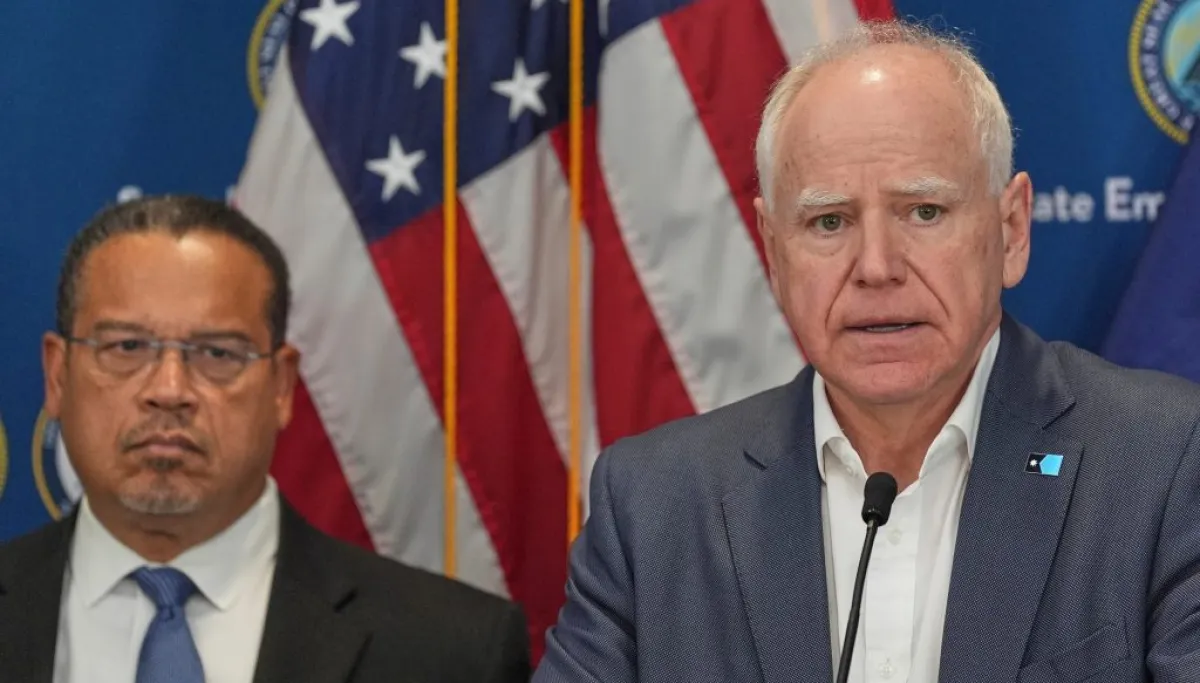
Minnesota lawmakers raised doubts about Gov. Tim Walz’s (D-MN) legislative anti-fraud package at a state House oversight hearing on Monday, questioning whether the governor’s proposals would actually detect and prevent scammers from defrauding the state’s taxpayer-funded programs.
Throughout the hearing, members of the GOP-led Minnesota House Fraud Prevention and State Agency Oversight Policy Committee grilled officials in Walz’s administration on how they exactly intend to execute his 18 proposed measures, which would require millions of dollars each year to implement.
Minnesota Department of Human Services Commissioner Shireen Gandhi, the Walz appointee who oversaw financial operations at the Minnesota Department of Human Services when organized scam rings stole millions in Medicaid funds from the state social services agency, stood by her boss’s $54 million fraud-prevention plans.
“Gov. Walz has put forward a strong set of program integrity proposals that tighten oversight across the life cycle of the Medicaid program,” Gandhi told the state committee, “from how we design programs to provider enrollment to enhanced prepayment review of claims before they are paid, payment controls, and more sophisticated data analytics after payments are made.”
High hurdles to investigating fraud
State Rep. Kristin Robbins, the committee’s Republican chairwoman, asked Gandhi and other state officials what would constitute a credible allegation of fraud under Walz’s suggested framework. One of Walz’s proposals would modify a Minnesota law that stipulates when officials can withhold payments to medical providers accused of fraudulent billing practices and would redefine actionable fraud allegations to mean claims that have already been “verified by the head of a state agency.”
None of the officials had an answer.
THESE ARE THE WALZ APPOINTEES WHO FAILED TO STOP RAMPANT MINNESOTA FRAUD
After the officials responded with silence, Robbins said she was concerned the statutory language suggests that fraud intervention must be based on “verified” findings from an administrative review, whereas state agencies have historically been able to take action in response to credible claims of fraud without the need for a thorough investigation.
State legislators voiced concern that the proposals would set a procedural standard too high for agencies to actually cut off payments, absent police action, and that the justification for withholding funds must arise from a criminal investigation.
Erin Campbell, commissioner of the Minnesota Management and Budget Department, argued that the legislation would also raise the threshold for flagging irregular reimbursement claims, mentioning that prior proposals automatically mandated administrative review but that this one would likely result in fewer investigations.
“What we ended up with was a weaker standard that we think actually does require that we do those investigations on the front end, and that has proven to be problematic and not useful,” Campbell said.
Chris McNulty, general counsel at the state budget office, added that the current language says a program head must find “a preponderance of evidence” showing that a suspected fraudster committed fraud for payments to be paused. In layman’s terms, that means “more likely than not fraud has been committed … more than a 50/50 chance,” McNulty said.
Referring to Walz’s rewrite, McNulty said, “The terminology used here at ‘credible allegations of fraud,’ what the intent of that is that the allegation has been verified, that there is some base level of credibility.”
For instance, he said if a complaint on its face seems credible, then that would be considered a credible allegation of fraud. McNulty noted other examples that would substantiate fraud suspicions include, but are not limited to, irregular billing patterns identified through audits, police affidavits, criminal indictments, and incriminating information revealed during the discovery process of civil cases.
“The verified language is merely to verify that there is some sort of information indicating that there may be fraud occurring,” McNulty explained.
“I agree with your intent,” replied Robbins, “but my concern is that ‘verified’ is going to hamstring us. For example, whistleblower reports are not there in your ‘not limited to,’ right?” She said that hundreds of whistleblower reports coming from inside agencies responsible for dispensing funds have been ignored over the past 14 months.
Robbins suggested that, to lower the suspicion threshold necessary to trigger a payment pause, the legislature alternatively change the language from “preponderance of evidence” to a ”reasonable person” standard.
“I want to make sure that, as we are developing this language around ‘credible allegation of fraud,’ we are not requiring such a narrow band of what ‘verified’ means that it’s precluding things that, under a reasonable person standard, people would think as credible,” Robbins said.
Critics find holes in Walz’s proposals
According to Robbins, as the bill is written, fraud response efforts would be bogged down by bureaucratic vetting while accused fraudsters could still receive reimbursements.
“That is what we are trying to avoid,” said Campbell, the Minnesota Management and Budget Department commissioner. “What we want to get passed, what the governor feels very strongly about, is legislation that puts us in a position to be able to withhold payments. That’s not where we are today.”
Robbins said the bill’s proponents should then specify that credible allegations of fraud do not have to stem from an official investigation.
SOMALI REFUGEE BOUGHT $1 MILLION HOME THE SAME YEAR HE WAS ACCUSED OF DEFRAUDING TAXPAYERS
Republican state Rep. Isaac Schultz questioned whether Walz’s budget proposal would improve data-sharing across agencies, noting that during and after internal evaluations of fraud allegations, findings are not being effectively communicated between departments.
“There are convicted fraudsters who are currently receiving money from the state government,” Schultz said. “We still lack the ability to shut off the money.”
Robbins urged state agencies to investigate, in addition to medical providers, owners of bogus healthcare businesses, operators, and other close associates financially tied to a fraud scheme.
“I don’t know why we haven’t been doing that so far,” she said. “That’s one of the problems we have seen in the web of fraud that we’ve constructed.”
‘Is anyone going to get fired?’
Robbins pointed to another bill championed by Walz regarding “debarment,” which is the disqualification of a vendor from receiving state funding “for a specified time commensurate with the seriousness of the offense, the failure, or the inadequacy of performance.”
“It’s vague,” she said. “I’m not sure why we just don’t say if someone has been convicted [of fraud], they cannot be a state vendor anymore.”
Another subsection caveats that misconduct “may” result in penalties: “A false statement of compliance … may result in ineligibility or termination of a contract awarded to a prime contractor or a subcontractor and may result in suspension or debarment proceedings.”
“There’s still quite a bit of wiggle room there,” Robbins said. “I think the public wants zero tolerance, and we still do not have that in this statute that I’m seeing. I encourage you to have a zero-tolerance policy.”
‘THIRD-PARTY’ AUDITOR INVESTIGATING MINNESOTA FRAUD RECEIVED MILLIONS IN STATE MEDICAID FUNDS
“When I read all these bills this weekend,” Robbins continued, “everywhere I go, it’s still not strong accountability.”
Robbins recalled how officials in the state budget office previously testified that they don’t see holding agency administrators to account as their role, rather that they are meant to serve alongside other state agencies in a supportive capacity.
“In your presentation [today], you talked about wanting to implement corrective action plans — that’s good, but where’s the accountability?” Robbins asked. “Are we still going to rely on self-attestation by commissioners? Is anyone going to get fired? This is what Minnesotans want to know. Where’s the accountability in these proposals?”
Robbins told Campbell that her department is in charge of internal controls governmentwide as the steward of the state’s finances. “The public is fed up with everyone being held to comply instead of actually being held accountable,” Robbins said.
She expressed concerns about state programs being mismanaged by compromised actors. At a House hearing last week, her committee heard testimony that oversight officials were falsifying and backdating documents.
In January, the Minnesota Office of the Legislative Auditor found widespread oversight failures within DHS’s behavioral health grant programs, including missing or fabricated progress reports created by the department only after the audit began and were backdated in response to the supporting documentation requests. The audit uncovered that the agency failed to verify that services were actually rendered and did not conduct required site visits.
Robbins pushed for legislation that would change the workplace culture surrounding watchdog duties and compel greater oversight.
“There should be real accountability for that,” Robbins said. “There should be consequences.”