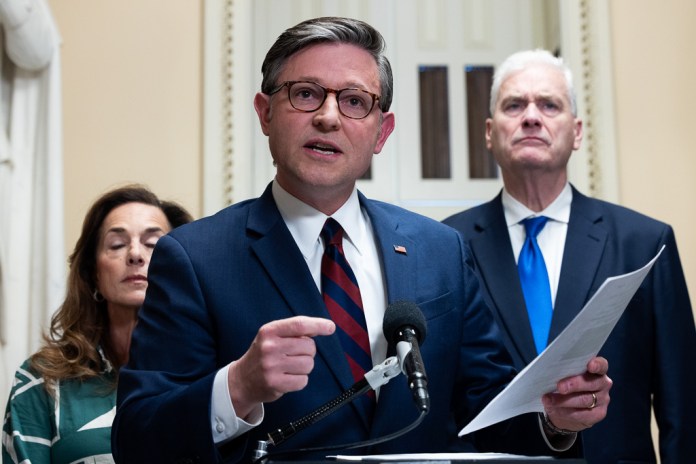
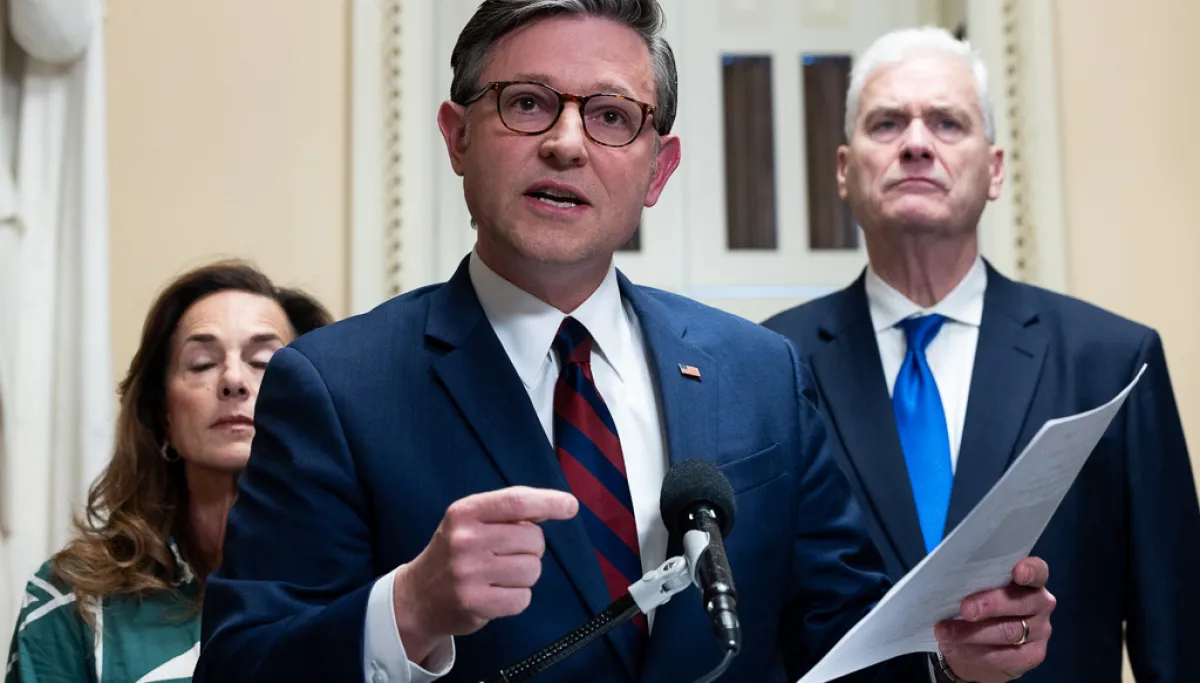
The House passed a short-term extension of a key government spy tool through unanimous consent early Friday morning after several GOP members voted to sink a late-night deal that would have allowed it to continue until 2031.
The 10-day extension kicks the can down the road for GOP leadership to come to an agreement with conservative holdouts until April 30. House Speaker Mike Johnson (R-LA) moved to pass the short-term extension to reauthorize section 702 of the Foreign Intelligence Surveillance Act after GOP hardliners sunk both the five-year extension and the procedural rule vote for a “clean” 18-month extension.
Rep. Tim Burchett (R-TN), who was one of the no votes on the rule, told the Washington Examiner that the two-week extension was the “best we could do.”
“I just hope we don’t wait till the last minute,” Burchett said. “We’re up here, but that’s just what we always do, we always wait until the last dadgum minute.”
House GOP leadership attempted to amend the rule on the floor with a five-year extension and small reforms, but GOP hardliners sunk the effort, 200-220, with 12 Republicans voting against and three Democrats voting yes. The amendment’s failure forced the floor to proceed with a vote on the rule for a “clean” 18-month extension passed out of the House Rules Committee earlier this week.
That vote failed 197-228, with 20 Republicans voting no and four Democrats voting yes.
The framework for the five year extension was released late Thursday night after an hourslong meeting Johnson held with several GOP members, including House Freedom Caucus Chairman Andy Harris (R-MD), Rules Chairwoman Virginia Foxx (R-NC), and Reps. Keith Self (R-TX), Eric Burlison (R-MO), Jim Jordan (R-OH), among others.
The double failure on the House floor comes after Johnson has had to repeatedly delay holding a vote on extending the FISA authority amid GOP opposition.
The Republican holdouts, which include members of the House Freedom Caucus, have been vocal in their opposition to extending the program, which allows warrantless wiretapping of noncitizens overseas, without reforms that build on the 2024 changes.
GOP privacy hawks have been demanding reforms to the program and add-ons in exchange for their support on any extension of section 702. That included adding a warrant requirement, restrictions on search queries, and enhanced penalties for privacy violations.
But there was also a GOP push for an inclusion to ban on a central bank digital currency, something that did not appear in the final framework.
HERE’S WHERE HOUSE AND SENATE RETIREMENTS STAND IN 2026
Rep. Chip Roy (R-TX) said while he voted for the rule, the five-year framework put onto the floor by House leadership was “sorely lacking.”
“It was five years, it didn’t get to the level of reforms we needed,” Roy told the Washington Examiner. “Some of us wanted CBDC on it. And, I mean, I voted for the rule because I said I was going to try to help in all this, but it was sorely lacking. We told them this yesterday, today, said, ‘guys just do a 30 or 60 day extension. Let’s do one. Get out here, right, and let’s go keep negotiating.’”