The Trump administration is rehauling its approach to wrestling influence in sub-Saharan Africa from China, an uphill battle against decades of Chinese momentum.
While the end of the Cold War saw the United States assert its unipolar moment over much of the world, this didn’t extend to sub-Saharan Africa, which ranked low on the list of U.S. priorities. The lack of U.S. interest helped facilitate China’s rise in the region, which has exploded since 2000. China’s dominance in sub-Saharan Africa has now exceeded anything ever achieved by the U.S. in the region.
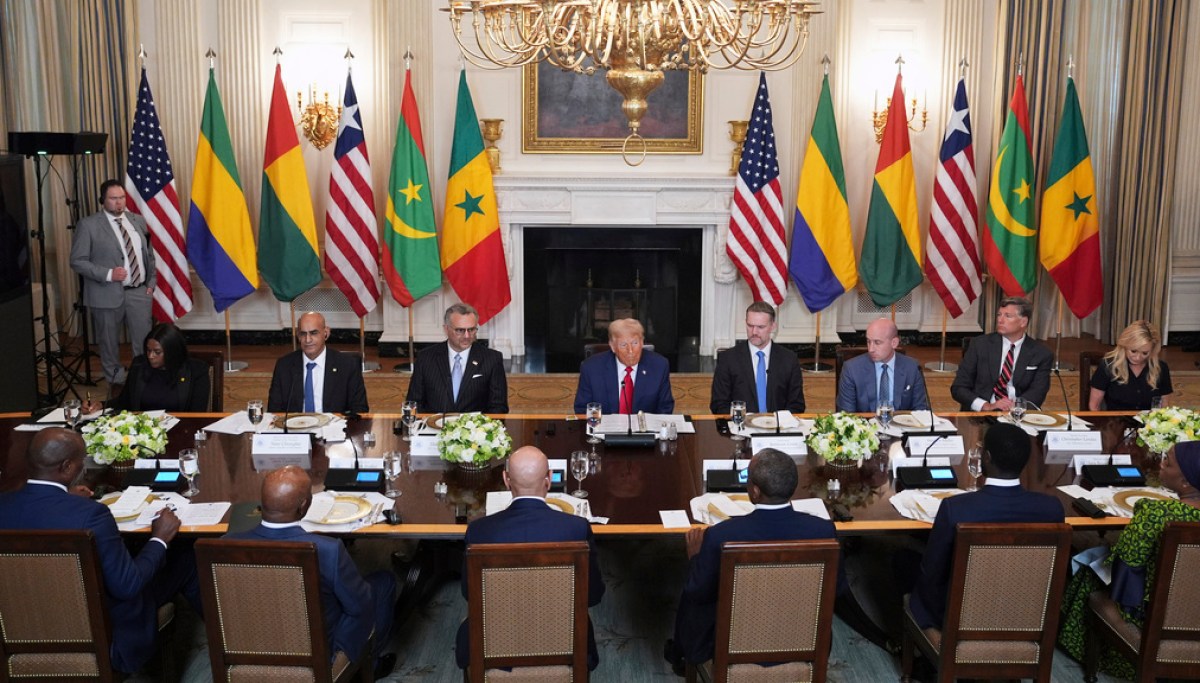
The Trump administration is looking to buck this trend by drastically reworking its approach from previous administrations, switching from an aid-focused model to one of trade, a focus on critical mineral acquisition, and transactional economic cooperation.
The Trump administration’s overhaul in sub-Saharan Africa
Trump administration officials have envisioned their change in approach to sub-Saharan Africa as almost revolutionary. Nick Checker, the senior bureau official leading the Department of State’s Bureau of African Affairs, characterized the second Trump administration’s approach to Africa in a recent speech as “very new and different,” representing a “fundamental reset in how the United States approaches development.”
“For decades, our approach was defined by how much assistance we delivered, how quickly we could spend, and how many programs we could launch. In this administration, that era is over. We are entering a new era — defined not by inputs, but outcomes; not by aid flows, but by economic growth; and not by dependency, but by mutually beneficial partnerships,” he said.
Checker outlined a strategy that approached African countries on a case-by-case basis, prioritizing “where American strategic and commercial interests directly align with African aspirations.
The previous model of prioritizing direct aid, he argued, was “fundamentally wrong” and unable to deliver concrete results.
“For too long, we treated symptoms rather than root causes. We measured success by dollars spent and programs launched, rather than by economies transformed. We funded programs without requiring performance, accepting commitments instead of insisting on results. And when governments failed to deliver, we often responded with more assistance — not less,” Checker said.
While experts are divided on the new strategy’s efficacy, nearly all are in agreement that it’s a radical break from the past.
Dr. Yun Sun, senior fellow and director of the China Program at the Stimson Center, told the Washington Examiner that this different view of aid was so far the greatest change the second Trump administration has implemented regarding its sub-Saharan Africa policy.
“The removal of aid from the equation is the most consequential,” she said. “It changes many of the premises of the U.S. approach to Africa.”
“With the removal of USAID, a lot of U.S. traditional influence in Africa is being put in a new perspective. Trump has suggested that the U.S. will prioritize trade over aid, which is logical,” she added, though warned that this could create a further imbalance in the U.S. and China’s roles.
In his April 10 speech, Checker argued that viewing African partners primarily as aid recipients rather than viable commercial partners was a disservice to both them and the U.S. The former U.S. model “reinforced dependency” and “crowded out private sector-led growth,” which Washington views as the primary means by which Africa can develop economically.
In response to past failures, Checker said the U.S. was now “making a clear shift, from aid to trade, from assistance to investment, and from dependency to partnership. And we are engaging African nations accordingly — not as aid recipients, but as capable commercial partners. This means working with governments as they are, not as Washington wishes them to be — focusing on mutual economic benefit rather than unsuccessful political transformation.”
These comments hint at a more realpolitik approach to Africa, abandoning previous U.S. objectives of promoting liberal and democratic values on the continent.
Ebenezer Obadare, a senior fellow for Africa studies at the Council on Foreign Relations, praised elements of the Trump administration’s shift in an interview with the Washington Examiner, even welcoming the scrapping of USAID.
“I like the idea. It’s almost as if Trump was acting as a ventriloquist for many of the grievances that African countries have been trying to put forward, the whole idea of: ‘please trade with us, stop giving us money,’” he said.
The new realpolitik approach in Washington was less appreciated, mostly because Obadare believed it stripped the U.S. of its biggest advantages in Africa.
Can the US recreate China’s success in cultivating African influence?
Trade, IP, and digital technology governance associate director Rodrigo Balbontin at the Information Technology and Innovation Foundation characterized China’s strategy in cultivating influence in the Global South as that of Imperial Germany in the late 19th century, inducing trade dependencies and wielding trade to gain a competitive advantage for its advanced industries. This is all in an effort to limit the development of its adversaries — in China’s case, the U.S.
Among the main differences between Washington and Beijing’s approaches have been the influence of ideology; the U.S. has focused on supporting liberal democratic NGOs and human rights, while China’s aid is primarily economic and without overt ideological strings attached. The latter model is particularly preferable for the more authoritarian regimes that hold power in much of the region.
As seen by rhetoric from Trump administration officials such as Checker, Washington looks like it’s aiming to recreate China’s economic and business-focused strategy. Obadare and Liam Karr, the Africa team lead with the American Enterprise Institute’s Critical Threats Project, outlined two predominant problems with this approach.
Despite real complaints that the usage of U.S. soft power in sub-Saharan Africa failed to yield tangible results, Obadare argued that it had a very real impact and gives a unique one-up on Chinese influence.
Reflecting on his growing up in Nigeria, one of Africa’s largest economies, he conceded that the country is still nowhere near the likes of Norway or Sweden in terms of a desirable model.
“Nigeria is not a model,” he said. “But it’s not Nigeria 1999. It’s a country that has had successive elections where there is a transfer of power and where, at least in terms of rhetoric, people commit to the idea of the rule of law, and the United States is partly responsible for that success. It invested heavily, morally and materially, in the success of a country like Nigeria.”
Despite lingering complaints, Obadare said all Nigerians would agree that the current state of the country is “infinitely preferable” to that of 25 years ago.
“In the case of Nigeria, the Fourth Republic has been there since 1999, but … right now you can take people to court, soldiers no longer lock people up without any explanation, people don’t get disappeared overnight and you don’t see them again,” he said.
U.S. investments in civil society, to the tune of tens of millions of dollars, have also borne fruit in Ghana, Kenya, and Senegal, Obadare said.
“In any case, countries are always democratizing, meaning they’re strengthening their muscles, sharpening their reflexes, getting better. The fact that Nigeria, a country of so many contradictions, is able to do that is one of the success stories that the United States can point to,” he argued.
Central to his argument against the full abandonment of the U.S.’s previous principles-based approach is his connection of liberal democracy, stability, and economic prosperity.
“There is everything to gain from having a stable and prosperous Africa, and less to gain from a region where we just go in and do business. See, that’s the thing about focusing on doing business only: If you do that at some point in the foreseeable future, there will be no business to deal with,” Obadare argued.
“Do you do business with Sudan right now? It’s in trouble. It’s in turmoil because it’s not anchored on any kind of solid democratic foundation,” he added.
Karr agreed “wholeheartedly” with the argument linking economic prosperity and stability with liberalism, adding that any lasting U.S. strategy to cultivate influence in the region would need to rely on a stable investment environment.
“For the US to compete with the likes of the Gulf and China, you’re going to need a lot of U.S. private investment, and to get that, you need better governance, and you need more representative and democratic governance. So I think that those things do go hand in hand, because otherwise you get corruption, you get instability and insecurity, and none of that is going to attract the US private business at the scale needed,” he said.
Barriers to entry
An attempt to recreate China’s success through the purely economic model will quickly run into another problem as well — it may not even be possible given the structure of the U.S., Karr argued.
“I don’t think that we can recreate the China model. We have to do it the American way, which is through private enterprise and capitalism, and you need good governance and institutions to attract that. China has gotten where it’s at now by… the Chinese government bankrolling billions of dollars of risky loans so that Chinese state-linked enterprises can go into the [Democratic Republic of the Congo] and make deals with these shady, corrupt figures,” he explained.
“The U.S. government … probably couldn’t match that scale,” he argued, and further, Washington wouldn’t even “want to in a place like Africa.”
While the U.S. government has a role to play in providing loans, risk insurance, and enticing U.S. private investment, Karr said private U.S. businesses would have to do the bulk of the work in Africa.
A purely economic approach would also set the U.S. up for an uphill battle.
From 2000 to 2024, the share of exports from China to the region went from under 5% of the total share to over 20%, while exports of the more vital National Power industries — strategic industries encompassing defense, dual-use, and other industries — now make up one quarter of Africa’s imports, according to data compiled by Balbontin. U.S. exports to the region, meanwhile, have declined from just under 10% in 2000 to about 6% in 2024, with its National Power industries faring similarly.
China’s overall trade with Africa exploded from just $10 billion in 2000 to $262 billion in 2023.
China has made a concerted effort to invest heavily across the Global South, but investments in sub-Saharan Africa have been among the most fruitful. As Balbontin explained, the region’s poverty level made this early investment easier than elsewhere, giving more room for growth and providing a blank canvas to work with.
“Building a subway line and creating a subway system in a city that doesn’t have a subway is much easier than modernizing New York metros,” he told the Washington Examiner. “So that same analogy also applies in tech adoption and enabling infrastructure for poorer regions. … So that’s where China has a larger advantage in that regard” as they’re building on top of their existing infrastructure and within their own standards.
RWANDA THREATENS TO STOP PROTECTING US GAS PROJECT FROM ISIS OVER SANCTIONS
The entrenchment of Chinese economic infrastructure means the window of opportunity for the explosive growth of influence through purely economic means in sub-Saharan Africa has largely passed. But Balbontin stressed in his April report that sub-Saharan African leaders had begun to grow wary of the influx of cheap Chinese goods and influence in their economies, giving Washington an opening.
The Trump administration’s new realpolitik has already reordered the situation in sub-Saharan Africa, and Sun noted that Beijing has so far adopted something of a wait-and-see approach. The radical new approach still has time to adjust and settle in, and the U.S.’s increasingly hands-on approach in areas such as the DRC could signal stepped-up U.S. interest.