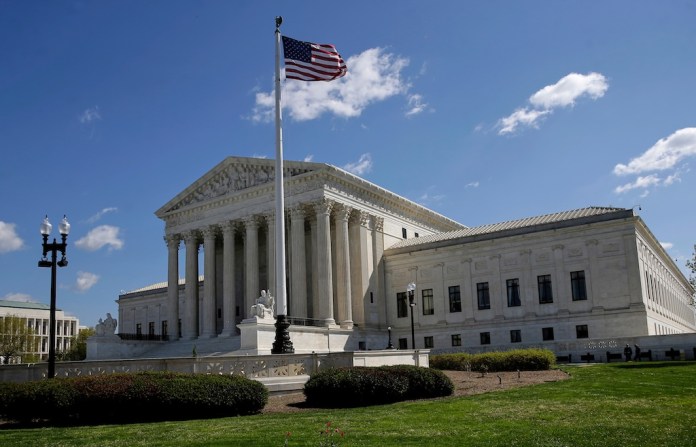
The Supreme Court will consider the constitutionality of a key law enforcement tool that has grown in significance in recent years alongside the growth of location-enabled devices: geofence warrants.
The justices will hear arguments on Monday in Chatrie v. United States, which will examine Okello Chatrie’s claim that the Justice Department’s use of a geofence warrant violates the Fourth Amendment, which protects against unreasonable searches and seizures. The arguments will put the emerging technological law enforcement tool under the microscope, and the high court’s decision in the case could limit a tool that has been at the center of various criminal investigations across the country.
A geofence warrant is a request made by the government to a technology company, such as Google, in this case, for information about devices that were physically within a certain geographic parameter during a certain period of time. The data from the geofence warrant used in Chatrie’s case was able to connect him to a bank robbery, for which he was convicted.
The DOJ argued to the high court in its brief that there is not a violation of constitutional rights “from the discovery of two hours of public movements,” especially for a service that Chatrie opted into sharing his location and other information with. The brief also noted that to obtain the warrant, it needed to go through a three-step process with a magistrate judge.
“The Court has made clear that an individual lacks a reasonable expectation of privacy in information that he ‘assumed the risk’ of sharing with others, including about his short-term public movements,” the DOJ brief said. “The warrant here sought movement information visible to anyone near petitioner when he robbed the credit union, and the inquiry it specified was closely analogous to what Google itself regularly did with opting-in users’ recorded Location History.”
The DOJ also argued that Chatrie’s position would “seem to imply that no geofence warrant, of any sort, could ever be executed,” and urged the justices to uphold the constitutionality of such warrants.
“His path to that counterintuitive result requires a number of novel Fourth Amendment innovations and would push the Court far out ahead of legislatures and common-law courts, where complex issues — such as questions about ownership of personal data, contract law on the Internet, and the proper boundary lines of online privacy—are still being debated and developed,” the DOJ brief said.
Chatrie told the high court it should rule against the DOJ’s scheme for obtaining broad swaths of data via geofence warrants, claiming it is the sort of “search first and develop suspicions later” policy the Fourth Amendment was designed to eliminate.
“A geofence warrant operates on precisely that principle,” Chatrie’s brief said. “To find the few people near a crime scene, the government compels a search of every account with Location History enabled — millions of people, all over the country, whose private digital papers must be searched so that the government can identify who was where and when.”
“The potential for abuse is breathtaking: the government need only draw a geofence around a church, a political rally, or a gun shop, and it can compel a search of every user’s records to learn who was there. The Fourth Amendment was adopted to ensure that the government could never wield such power,” the brief continued.
Google, which provided the information the DOJ requested with the geofence warrant, filed a brief to the high court not taking a side in the case, but urging the Supreme Court “to hold that Google Location History and other similar digital documents stored remotely deserve the Fourth Amendment’s protection.”
The technology company urged the high court to uphold that a person’s location data should be subject to more individualized warrants, rather than blanket warrants that cover all data in the company’s digital “cloud.”
“A contrary rule would leave the intimate details of millions of Americans’ daily lives—data that will exist in many forms as technology rapidly develops—exposed to warrantless surveillance,” the brief said.
The case marks the latest foray by the Supreme Court into emerging law enforcement tools that take advantage of constantly evolving technology, such as device location data. The court previously ruled that law enforcement must show probable cause to obtain cell phone tower data as part of an investigation, in its 2018 Carpenter v. United States ruling.
SUPREME COURT GRAPPLES WITH IF CRIMINAL LEGAL IMMIGRANTS MAY BE DENIED ENTRY IN THE US
Oral arguments in Chatrie v. United States will begin at 10 a.m. Monday, kicking off the Supreme Court’s final scheduled week of oral arguments for the term. After the high court hears arguments in the case, a decision is expected by the end of June.
During the final week of oral arguments, the Supreme Court is also set to hear arguments in a case over if Bayer, the maker of RoundUp weedkiller, should be held legally liable for not informing its customers that glyphosate could cause cancer on Monday immediately following arguments in Chatrie. On Wednesday, the high court will kick off its final argument day of the term by hearing a case on whether the Trump administration may end temporary protected status for Haiti and Syria.