With more competitive House races than any other state, Pennsylvania’s May 19 primary is shaping up as a high-stakes test of Gov. Josh Shapiro’s (D-PA) political capital as he seeks a second gubernatorial term ahead of a widely expected bid for the 2028 Democratic presidential nomination.
Pennsylvania’s bellwether status in the fight for House control leading up to the Nov. 3 midterm elections runs downstream from its longtime role as a presidential battleground. The Keystone State backed former President Joe Biden in 2020 before flipping to President Donald Trump in 2024, alongside Arizona, Georgia, Michigan, Nevada, and Wisconsin. Voter registration is tight in the state home to more than 13 million people, the nation’s fifth-most populous. There are about 3.8 million registered Democrats to 3.6 million Republicans, making Pennsylvania a microcosm of American politics in the era of Trump.
Shapiro, one of the state’s most popular Democratic governors in history, is well-positioned for reelection. His likely challenger in the general election will be Republican state Treasurer Stacy Garrity, who has the backing of the state GOP. But for Shapiro, the implications of this year’s primaries extend well beyond the governor’s race.
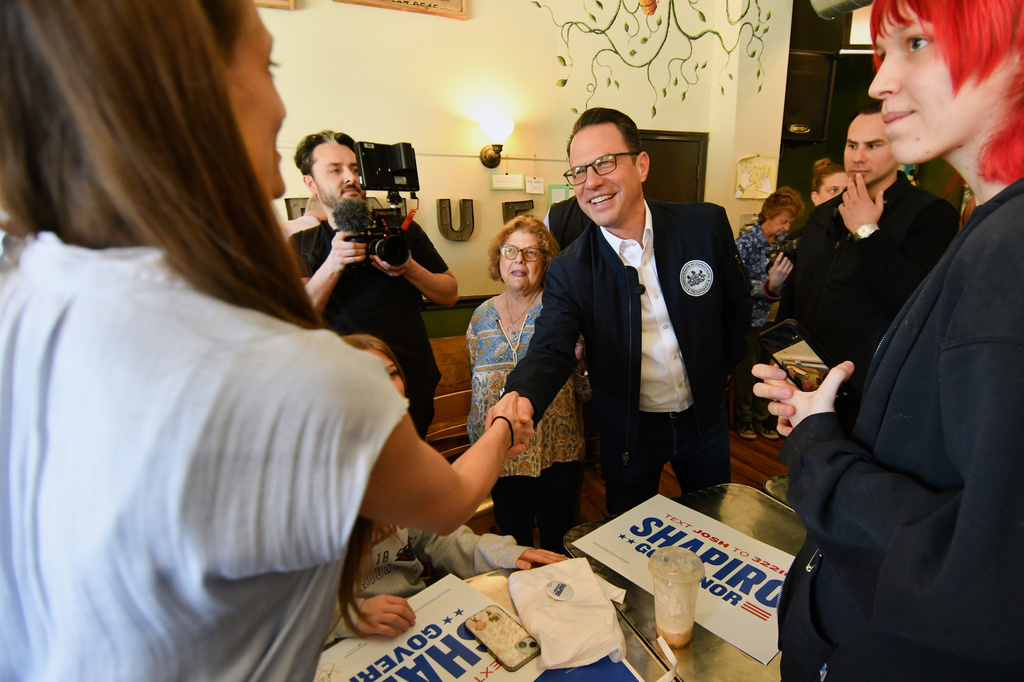
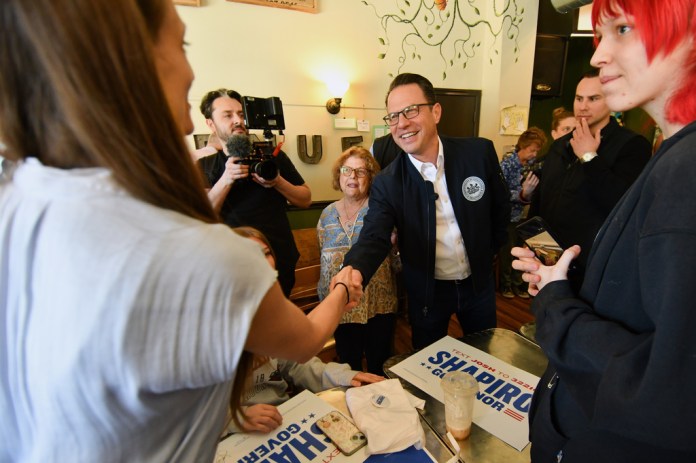
“The only thing I am focused on is beating my opponent for governor and helping other Democrats get elected here and sending a clear message to Donald Trump that the chaos, cruelty and corruption that he’s been engaged in is not something that we support here in Pennsylvania,” Shapiro told reporters after speaking to Democrats at a coffee shop in Lock Haven, located in the north-central part of the state.
Though Shapiro has downplayed an interest in a presidential bid, he has said he wants a voice in the Democratic Party’s future, and it’s clear the political ramifications of this year’s elections could still reshape his national standing. A commanding win at the top of the ticket, combined with Democratic success in competitive House districts, would strengthen his reputation as a governor capable of delivering results in a pivotal swing state. Democratic leaders have increasingly valued that kind of influence, as seen with Gov. Gavin Newsom (D-CA) taking a leading role in California’s redistricting battles and Gov. JB Pritzker (D-IL) asserting control over Illinois’ Senate succession.
Amid 2028 speculation, Shapiro has ramped up his presence on the campaign trail ahead of Tuesday’s primary election, aiming to shape the Democratic field. He is backing preferred candidates in competitive congressional contests and pushing for Democrats to take control of the state legislature for the first time in decades — a coordinated effort to influence both Harrisburg and Washington.
Pennsylvania-based Democratic strategist J.J. Abbott said that if Shapiro can run up the score in a “big, important swing state,” it would be a “strong credential” for the governor should he run in 2028.
The results will serve as an early measure of Shapiro’s political strength, with implications not only for his own trajectory but for the direction of the Democratic Party. Pennsylvania’s closed primary system adds another layer of intensity, as each party works to define its slate ahead of November.
“Pennsylvania isn’t just a swing state anymore: it’s the swing state,” political analyst Mike Fahey told the Washington Examiner. “The most underrated factor in all of this is Josh Shapiro. He’s the most valuable asset Pennsylvania Democrats have right now, and running unopposed frees him to play kingmaker in exactly the kind of suburban districts where his approval numbers actually move voters. Shapiro doesn’t need to campaign for himself; he needs to show up for the right people at the right moment. The candidates who quietly build their infrastructure now are the ones who survive November. Noise doesn’t win races. Organization does.”
Although Shapiro has avoided taking sides in the bitter Democratic primary for Philadelphia’s 3rd Congressional District, he has thrown his political weight behind several House candidates in key battleground races that could shape control of Congress.
Last year, the governor moved early to support former television journalist Janelle Stelson in central Pennsylvania’s 10th District as she mounted another challenge against Rep. Scott Perry (R-PA). He later endorsed Scranton Mayor Paige Cognetti in the 8th District race against Rep. Rob Bresnahan (R-PA), and more recently lined up behind Bucks County Commissioner Bob Harvie in the 1st District contest targeting Rep. Brian Fitzpatrick (R-PA).
But nowhere may the governor’s influence be tested more directly than in the Lehigh Valley-centered 7th District, where Democrats are locked in a bruising four-candidate primary to face Rep. Ryan Mackenzie (R-PA) in one of the nation’s most closely watched swing seats.
“The Lehigh Valley has become one of the most politically elastic regions in the country because voters there tend to respond less to ideology and more to perceived economic competence,” James Christopher, founder of James Christopher Communications, LLC, told the Washington Examiner. “It contains a blend of union households, rapidly diversifying suburbs, and working-class independents who are highly sensitive to inflation, healthcare costs, and wage stagnation. If Democrats frame the race around affordability and local economic stewardship, rather than a broad ideological conflict, they have a real opportunity there.”
In the race, Shapiro has gone all in for Bob Brooks, a retired firefighter and labor leader, even appearing in a prominent campaign advertisement on his behalf. Brooks has elevated the endorsement into a centerpiece of his campaign, repeatedly highlighting Shapiro’s backing in speeches, mailers, and voter outreach efforts as evidence of establishment confidence in his candidacy.
Brooks’s campaign website prominently touts the governor’s endorsement with a bold announcement celebrating Shapiro’s support, though it leaves out another key detail: the governor personally encouraged Brooks to enter the race months earlier.
“BREAKING: Bob was just endorsed by Governor Josh Shapiro!” Brooks’ campaign website reads.
Brooks is also endorsed by former transportation secretary and former (and possibly future) presidential candidate Pete Buttigieg, and Sen. Elizabeth Warren (D-MA), among others.
PENNSYLVANIA’S TREASURER BLOCKS $1 MILLION FOR JOSH SHAPIRO’S HOME SECURITY ONE YEAR AFTER ATTACK
But not everyone thinks Shapiro is the political power broker he has portrayed himself to be.
“The impact as governor Shapiro may have is quite limited,” Tim Blessing, political science professor at Alvernia University in Reading, Pa., told the Washington Examiner.
“He controls the Democratic Party machinery and can influence, to a degree, the dispensing of moneys, but he and virtually every other governor in the country cannot overcome the fierce partisan winds ripping through the country. The flat-out truth is that the more extreme elements of both parties pretty much control the election process. They decide the primaries and they turn out to vote, en masse, in the general. … Outside of the formal mechanisms of governance and party machinery, Shapiro comes close to irrelevance—even before he begins his second term.”