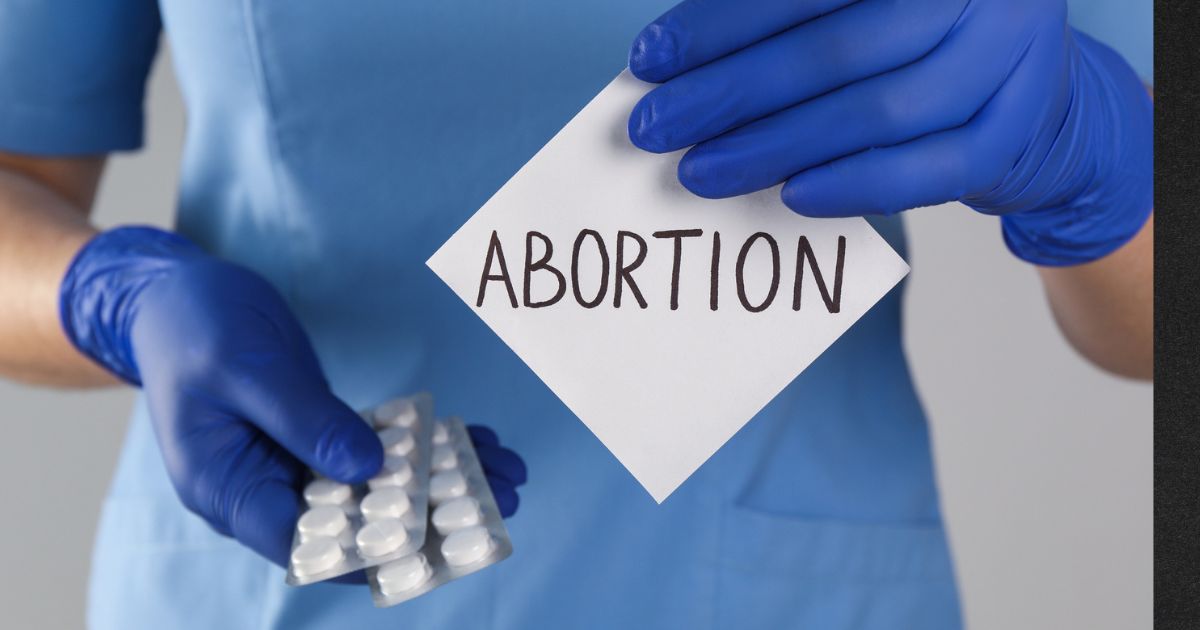
Last Friday, a federal court ruled to restrict the mailing of the nation’s most commonly used abortion pill, mifepristone.
The U.S. Supreme Court temporarily granted a weeklong reversal of the decision, and on Monday extended the pause.
If the federal court’s original opinion stands, access to one of the most widespread forms of abortion in America will be significantly reshaped.
The reaction has been immediate and predictable: Many pro-abortion advocates claim that women’s health is at risk and they will no longer have access to the “care they need.”
We should ask an honest question. Is this concern even valid?
That assumption has become cultural dogma, repeated so often that many simply accept it as fact.
But if we genuinely care about women facing unexpected pregnancies, then we cannot build public policy on slogans or ideology. We must be willing to examine the evidence honestly — even when it challenges the prevailing narrative.
And a recent study does just that.
The data show that strong pro-life laws are not contributing to higher maternal mortality rates. In fact, states with stronger pro-life protections experienced slightly faster declines in maternal mortality than states with more permissive ones. Notably, no state that enacted a heartbeat law or abortion restriction saw a statistically significant increase in maternal deaths.
Simply put, abortion cannot be shown as a determining factor in protecting the lives of pregnant women.
This finding matters because it directly challenges a central claim in the abortion debate, that restricting abortion physically harms women. The data does not support that conclusion.
While there is also no clear evidence that abortion bans consistently improve maternal mortality rates, there is also no evidence that bans worsen them. If the goal is to protect women’s physical health, abortion access is not a necessary component of the equation.
So the natural question follows: If abortion restrictions don’t demonstrably improve outcomes, why pursue them at all?
Because this conversation must go beyond physical outcomes alone.
Maternal health is not merely a physiological issue; it is deeply human, emotional and relational.
The contrast between physical life and death is only one aspect of the conversation. Yet, there is a striking lack of unbiased, long-term research on the emotional and psychological impact abortion can have on women, not only during the abortion itself, but for years afterward.
In the studies that do exist, it was found that women who have had an abortion were twice as likely to have attempted suicide and had increased odds ratios of anxiety and depression. The testimony of many women who have experienced abortion points to deep emotional and relational consequences that can linger for years.
Normally, patterns like these prompt further scientific inquiry and objective study. Yet when it comes to abortion, there has been a surprising reluctance to seriously examine those long-term psychological effects. That hesitation appears driven more by ideology than by a genuine pursuit of truth.
If we truly care for women, then our response must be holistic, accounting not only for physical safety but also for mental and emotional well-being. Our aim, therefore, is not simply to help a woman choose life and to physically live, but for women and their children to thrive and to experience abundant life.
This means stepping into the lives of women and children with tangible support. We need mentors, advocates, and churches showing up consistently to champion mothers in the hard, the messy, and the uncomfortable seasons of her journey. Pro-life believers need to show up when it matters to show that being pro-life is not just being pro-birth, but is for the flourishing of women and mothers. The gap often attributed to the absence of abortion is really a gap in support. And it is one the Church is uniquely equipped to fill.
Some will point to tragic cases involving women who have died amid restricted abortion access. Those deaths are tragic and should never be minimized or trivialized. Every life bears immeasurable value and dignity, both mother and child alike.
But compassion must still be grounded in truth. We should be careful not to assume causation where the evidence remains unclear. There is no definitive evidence that abortion access would have saved those mothers, and it certainly would not have saved their children. In the hardest medical moments, our aim should never be to pit one life against another, but to preserve both lives whenever possible.
If we truly want to reduce maternal mortality, to see the numbers fall to zero in every state, then we must focus on the factors that actually drive those outcomes.
Good maternal health care is not defined by offering women a choice between life and death. It is defined by ensuring they receive true, high-quality care from the very beginning: consistent prenatal care, skilled medical support, and ongoing resources that address both physical and emotional needs for the long term of mother and baby.
Imagine if the time, funding, and energy spent promoting abortion were instead invested in comprehensive maternal health care and support systems. That is how lives and souls would be saved.
Maternal mortality will fall not through persuasive pseudo-narratives, but through genuine, compassionate, comprehensive care for women at every stage of pregnancy and motherhood.
The views expressed in this opinion article are those of their author and are not necessarily either shared or endorsed by the owners of this website. If you are interested in contributing an Op-Ed to The Western Journal, you can learn about our submission guidelines and process here.
Advertise with The Western Journal and reach millions of highly engaged readers, while supporting our work. Advertise Today.
Submit a Correction →