
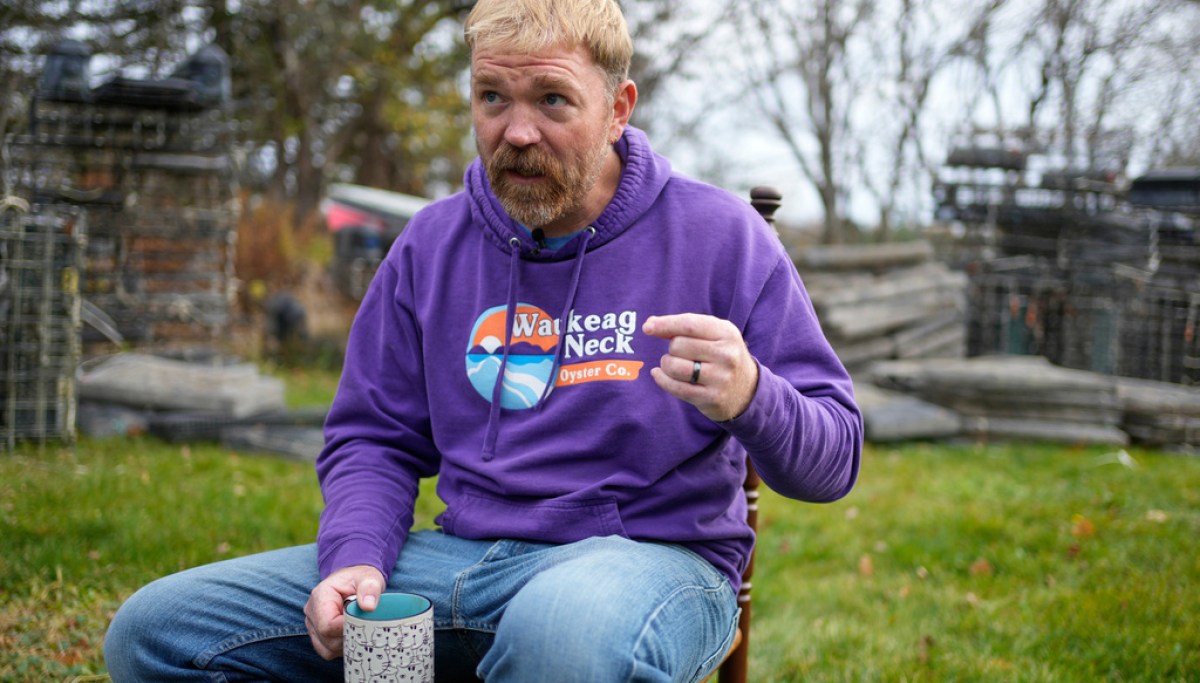
One of Democrats’ best pick-up opportunities in the Senate this November is an unexpected one. Graham Platner, the presumptive Democratic nominee in the race against Sen. Susan Collins (R-ME), has been scandal-prone, complete with a Nazi symbol tattoo, but is polling ahead of the five-term incumbent from Maine.
Last week alone Platner, 41, faced a slew of bad headlines.
First, it came to light that Platner claimed during a 2024 appearance on the Green Beret Chronicle Show podcast that American Sniper Chris Kyle was “less discriminating” during the Iraq war and allegedly increased his kill count by aiming at civilians.
Also last week, five new posts from his since-deleted Reddit account were uncovered, including one from 2019 in which the Marine veteran, whose username was “P-Hustle,” mocked a Purple Heart recipient as a “dumb motherf*****” who “didn’t deserve to live” after the soldier was shot four times during a 2012 skirmish with the Taliban in Afghanistan.
The other four contained explicit content. In one post from 2017, Platner recalls masturbating in a portable toilet while deployed during the Afghanistan war. Another one from 2018 saw Platner praise a portable-toilet graffiti drawing of a penis. Still, another post from 2020 saw Platner recall having phone sex on a cell phone network compromised by the Taliban.
In a separate 2019 post, Platner also complained about a loophole closing that provided military contractors with the opportunity to save money on their taxes by remaining abroad, “banging hookers in Thailand” instead of getting “b****ed” at by their partners in the U.S.
Regardless, less than six months before the election, Platner has a polling advantage over Collins, averaging a more than 7-point edge according to RealClearPolitics.
In fact, in one poll published by Pan Atlantic last week, Platner had more support among women than Collins, 53% to 34%, though Collins had more of the male vote, 47% to 44%.
University of Maine Department of Political Science Chair Mark Brewer contended that Platner, who last month pushed incumbent Gov. Janet Mills (D-ME) out of their primary, was performing so well for two reasons.
“Democrats in Maine and also nationally are just so fed up with the current leadership of their own party that they’re looking for something different, and that something different that they want is someone who they see as a brawler who’s willing to mix things up and not do things the way they’re normally done,” Brewer told the Washington Examiner. “The other part of it is that I would say over the last decade or so the rules of what’s deemed acceptable, or disqualifying, or permissible have changed.”
“Part of that might be generational change, younger voters are more willing to overlook things,” the professor said. “I think also part of it has to do with President Trump.”
For Brewer, Platner also has “something that not all candidates for public office have”: the “it” factor.
“You can tell that from the crowds he draws, the reactions he gets from those crowds, the huge number of people who are signing up to volunteer with this campaign,” he said. “I talked to a number of my students about Platner and I’ll ask them, ‘These comments about women, don’t these things bother you?’ They’ll say, ‘Well, he was younger, and PTSD, and people can change and make mistakes, and we’re gonna overlook it.’ ‘Well, what about a Nazi tattoo?’ ‘Well, you know, he didn’t know it was that, and when he found out, he got it covered up.’”
Pollster David Paleologos added that voters may perceive Platner’s scandals “as the rusty, old, toxic D.C. political system trying to beat down a young, authentic oyster farmer and ex-Marine, and the strategy could backfire.”
“There is always a risk to degrading a young candidate with momentum who is powering his way toward his party’s nomination,” the director of the Suffolk University Political Research Center told the Washington Examiner. “Kind of like shooting spitballs at a battleship.”
Meanwhile, Northeastern University political science professor Costas Panagopoulos conceded that it is “conceivable” that voters are dismissing Platner’s scandals and concentrating “instead on other considerations.”
But “at the end of the day,” “this race is likely to be a referendum on Collins’ performance and GOP policies and priorities,” Panagopoulos told the Washington Examiner.
A Republican strategist defended Collins, arguing that “polls have never really captured Maine well” and the senator won by 9 points in 2020, despite the doomsayers about that race against Democrat Sara Gideon.
“I don’t know if it’s ranked choice or a reluctance to be entirely candid with an anonymous pollster, but our polls have never really reflected the on the ground situation in Maine very well at all,” the operative told the Washington Examiner. “We are not concerned about polls, we’re concerned about the feeling on the ground, and we feel pretty good.”
That argument was reiterated by Collins’ campaign, whose spokesman Shawn Roderick repeated “every single public poll last election showed Sen. Collins losing her reelection, and every single poll was wrong.”
“These polls haven’t been particularly useful in predicting outcomes in our campaigns,” Roderick told the Washington Examiner.
A third Republican strategist told the Washington Examiner that the GOP has not spent a dramatic amount of money on Collins, but that once the senator has ads on the airwaves, there will be a “tide change.”
LAWFARE COMPENSATION FUND THREATENS TO REOPEN JAN. 6 DEBATE FOR REPUBLICANS
Brewer, the University of Maine professor, agreed that although Platner’s lead is “real,” “there’s a long time before November,” and many Democrats and “unenrolled” voters, or independents in Maine, are “yet to be convinced to pull the ballot box switch” for him.
“He’s not just running just against Collins, he’s running against the larger establishment as a whole,” he said. “I also think there’s going to be a certain amount of referendum on Donald Trump.”