Settlements for those the Justice Department deems were victims of “lawfare and weaponization” under past administrations is the latest attempt to provide financial compensation to Republican senators whose phone records were tapped in the “Arctic Frost” investigation into efforts to overturn the 2020 election.
However, the Republican-controlled Congress has already rejected similar past proposals. The DOJ’s fund is a venture from the administration, not directly tied to Congress, yet outrage from GOP senators tanked the upper chamber’s plans to advance a Trump-inspired $70 billion immigration enforcement bill. The DOJ money could benefit 2021 Capitol rioters, creating a major friction point.
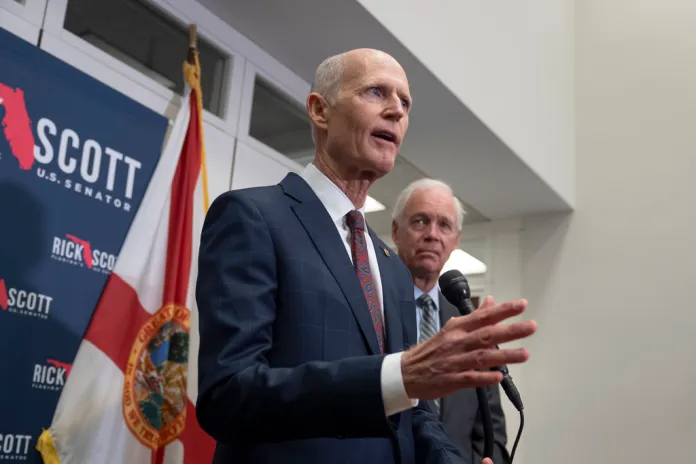
“I don’t need any compensation for that,” Sen. Rick Scott (R-FL), whose phone records were subpoenaed, told the Washington Examiner.
Scott declined to elaborate whether it was appropriate for other lawmakers to seek compensation, should they choose to do so, but noted that he is seeking damages from government consulting firm Booz Allen Hamilton over a leak of his confidential tax returns. The DOJ fund was created as part of a settlement resolving Trump’s lawsuit against the Internal Revenue Service for leaking his tax records.
Sen. Ron Johnson (R-WI), another lawmaker whose phone records were secretly seized and revealed last fall by a Senate investigation into “Arctic Frost,” defended the fund as a deterrent against “the federal government from abusing its citizens.” Still, Johnson said he personally “would not apply” for a settlement.
A DOJ memo with details of how the fund would operate was circulated to senators as part of its lobbying effort to salvage deteriorating negotiations over the GOP’s immigration reconciliation bill. It lists “Senators whose phone records were subpoenaed” under a section laying out who could benefit. Some current and former House Republicans’ phone records were also targeted and would likely be eligible.
But even those such as Johnson who have offered favorable rhetoric toward the fund have acknowledged the political toxicity of the timing. There were underlying tensions from Trump’s revenge tour against incumbent senators and quarrels over the reconciliation bill’s $220 million in security funding for the president’s yet-to-be-built East Wing ballroom.
Trump laid out his latest defense of the DOJ fund on Friday, contending he “gave up” a large settlement from the federal government in his IRS litigation in exchange for establishing the $1.776 billion program. The figure is based on America’s founding 250 years ago.
“I gave up a lot of money in allowing the just announced Anti-Weaponization Fund to go forward,” Trump wrote on Truth Social. “I could have settled my case, including the illegal release of my Tax Returns and the equally illegal BREAK IN of Mar-a-Lago, for an absolute fortune. Instead, I am helping others, who were so badly abused by an evil, corrupt, and weaponized Biden Administration, receive, at long last, JUSTICE! President DJT.”
Sen. Lindsey Graham (R-SC), a close Trump ally, also had his phone records subpoenaed and has been the fiercest advocate on Capitol Hill to allow lawmakers like him to seek reparations. But efforts in recent months to tuck provisions into broader legislation for upwards of $500,000 payouts per lawmaker were rebuffed over uproar from House Republicans. Graham’s rationale has centered on making it “hurt as much as I possibly can” for the federal government “so nobody will do this again.”
GOP CAPS TURBULENT WEEK, POINTING FINGER AT WHITE HOUSE FOR IMMIGRATION BILL BLUNDER
Sen. Rand Paul (R-KY) suggested the notion of another attempted payout was clearly an unpopular one, having already litigated the subject in the court of public opinion.
“I think things need to be the same for everyone,” Paul told the Washington Examiner. “Justice is when things occur that aren’t different for you because you’re in elected office.”
David Sivak contributed to this report.