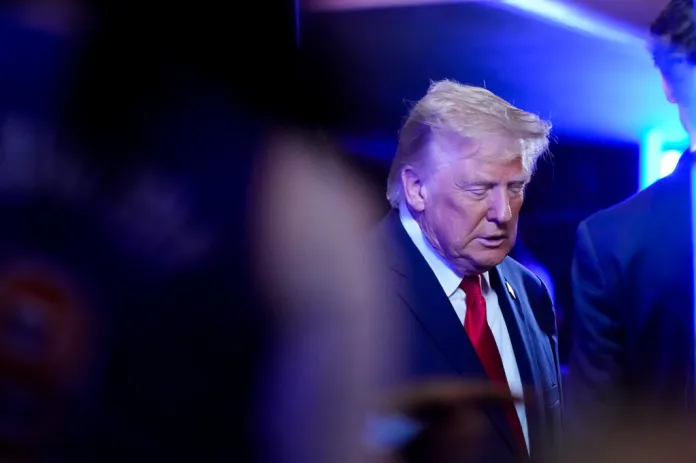
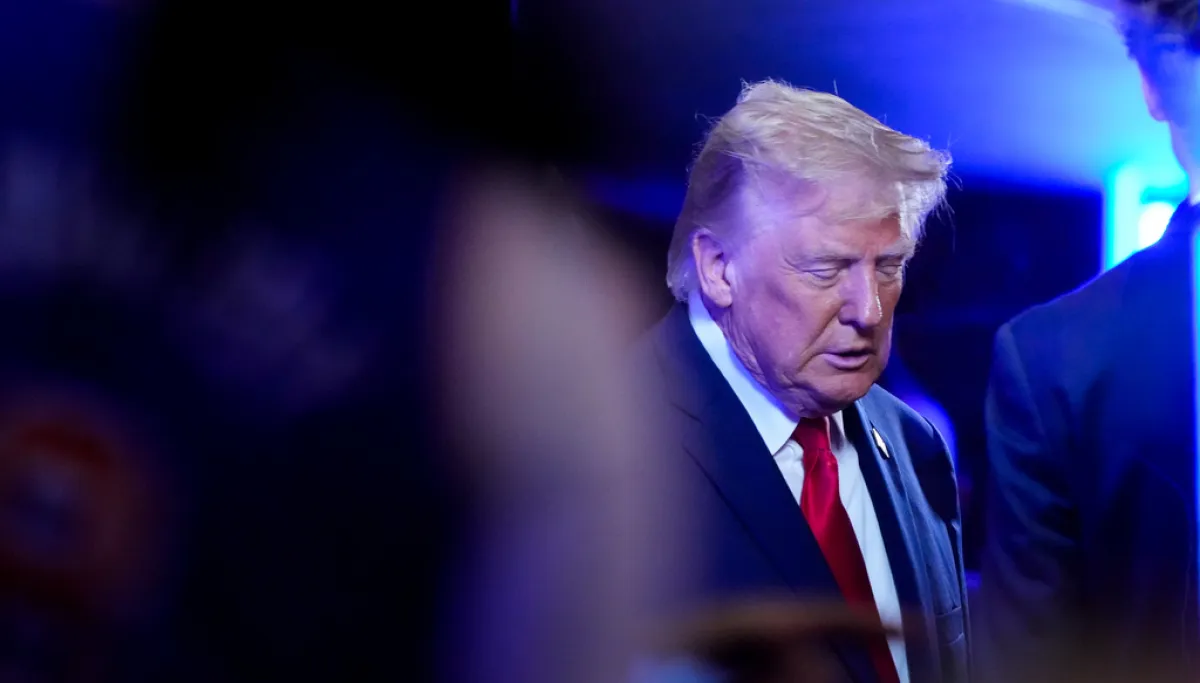
President Donald Trump will meet with Middle Eastern leaders in Evian, France, early Monday morning, where his efforts to finally end the Iran and Ukraine wars are likely to cloud all other topics of conversation at the G7 summit.
In recent weeks and months, Trump has voiced displeasure with nearly every G7 leader for failing to assist the United States in securing unencumbered commerce through the Strait of Hormuz.
Trump will hold a bilateral meeting with the Emir of Qatar, Sheikh Tamim bin Hamad Al Thani, followed by a bilateral meeting with the United Arab Emirates President Sheikh Mohamed bin Zayed Al Nahyan, and then join a working lunch with G7 leaders and leaders from the Middle East.
A senior administration official said that Trump will discuss the opening of the Strait of Hormuz, a key item in MOU negotiations, with other G7 leaders.
“There’s a lot that the G7 countries have said that they can do once that deal goes forward,” said the official. “Iran is going to open up the Strait of Hormuz, that’s a requirement. It could be open with no tolls, as they do that, we will lift our blockade.”
At the G7 summit, Trump will also hold a bilateral meeting with Macron on Monday evening, according to a senior administration official who spoke to reporters on Saturday. On Tuesday, Trump will participate in a working session with G7 leaders and President Volodymyr Zelensky of Ukraine. There currently isn’t a scheduled one-on-one meeting between Trump and Zelensky, although that could change. But “they very well may meet with each other on the sidelines,” said a second administration official.
The Ukraine war has lasted longer than World War I, after Russian President Vladimir Putin invaded Ukraine in February 2022. Trump has repeatedly pushed Putin and Zelensky to end the war, but negotiating an acceptable peace deal for both leaders that wouldn’t alarm European allies has proven elusive.
“We want the war to end, we want the war to end as quickly as possible,” said the second senior administration official about Ukraine. “It’s something that is one of the president’s top priorities. It’s terrible, what’s going on in terms of the loss of life.”
French President Emmanuel Macron had largely planned to focus the summit’s agenda on economic matters, particularly advancements in artificial intelligence.
However, according to Council on Foreign Relations senior fellows Heidi Crebo-Rediker and Matthias Matthijs, much of the summit itself, both its form and diplomatic successes, will be determined personally by Trump, or at least his mood.
“We have to remember that President Trump is going to be having just had his birthday on the White House lawn with the UFC. And so one of the questions is, really, just what Trump is going to show up?” Crebo-Rediker told reporters during a pre-trip briefing on Friday.
“Post-U.S. and Israeli attack on Iran, the retaliation and the closure of the Strait of Hormuz, we have energy supply chain and commodity shocks,” Crebo-Rediker continued. “And they’re wreaking havoc on the global economy. So whether it’s, you know, rising transportation costs or concern about fertilizer supplies, food security, helium, and all of the relevant inflationary pressure. And then speaking of, you know, geopolitical backdrop, you have Ukraine as well.”
TRUMP FUMES OVER ‘FAKE’ PEACE DEAL TERMS LEAKED BY IRAN
“Macron’s challenge may be less about advancing his own initiatives than about managing the summit itself,” Matthijs said. “Success may depend less on the formal agenda than on whether seven increasingly divergent partners can keep moving, however imperfectly, in the same direction.”
On the Iran war front, the administration has been working with Tehran to negotiate a memorandum of understanding that would end the more than three-month-old war. Vice President JD Vance was delegated to represent the administration at a potential signing of the MOU. But Iranian Foreign Ministry spokesperson Esmaeil Baghaei said the signing would not happen on Sunday.
Before the president left for France, a White House official told the Washington Examiner that the U.S. has six specific goals for the summit:
- 1) Reframing the conversation around development to focus on investment partnerships that are mutually beneficial for both investor and recipient nations.
- 2) Promoting innovation and the adoption of AI technology the U.S. is leading the world in developing.
- 3) Highlighting U.S. leadership in addressing the Ebola outbreak and calling on other nations to join us in our efforts.
- 4) Boosting critical mineral supply chain resilience to promote economic security.
- 5) Working with G7 partners to strengthen responses to illegal immigration and drug smuggling.
- 6) Promoting American exports and championing global growth through regulatory streamlining and energy abundance.
Two senior administration officials, granted anonymity to discuss private conversations publicly, say that the president will not only continue to press to reverse “trade imbalances” with other G7 states, but also make the case to G7 members of the North Atlantic Treaty Organization — Canada, France, Germany, Italy, and the United Kingdom — for increasing their own defense budgets, a pet issue of the president’s dating back to his first term in office.
The NATO alliance introduced a requirement in 2014 that every member needs to spend at least 2% of its gross domestic product on defense, but it took until last year for every country to meet that minimum. Also last year, under the president’s insistence, the alliance increased that minimum to 5%, which includes 3.5% to fund core defense, but many countries will not meet that mark for years.
In 2025 alone, NATO allies in Europe, combined with Canada, increased their defense spending by 20% compared to the year prior, according to the NATO annual report released in March.
NATO members that have increased their defense budgets have largely done so as a means of keeping Trump in line with Western Europe’s position, as “Trump seems to have a greater affinity for President Putin than he does for many European leaders,” Crebo-Rediker suggested Friday.
Macron has slapped at least one non-war-focused issue on the summit’s agenda, which Trump should be happy to engage with: extensive discussions on AI advancements. Macron invited OpenAI CEO Sam Altman to participate in summit conversations on the topic.
WHITE HOUSE POINTS OUT TWO FACTORS THAT CHANGED TRUMP’S MIND ON THE IRAN DEAL
The U.S., during Trump’s second term, has placed a concerted bet on fostering the American AI industry, but despite a steady buildup of domestic infrastructure, the U.S. and other G7 members still face a serious bottleneck when it comes to the critical earth mineral supply chain.
“It’s really the ripest area for collective action,” Crebo-Rediker said. “This whole concept of needing to collaborate through the G7 on this area — it was very strong within the Japanese G7 presidency, even stronger on the critical minerals side with Canada last year. And we’ve seen since then significant escalation in export controls by China, up and down the supply chain, sort of weaponizing their near monopoly. So I think the one issue with the G7 is that while that has been one of the drivers of collaboration, the U.S. has really taken a lead in this effort for multilateral approaches. They’ve created complicated overlapping agreements, like FORGE. … And at the end of the day, China’s chokehold threatens all advanced economies. So there’s really a consensus that you need a shared solution.”