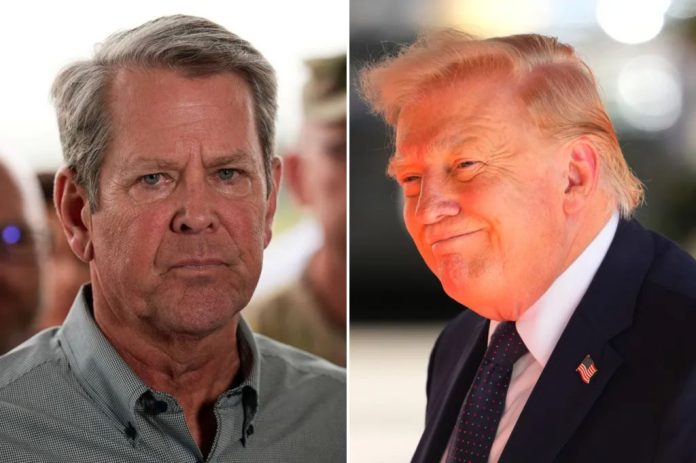
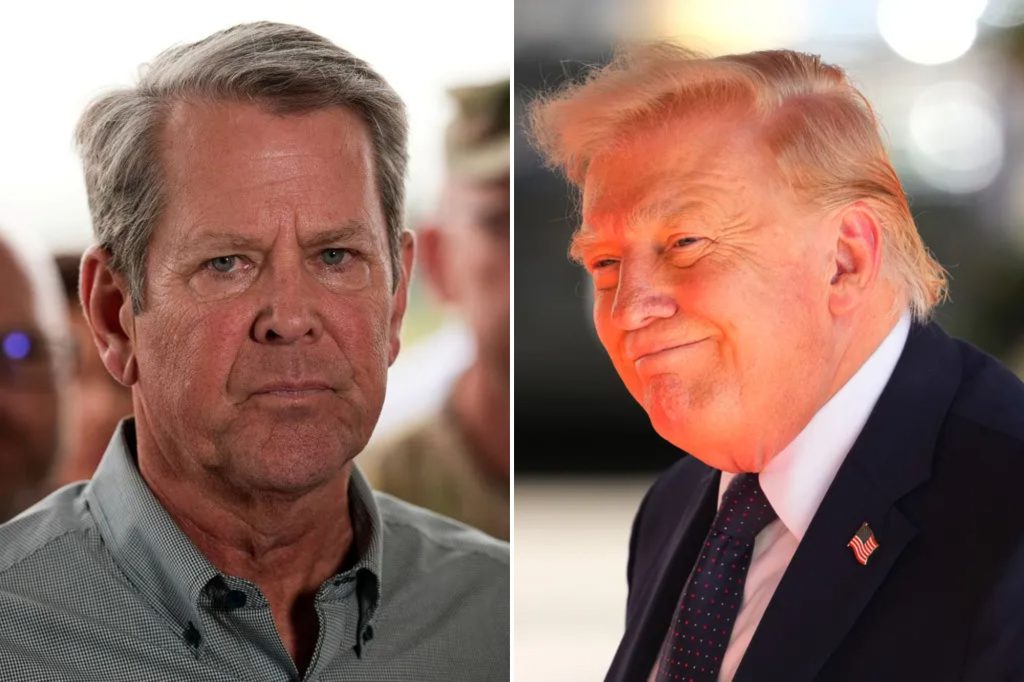
President Donald Trump and Georgia Gov. Brian Kemp enter Tuesday’s Republican runoff elections as both allies and rivals, backing the same candidate in the governor’s race while at odds in a closely watched Senate showdown that will test the competing power centers inside the Georgia GOP.
The overlapping endorsements highlight the increasingly complicated relationship between Trump and Kemp, whose long-running political feud has loomed over Georgia Republican politics for much of the last decade, even as both remain dominant forces within the party.
Trump elevated Kemp during the 2018 gubernatorial race with a late endorsement that helped him secure the Republican nomination, but the alliance unraveled after Kemp refused to intervene in Georgia’s certification of the 2020 presidential election following Trump’s loss in the state. Trump later backed former Sen. David Perdue’s failed 2022 primary challenge against Kemp and continued publicly criticizing the governor throughout much of that cycle before softening his rhetoric again during the 2024 campaign.
Trump over the weekend undercut Kemp’s Senate pick of former football coach Derek Dooley by backing Rep. Mike Collins (R-GA). Meanwhile, Trump and Kemp are aligned in the governor’s race, where both are now supporting Lt. Gov. Burt Jones over businessman Rick Jackson in one of the most expensive and bitter Republican gubernatorial primaries in Georgia history.
Jones, a longtime Trump ally and Georgia’s lieutenant governor, entered the runoff as the establishment favorite after securing Trump’s endorsement nearly a year ago and locking down support from many of the state’s top Republican officials. Jackson, a wealthy businessman running as an outsider candidate, dramatically reshaped the race after launching a late bid and pouring more than $100 million of his personal fortune into the contest while attempting to position himself as the more committed MAGA candidate. Jones finished first in the primary last month with 38% of the vote, while Jackson earned 32%.
Kemp allies were also frustrated by some of Jackson’s campaign tactics, including advertising that implied Kemp’s support despite the governor remaining publicly neutral for months. It was also not lost on many in Georgia Republican circles that several of Jackson’s top strategists previously orchestrated Perdue’s failed 2022 primary challenge against Kemp.
Kemp ultimately endorsed Jones in the final stretch of the runoff, arguing he was the strongest Republican candidate to face Democratic nominee Keisha Lance Bottoms in November.
“I’ve said all along my whole goal during this whole primary and runoff season was to make sure that we win in November, keep our state moving in the right direction, because the alternative of Keisha Lance Bottoms to that is just unacceptable,” Kemp said during a Monday press conference.
Still, some Georgia Republicans reject the idea that the Senate runoff has become a straightforward proxy war between the two leaders.
“People want to make this like a Trump versus Kemp war because that makes for good headlines, but I don’t think Georgia voters see it that way,” Republican strategist Ryan Mahoney told the Washington Examiner. “They’re aligned on one race and they’re on different sides on the other end, and that’s fine.”
Mahoney argued the split endorsements reflect differing candidate preferences more than a full-scale political feud, noting that both Trump and Kemp remain enormously popular among Georgia Republicans despite years of public clashes.
Moreover, the pair is aligned on the state’s more marquee race.
The governor’s race has largely overshadowed the Senate contest in recent weeks, according to several Republican operatives, as Jackson’s massive spending barrage dominated television and digital advertising across the state.
“It is taking over everything,” one Republican consultant said of the governor’s race, speaking on the condition of anonymity, adding that the Senate contest “almost never comes up” in conversations with voters.
Even so, Republicans said Dooley appears to have gained momentum in recent weeks after campaigning aggressively alongside Kemp across the state.
“I do get the sense that Dooley is moving,” another anonymous Republican operative said, pointing to Kemp’s efforts to campaign with him across Georgia in the final stretch of the runoff.
The runoff elections are also unfolding under conditions that could produce unusually low turnout, forcing both campaigns to focus intensely on voter mobilization efforts rather than persuasion. Georgia Republicans have repeatedly noted the difficulty of motivating voters to return to the polls only weeks after the initial primary, particularly during the summer heat and vacation season.
“We can talk about these races, and we can read the news and see all the millions of dollars spent on TV, but at the end of the day, people need to wake up tomorrow between the hours of seven and seven and actually go and cast a ballot,” Mahoney said. “It’s 95 degrees here, and kids are going to swim team, and people are going on vacation.”
Mahoney said turnout operations could ultimately matter more than endorsements or television advertising in determining the races’ outcomes.
“At the end of the day, it’s going to come down to which campaign was able to target effectively and turn out their likely voters,” Mahoney said.
The uncertainty surrounding turnout has also complicated polling in both contests, particularly because operatives remain unsure which segments of Republican voters will actually return for the runoff.
“It’s basically a coin flip going into election day,” Mahoney said, referencing recent polling that showed both races within the margin of error.
Collins has pitched himself as the unapologetic Trump ally in the race, arguing Republicans want a fighter closely tied to the president and highlighting his work on immigration legislation, including the Laken Riley Act. Dooley, meanwhile, has campaigned as a candidate better suited to expand the party’s coalition in a competitive general election while pairing that message with proposals such as congressional term limits and a ban on stock trading by lawmakers.
The runoff has also exposed broader Republican frustrations about how long the Senate primary dragged on while Democratic Sen. Jon Ossoff (D-GA) continues to build a substantial fundraising advantage ahead of the general election.
“There’s not a good reason why this thing has dragged out for a year only to end up right where it was a year ago,” one Republican strategist said, arguing the extended primary left Republicans politically vulnerable heading into the fall campaign.
Mahoney also argued the outcome of Tuesday’s runoff is unlikely to fundamentally alter either Trump’s or Kemp’s standing inside the Georgia GOP, regardless of which candidates ultimately prevail.
“Brian Kemp and Donald Trump are still going to be wildly popular, and people are still going to want those endorsements,” Mahoney said. “It’s not going to impact that at all.”
KEMP BACKS BURT JONES IN TIGHT GEORGIA GUBERNATORIAL RACE, ALIGNING LAST-MINUTE DECISION WITH TRUMP
Mahoney specifically pointed to Kemp’s enduring popularity with Georgia Republicans, arguing the governor’s political operation remains one of the strongest forces in state politics.
“People in this state love their governor,” Mahoney said. “He’ll go down as the most popular governor in history.”
Tuesday’s results will not only determine Republicans’ nominees for governor and Senate, but could also provide an early test of whether Trump’s MAGA movement or Kemp’s well-established statewide machine is better positioned to drive turnout, shape Republican politics in Georgia, and possibly chart the party’s path forward in one of the nation’s most important battleground states.