The United Kingdom is set to see its seventh prime minister in the past ten years and it appears that man will be Andy Burnham, a veteran Labour Party Westminster insider who has sought to cast himself as a "socialist" working class hero.
The post Self-Described ‘Socialist’ Andy Burnham Looks to Replace Starmer as British Prime Minister appeared first on Breitbart.
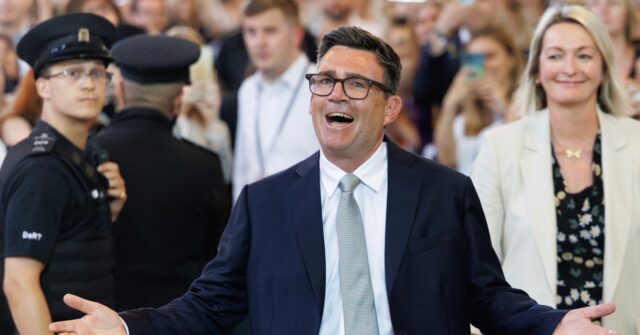
The United Kingdom is set to see its seventh prime minister in the past ten years, and it appears that man will be Andy Burnham, a veteran Labour Party Westminster insider who has sought to cast himself as a “socialist” working-class hero.
Andy Burnham will return to the House of Commons on Monday after having spent the past ten years outside of the London political bubble as Mayor of Greater Manchester. Previously serving as the MP for Leigh from 2001 until 2017, his return was orchestrated over the past year as it became clear that outgoing Prime Minister Sir Keir Starmer was unable to inspire public confidence.
Starmer successfully blocked Burnham’s first bid to return to parliament — a necessity for him to launch a leadership challenge — at the Gorton and Denton parliamentary by-election in January. However, the PM was unwilling or perhaps unable to block his candidacy a second time after anti-Breitbart censorship activist Josh Simons vacated his seat in Makerfield following last month’s local elections that saw Labour lose major ground in once safe territory to Nigel Farage’s Reform UK party.
Last week may have sealed Starmer’s fate, as Burnham, bolstered by his local popularity after a decade serving as Mayor in conjunction with voters strategically backing his campaign with the ultimate aim of ousting Starmer, won a convincing victory over Reform. This apparently convinced the Labour top brass that Burnham was the party’s best shot at retaining power and preventing Farage from taking over Downing Street.
While there was initially talk of other potential challengers in a leadership contest over the summer, it appears that Burnham is set for a coronation rather than a battle, with top rival Health Minister Wes Streeting quickly announcing his support for Burnham after Starmer’s resignation. The liberal legacy media was also quick to fawn over the supposed political saviour, with the BBC even chartering a helicopter simply to cover his train journey from Manchester to London with bated breath.
Yet, despite the fanfare, it remains to be seen whether Burnham will have what it takes or if he will become another statistic in the great political churn that has engulfed Westminster politics since the Brexit referendum nearly exactly a decade ago.
One of the key questions swirling around the tipped Starmer successor is which Burnham will show up, given that the Liverpudlian has inhabited multiple roles during his political career.
Although he describes himself as a supposedly business-friendly “socialist”, the Cambridge University-educated Burnham came to power under the banner of Tony Blair’s ‘New Labour’ centrist movement in 2001 and served as Parliamentary private secretary to two Blairite cabinet ministers. During this time, Burnham backed Blair’s controversial decision to join George W. Bush’s war in Iraq, a vote which he later claimed to regret.
He would later serve in the government of Blair’s successor, Gordon Brown, having been appointed Chief Secretary to the Treasury from 2007 until 2008, shortly before the financial crisis. He then served as Secretary of State for Culture, Media and Sport for two years, after which he remained within the Shadow Cabinet while Labour was relegated to the opposition benches.
Perhaps sensing the shifting political winds, Burnham then decided to leave Westminster and rebrand himself as the Mayor of Greater Manchester.
Clearly attempting to shed the label of the consummate London insider, Burnham won some plaudits during the coronavirus lockdowns, during which he supposedly earned the moniker “King of the North” for advocating that recovery funds be distributed outside the London capital region.
So far, Burnham has remained relatively vague about his potential policies as prime minister, having run his recent parliamentary campaign on niceties such as “unity and hope” rather than the “divided, dark politics of the kind we see in the United States.”
The former Mayor has promised to bring utilities under “stronger public control” and has advocated for some, such as Thames Water, to be entirely nationalised. While the government has warned that nationalising the entire water industry could cost as much as £100 billion, it is unclear how much and to what extent Burnham would seek state control.
It also remains to be seen how Burnham will look to bring the British economy back to growth and what his policies on critical issues like migration will be. Although he previously stated that he would want to rejoin the European Union, his current position is that the country should not rehash the battles of the Brexit vote.
Opponents, chief among them Reform UK leader Nigel Farage, have called on Burnham to hold a snap election if installed as PM, arguing that he has no democratic mandate and that whatever his future policies are, they were not voted on by the public. It is not inconceivable that Burnham may relish the opportunity to achieve a mandate, given the likelihood that his popularity will wane the longer he is in the national spotlight.