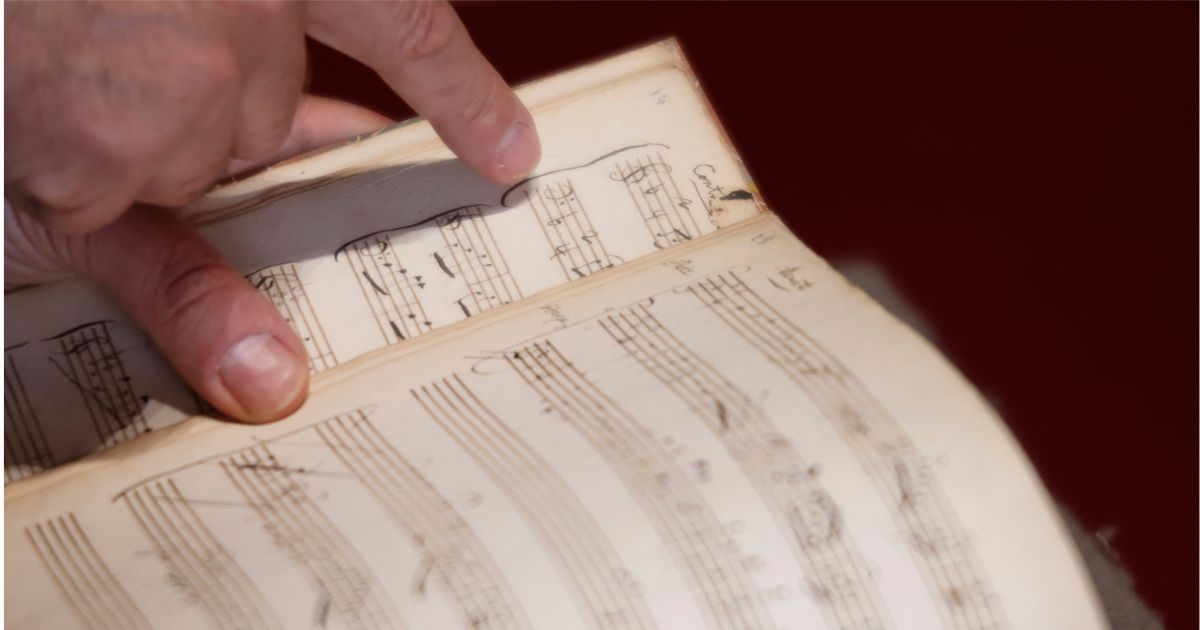
It was the discovery of a lifetime.
In February, François-Pierre Goy, a curator at the National Library of France, was glancing through some old classical music manuscripts when he noticed something distinctive about one of them.
“I couldn’t believe my eyes,” Goy said.
The almost 250-year-old notebook had clearly been used for composition lessons.
“There were two distinct styles of handwriting — a pupil’s and a teacher’s — and the teacher had an unusual way of drawing certain musical signs,” The New York Times reported.
He called in another music expert, then another. Together, they compared the manuscript to other works.
Finally, they confirmed their findings: The notebook had been used by Wolfgang Amadeus Mozart.
While some of the contents of the manuscript had been written by his student, much of it was composed by Mozart himself.
The 44-page notebook dates to 1778, when the 22-year-old Mozart was trying to teach composition to a teenage aristocrat and accomplished harpist, Marie-Louise-Philippine de Bonnières de Guînes, the daughter of Duke Adrien-Louis de Bonnières de Souastre, a renowned flautist.
“Convinced that his daughter was a genius, the duke wanted her to learn how to compose grand sonatas for their two instruments,” according to a statement from the National Library of France.
Alas, Mozart was unimpressed with the young woman, who, he famously complained, “had no ideas at all.”
The find “is one of the most important discoveries in recent decades for two reasons,” Gilles Pécout, president of the National Library of France, said in a statement.
“First, it sheds light on Mozart’s final stay in Paris, and second, it reveals the day-to-day activities of Mozart as a young teacher in dialogue with his pupil.”
It also contains seven never-before-seen compositions for flute and harp.
One of those, “a fast movement lasting about five minutes,” shows extensive corrections by Mozart, so that “roughly three quarters to 80 percent should be by Mozart,” Goy told The New York Times.
Those were performed in public for the first time Sunday in Paris.
[embedded content]
Harpist Nicolas Tulliez, of the Orchestre Philharmonique de Radio France, said the fast movement is the strongest piece of the new discoveries and “is going to definitely become one of our main works.”
Advertise with The Western Journal and reach millions of highly engaged readers, while supporting our work. Advertise Today.