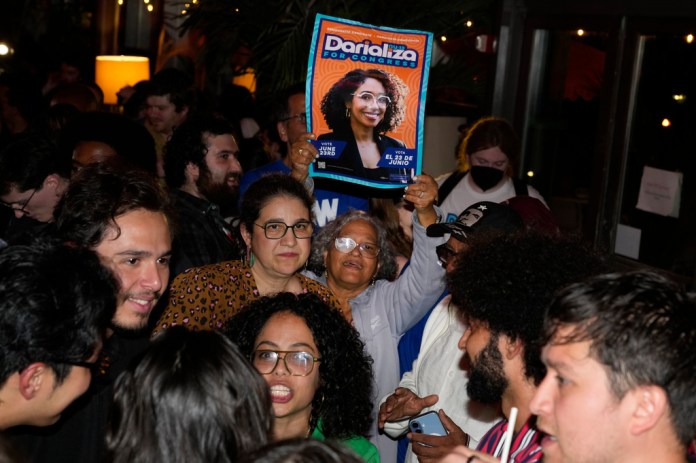
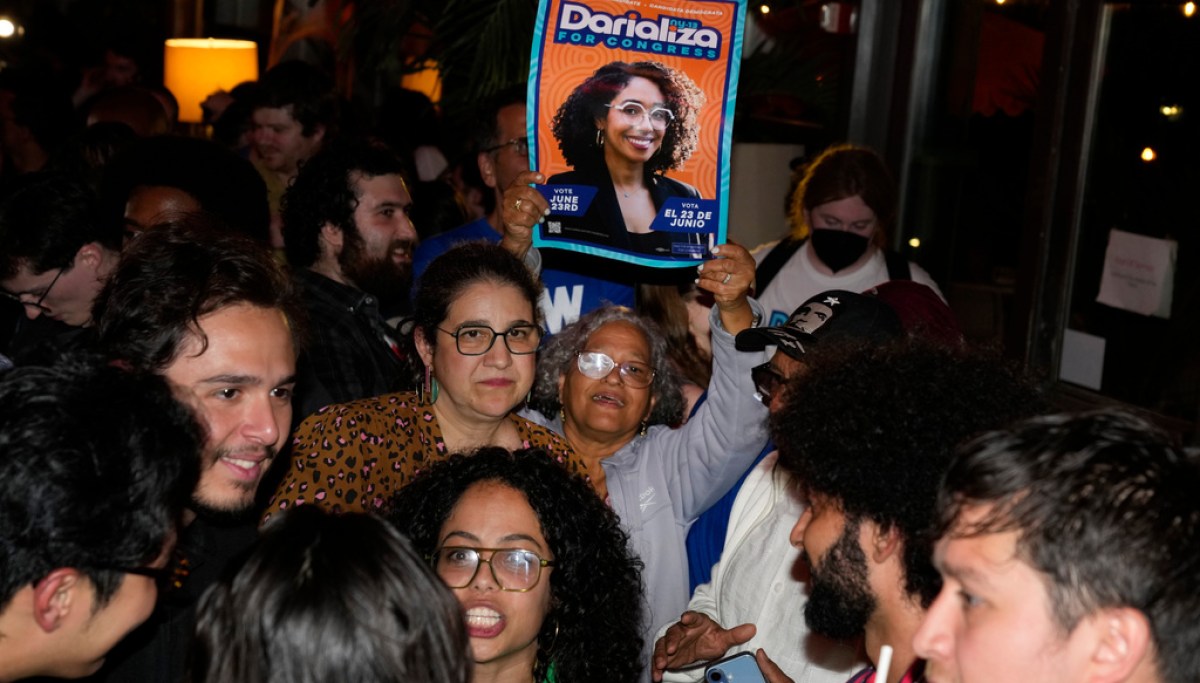
The victories by DSA-backed candidates Darializa Avila Chevalier and Claire Valdez this week reinforced confidence among party activists that democratic socialist candidates can build broader coalitions in Democratic primaries, particularly with younger, black, and Latino voters.
There are already signs that progressive candidates are gaining traction outside New York. In Washington, D.C., Democratic voters recently elected socialist Janeese Lewis George as their next mayor, while in Los Angeles, DSA-backed candidate Nithya Raman advanced to the general election in the city’s mayoral race earlier this month.
More tests follow in August. In Missouri, a local DSA chapter is backing former Rep. Cori Bush as she attempts to reclaim her old House seat. In Michigan, the Metro Detroit DSA chapter is supporting state Rep. Donavan McKinney in his challenge against Rep. Shri Thanedar. In Colorado, the group is backing Melat Kiros in her bid to unseat longtime Rep. Diana DeGette. And in Wisconsin, state Rep. Francesca Hong is running in a crowded Democratic gubernatorial primary in a key presidential battleground.
Stu Smith, an investigative analyst at the conservative Manhattan Institute think tank who closely tracks the DSA, said the organization has built an increasingly effective political operation powered by young activists, online mobilization, and aggressive grassroots organizing.
“They have a good ground game,” Smith said. “They don’t always win, but they are very determined, and they learn from their mistakes.”
Smith argued many Democrats are underestimating the organization’s ability to compete outside New York City, pointing to its younger activist base and digital infrastructure as major advantages.
“Before Bernie [Sanders], the average age was like 68 years old,” he said. “Now, when we talk about DSA, we’re really talking about a youth organization that brings that youth energy with them as well.”
The broader progressive push also extends to Michigan’s high-stakes Senate race, where Abdul El Sayed is competing for the Democratic nomination in a contest the party views as critical to any path back to a Senate majority. While El Sayed is not a socialist candidate, his campaign has emerged as one of the most prominent progressive statewide efforts in the country this cycle.
Another closely watched race is unfolding in South Florida, where socialist candidate Oliver Larkin is challenging Rep. Jared Moskowitz in a newly redrawn battleground district that national Democrats see as essential to holding their House map together.
DSA activists are betting the recent momentum is not just a New York phenomenon, but the start of a larger revolution inside the Democratic Party.
“These victories prove that democratic socialists are building a winning coalition,” NYC-DSA Co-Chair Grace Mausser said in a statement after Tuesday’s wins.
“While the Democratic establishment and MAGA fascists ignore the needs of working people, democratic socialists are speaking to the ever-growing base of voters demanding we end war, abolish ICE, tax the rich, and win universal healthcare.”
The DSA did not respond to the Washington Examiner’s request for comment. The group says it has endorsed roughly 150 candidates this cycle, with 35 either winning primaries or advancing without opposition so far. The group has also claimed victories in local races across Oregon, California, Arizona, Georgia, North Carolina, Pennsylvania, Vermont, Utah, Maryland, and New York. In last year’s off-cycle elections alone, DSA-backed candidates posted 14 victories against nine defeats, according to the organization.
The DSA’s rise has accelerated since Sen. Bernie Sanders’s 2016 presidential campaign and Rep. Alexandria Ocasio-Cortez’s upset 2018 primary victory over longtime New York Democratic Rep. Joe Crowley. In the years since, the group has transformed from a protest movement into a growing political infrastructure operation inside Democratic Party nationwide. Sanders himself celebrated Tuesday’s results as proof that voters are increasingly frustrated with establishment politics.
“Working people” in New York “delivered a powerful message: the era of status quo politics is over,” Sanders said in a statement after the elections.
The Vermont senator expanded on that argument in a social media post, saying progressive victories showed that “ordinary people” could overcome “enormous amounts of money and political influence” by organizing around economic issues, including housing, healthcare, and childcare.
Still, Democratic strategists remain divided over what the movement’s growth actually means for the broader party coalition. Matt McDermott, a Democratic pollster and senior vice president at Whitman Insight Strategies, argued that many voters are less motivated by ideology than by frustration with the economy and dissatisfaction with President Donald Trump.
“What I think we’re seeing is a reflection of the fact that this is a very diverse party,” McDermott said.
McDermott added that Democratic voters are searching for candidates they believe will aggressively confront Trump and economic anxiety, rather than necessarily embracing socialism itself.
“They’re hoping and praying that there’s a Democratic Party that’s going to be able to stand up, fight back against the corruption of the Trump administration, and actually focus the full force of government on getting the economy working for everyday people again,” he said.
Other Democratic operatives warned the party could face risks if it becomes too closely tied to the DSA brand nationally. Democratic strategist Jon Reinish argued the movement’s politics may resonate in deep-blue districts but could become a liability in more moderate battleground areas.
“Yes, times 100,000 million billion trillion percent,” Reinish said when asked whether Democrats risk political backlash if the party becomes too closely associated with socialism. “Radicalism is not mainstream. Most people are not radicalized.”
Republicans, meanwhile, have eagerly seized on the leftward shift inside Democratic primaries, arguing the party is increasingly being shaped by its progressive flank after GOP candidates faced their own struggles with controversial nominees during the 2022 midterm elections.
“Tuesday was the night the Democrat establishment officially surrendered to Zohran Mamdani and the socialist wing of their party,” National Republican Congressional Committee spokesman Mike Marinella said in a statement.
“Every House Democrat, in safe and competitive districts alike, will now answer to the radicals calling the shots,” Marinella said. “And Americans should be terrified by where the Democrat Party is headed.”
The DSA is already preparing for its next phase. According to reporting from Politico, the group plans to survey all 250 local chapters this summer to identify future candidates and shape the organization’s long-term political strategy ahead of 2028. Chapters are expected to submit recommendations to national leadership by Sept. 15.
Another key inflection point, according to Smith, could come in 2027 when the organization is expected to hold its next national convention and possibly reshuffle leadership inside its National Political Committee. Smith said an internal divide is emerging between members primarily focused on winning elections and more ideological factions pushing a broader activist movement centered on anti-ICE organizing and “community defense” efforts.
“A lot of the language that made it into the new national platform comes from this wing of the DSA,” Smith said, pointing to caucuses including Red Star, Springs of Revolution, and Marxist Unity Group.
HOW DEMOCRATIC SOCIALISTS OF AMERICA ARE RESHAPING THE DEMOCRATIC PARTY FROM THE INSIDE
The outcome of those internal battles could shape whether the organization continues prioritizing electoral politics or shifts toward a more confrontational activist approach heading into 2028.
“Their theory of change is that, hey, we can win elections and implement socialism, while the other people believe you have to have a revolution and then you can implement socialism,” Smith said. “That is a major difference.”