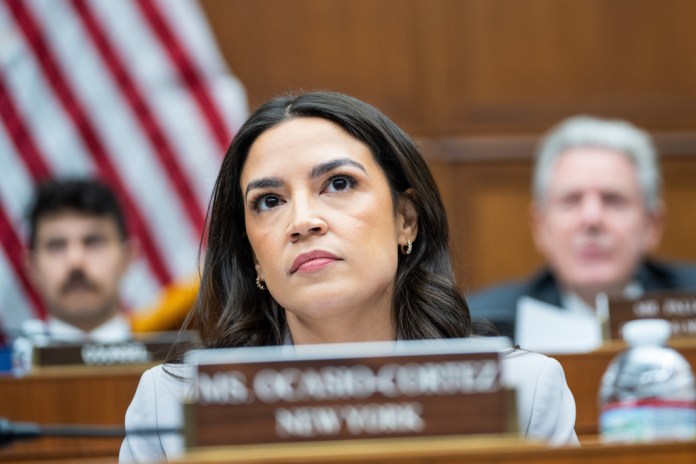
The Democratic Socialists of America‘s shocking wins in New York‘s primaries not only solidified its growing power among the Democratic base but also fueled speculation that Rep. Alexandria Ocasio-Cortez (D-NY) could mount a successful run for higher office.
Two DSA-aligned candidates, backed by New York City Mayor Zohran Mamdani, took down incumbent Democrats Tuesday night in a similar manner to Ocasio-Cortez’s defeat of 10-term incumbent Joe Crowley during the 2018 midterm elections.
Darializa Avila Chevalier defeated Rep. Adriano Espaillat (D-NY), the chairman of the Congressional Hispanic Caucus, and former New York City Comptroller Brad Lander defeated incumbent Rep. Dan Goldman (D-NY). State Assemblywoman Claire Valdez also defeated Rep. Nydia Velazquez’s (D-NY) preferred successor, Brooklyn Borough President Antonio Reynoso.
The primaries immediately put the Democratic establishment on notice that DSA members, of which Ocasio-Cortez is included, are no longer waiting their turn for power and can successfully oust senior Democrats. Topping the list of outstanding questions after the DSA sweep is Ocasio-Cortez’s own future.
Ocasio-Cortez could mount a challenge against Senate Minority Leader Chuck Schumer (D-NY) in 2028, or, given her popularity and ability to fundraise, she could launch a 2028 presidential campaign.
“AOC has a massive platform already and all eyes are on her,” said Kaivan Shroff, a political communications expert who worked on Hillary Clinton’s 2016 presidential campaign. “She doesn’t need the Senate, and it would be a waste of her momentum and also missing the moment to not run for president.”
The New York lawmaker has made several moves in recent months hinting at a 2028 run. In February, she made her international debut at the Munich Security Conference, although the event was not without some missteps. Back stateside, Ocasio-Cortez went on a nationwide “Fighting Oligarchy” tour with Sen. Bernie Sanders (I-VT) last year, attracting huge crowds of Democrats. Ocasio-Cortez also attended Martin Luther King Jr.’s home church in Atlanta, Ebenezer Baptist, at the invitation of Sen. Raphael Warnock (D-GA).
Despite coming into office as an insurgent “Squad” member, Ocasio-Cortez has also shown that she can work with the establishment by fundraising for party members, hitting the campaign trail for candidates, and not endorsing primary challengers to incumbent Democrats.
“She’s established a prominent record already, and is one of the most visible Democrats in Congress that we have,” said Heath Brown, an associate professor at the John Jay College of Criminal Justice at CUNY and expert on presidential transitions. “I think it’s for that reason that the possibility of her running for another office is very strong. I think the very recent electoral outcomes only support her case that another office is a strong possibility.”
After former President Joe Biden’s disastrous 2024 campaign and former Vice President Kamala Harris’s loss to President Donald Trump, the Democratic Party has been at odds over the direction of the party.
It has also been largely leaderless since Biden has decamped for Delaware to write a memoir and Harris hasn’t taken an active role in the 2026 midterm elections. Sanders, who is endorsing candidates this cycle, has ruled himself out of contention for a 2028 White House bid.
In that vacuum, the DSA has risen to prominence. The socialist group has won at least 30 primaries this year, including the high-profile wins in New York and Janeese Lewis George’s victory in Washington, D.C.’s Democratic mayoral primary. The DSA’s success in New York City, in particular, might make a challenge to Schumer all the more attractive.
The Senate minority leader is also widely unpopular among Democrats. RealClearPolitics’s composite of polls shows Schumer at a 49.4% unfavorable rating and a 25.1% favorable rating.
But strategists warn Ocasio-Cortez’s path to higher office won’t be easy just because she’s popular and nationally known.
Running a statewide campaign is completely different from running in a “super blue, super, super progressive district,” said Jon Reinish, a New York-based Democratic strategist.
“Statewide primaries tend to be very high awareness,” Reinish added. “You also have to win voters, not just in the most left-leaning precincts and districts. She would have to compete in the suburbs, she would have to compete outside New York City. Can she do that? That is something that I would really be looking at.”
While most strategists told the Washington Examiner that Ocasio-Cortez is a tactical lawmaker when it comes to coalition building and endorsements, her perception as an outsider has waned. Ocasio-Cortez did not endorse against New York lawmakers in the primaries and likely didn’t weigh in on the race to succeed Velazquez due to their mentor-mentee relationship.
“AOC has straddled the establishment and progressive lane artfully, but this new DSA takeover, at least in NYC, is totally unfocused and unruly,” said Shroff. “You can already look online to see leftists bashing her for being ‘establishment’ or not supporting figures like Graham Platner to the extent the Bernie bros want.”
Sathvik Kaliyur, a Democratic strategist who has worked with New York lawmakers, cautioned that Ocasio-Cortez would likely shore up as much support as possible before launching a campaign for higher office.
“If AOC decides to run for president, I think there are a few things that if she were strategic, she would make sure she had going into it,” Kaliyur said. “And I think one of those things is the support of Bernie. Another one of those things would be the support of the big left-wing groups like the [Working Families Party], like DSA.”
NO HEIR APPARENT: PROGRESSIVES SPLIT OVER WHO CARRIES BERNIE SANDERS’S TORCH IN 2028
And if the New York lawmaker decides to take on Schumer, she would prevail, Kaliyur added.
“His days are numbered, DSA or no DSA, and obviously I think that helps a lot,” he said. “I don’t think he could win a primary in a modern-day Democratic electorate, especially because I think if AOC were to run, she has a bunch of money now … and I think she’s built coalitions in the mainstream Left, as well as the DSA Left, and I think she would build a broad enough base that it wouldn’t be particularly close.”