Ukraine‘s long-range drone campaign targeting Russia‘s energy infrastructure has delivered Kyiv some of its first tangible victories in years, but Russian resilience and adaptation have prevented it from being a true game changer.
Western and Ukrainian strategists have long viewed Russia’s oil industry as the key driver of its war machine, and likewise its Achilles’ heel. With U.S. and Western intelligence support, Ukraine dramatically escalated its drone and missile campaign in 2025, a sustained campaign that has extended into 2026. Its most dramatic attack occurred last week, when hundreds of drones overwhelmed Moscow’s air defenses and hit refineries and storage tanks, sending up black plumes of smoke that darkened the sky.
The shocking images of flames and smoke rising above Moscow, combined with constant news and images of new strikes for nearly a year, have sparked hopes among allies that the war has reached a turning point in Ukraine’s favor. However, experts caution the situation isn’t so simple, and while Ukraine has inflicted tangible damage, Russian resilience and logistical limitations mean the campaign has yet to pass into decisive territory.
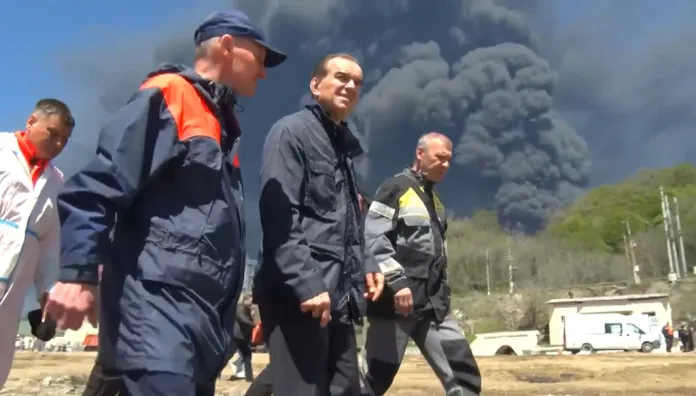
FILE – In this image taken from a video released by Gov. Veniamin Kondratyev’s Telegram channel, Kondratyev, 2nd right, inspects the aftermath of a drone attack on the oil refinery and terminal in Tuapse, Russia, on Wednesday, April 29, 2026. (Gov. Veniamin Kondratyev Telegram channel via AP, File)
” data-large-file=”https://conservativenewsbriefing.com/wp-content/uploads/2026/06/ukraines-drone-campaign-against-russias-energy-infrastructure-takes-a-toll-but-falls-short-of-a-game-changer.webp” src=”https://conservativenewsbriefing.com/wp-content/uploads/2026/06/ukraines-drone-campaign-against-russias-energy-infrastructure-takes-a-toll-but-falls-short-of-a-game-changer.webp” alt=”Russia oil” class=”wp-image-4627544″ srcset=”https://conservativenewsbriefing.com/wp-content/uploads/2026/06/ukraines-drone-campaign-against-russias-energy-infrastructure-takes-a-toll-but-falls-short-of-a-game-changer-3.webp 1024w, https://conservativenewsbriefing.com/wp-content/uploads/2026/06/ukraines-drone-campaign-against-russias-energy-infrastructure-takes-a-toll-but-falls-short-of-a-game-changer-3.webp?resize=300,171 300w, https://conservativenewsbriefing.com/wp-content/uploads/2026/06/ukraines-drone-campaign-against-russias-energy-infrastructure-takes-a-toll-but-falls-short-of-a-game-changer-3.webp?resize=768,437 768w, https://conservativenewsbriefing.com/wp-content/uploads/2026/06/ukraines-drone-campaign-against-russias-energy-infrastructure-takes-a-toll-but-falls-short-of-a-game-changer-3.webp?resize=150,85 150w, https://conservativenewsbriefing.com/wp-content/uploads/2026/06/ukraines-drone-campaign-against-russias-energy-infrastructure-takes-a-toll-but-falls-short-of-a-game-changer-3.webp?resize=696,396 696w” sizes=”(max-width: 1024px) 100vw, 1024px”>
Ukraine’s strategic drone campaign
Ukraine has faced unrelenting Russian missile and drone attacks against key strategic targets in its major cities since the first day of the war, an air campaign that continues to reach new heights. Before the focus on drones, Moscow was able to hit anywhere in Ukraine using ballistic and cruise missiles, launched from its Black Sea Fleet, heavy strategic bombers, and ground-based launchers. Ukraine lacked these capabilities, preventing any comparable response for the first 2 1/2 years of the war.
The turning point came in late 2024, when the Ukraine-based company Fire Point introduced its FP-1 long-range kamikaze drone, a relatively cheap aircraft with a range of nearly 1,000 miles, allowing it to hit most of Russia’s major cities, including Moscow. August of last year saw a massive increase in strikes, a pattern that has largely continued to the present day.
Sources vary on the exact number of strikes on energy infrastructure, but George Voloshin, a Paris-based Russia and energy analyst, pointed to data suggesting over 150 successful long-range strikes against Russian oil infrastructure across all of 2025, amounting to about 13 to 17 successful strikes per month. This year has seen a notable uptick, with nearly 70 strikes against Russian energy assets across the first five months of 2026, including 21 in April. The attacks have become more advanced as well, both in terms of targets and tactics.
“The nature of these attacks has also evolved from targeting low-value storage tanks to deploying synchronized drone swarms that deliberately overwhelm regional air defenses,” he told the Washington Examiner, pointing to the Moscow refinery attacks. “Vulnerable offshore maritime export terminals have further come under repeated attack, in a break from more timid and less focused targeting during 2025.”
Ukraine’s incorporation of artificial intelligence into its drone operations has been a major factor in the increased effectiveness of the campaign. Through its partnership with Palantir, Ukraine uses the company’s PRISMA system in the operation planning stage of the attacks, optimizing the best flight routes to exploit radar and air defense blind spots and weaknesses.
The toll
Yevgeny Borovikov, deputy CEO of insurance broker Mains, told the Kommersant business daily that Russian oil companies suffered over $13 billion in total losses from Ukrainian drone attacks in 2025. Direct damage amounted to $1.29 billion, while the remainder of losses came from lost profits and indirect losses. At the current rate, losses in 2026 are set to be even worse.
The patterns of strikes indicate Kyiv has found targeting Russia’s oil refineries to be the most effective. Since March, Ukraine has launched over two dozen strikes against Russian oil refineries, including eight of its ten biggest.
Sergey Vakulenko, the head of strategy and innovations at Gazprom Neft from December 2011 to the beginning of Russia’s invasion of Ukraine, and current senior fellow at the Carnegie Russia Eurasia Center, wrote that Russia’s daily refined oil output fell by up to 700,000 barrels per day across April and May. That amounts to a 13% decline from 5.2 million barrels per day at the end of March.
Sunset lights the sky over a Moscow district in Moscow, Russia, Monday, June 22, 2026. (AP Photo/Alexander Zemlianichenko)
” data-large-file=”https://conservativenewsbriefing.com/wp-content/uploads/2026/06/ukraines-drone-campaign-against-russias-energy-infrastructure-takes-a-toll-but-falls-short-of-a-game-changer-1.webp” src=”https://conservativenewsbriefing.com/wp-content/uploads/2026/06/ukraines-drone-campaign-against-russias-energy-infrastructure-takes-a-toll-but-falls-short-of-a-game-changer-1.webp” alt=”Moscow” class=”wp-image-4627546″ srcset=”https://conservativenewsbriefing.com/wp-content/uploads/2026/06/ukraines-drone-campaign-against-russias-energy-infrastructure-takes-a-toll-but-falls-short-of-a-game-changer-3.jpg 1024w, https://conservativenewsbriefing.com/wp-content/uploads/2026/06/ukraines-drone-campaign-against-russias-energy-infrastructure-takes-a-toll-but-falls-short-of-a-game-changer-3.jpg?resize=300,200 300w, https://conservativenewsbriefing.com/wp-content/uploads/2026/06/ukraines-drone-campaign-against-russias-energy-infrastructure-takes-a-toll-but-falls-short-of-a-game-changer-3.jpg?resize=768,512 768w, https://conservativenewsbriefing.com/wp-content/uploads/2026/06/ukraines-drone-campaign-against-russias-energy-infrastructure-takes-a-toll-but-falls-short-of-a-game-changer-3.jpg?resize=150,100 150w, https://conservativenewsbriefing.com/wp-content/uploads/2026/06/ukraines-drone-campaign-against-russias-energy-infrastructure-takes-a-toll-but-falls-short-of-a-game-changer-3.jpg?resize=696,464 696w” sizes=”(max-width: 1024px) 100vw, 1024px”>
However, Russia’s skill in repairs has allowed it to continually recover from the worst damage to its refining capacity. Vakulenko noted that the current trend has Russia’s oil refinery throughput “fluctuating wildly.” At the end of May, Russian oil production briefly dropped to below 4 million barrels per day, before surging back to over 4.5 million barrels per day at the beginning of June. The mid-June strikes on Moscow’s Kapotnya refinery and Tatneft’s TANECO refinery knocked out 600,000 barrels per day in throughput.
Just because Russia can bounce back, however, doesn’t mean the Ukraine strikes aren’t costly. Russia’s brief dip below 4 million barrels per day in late May represented its lowest refining throughput since 2005. Overall, nearly a quarter of Russia’s total oil refining capacity has been knocked offline by Ukraine at some point in the past year.
One major boost to the strike campaign has been the quality of damage. Vakulenko pointed out that damage to refineries’ primary processing units is relatively easy to repair, but damage to units that break down oil components and make them into gasoline, jet fuel, and diesel is far more difficult to repair due to the need to import replacement parts.
Damage from the campaign has been felt most acutely in Crimea, the four regions Russia occupies in Ukraine, the areas that border Ukraine, and, perhaps most notably, Moscow. Kyiv has focused many of its attacks on refineries and storage facilities supplying gas to Moscow’s residents, likely looking to impose as big of a cost on Russia’s most influential and well-off populace.
Russian resilience: Moscow’s response and adaptation
While dealing real damage, Moscow’s ability to adapt has prevented Ukraine’s drone campaign from dealing the decisive blow Kyiv’s allies had hoped. Dr. Tatiana Mitrova, a global fellow at Columbia University’s Center on Global Energy Policy, argued Russia’s ability to adapt has offset many of the losses.
“The sector has not collapsed, and part of the impact has been absorbed by shifting barrels from domestic refining into crude exports (actually, last week Russian seaborne crude exports were at the highest level since the beginning of the year). So I would describe this less as a knockout blow and more as a campaign of sustained degradation,” Mitrova, who has spent over 25 years analyzing Russian energy markets, told the Washington Examiner.
The heavy damage to Russia’s refining capacity has driven many of the most visible changes, including bans on gasoline and jet fuel exports. Isaac Levi, Europe-Russia policy and energy analysis team lead at the Centre for Research on Energy and Clean Air, said Russia has been able to offset some of the damage through importing fuel to particularly affected areas, a response he ranks alongside its repairs to refineries and bolstering air defenses in importance.
“It has adapted, but at a growing economic and logistical cost. Russia’s crude oil exports have risen as they have been unable to refine as much oil due to the effective Ukrainian drone strikes,” he told the Washington Examiner.
Much of Russia’s economic efforts have focused on limiting the short-term impacts, though at the expense of raising long-term costs, Mitrova argued.
“More broadly, Russia’s economic response has been administrative: export restrictions, more controls, more manual redistribution, regulatory adjustments (like lowering fuel standards), more effort to contain local shortages and keep the system functioning. That limits the immediate visible impact, but obviously it also raises the long-term cost of resilience,” she said.
The closing of the Strait of Hormuz due to the U.S.-Israel war with Iran also sent oil prices skyrocketing, a blessing for Russia’s energy revenue.
To keep its energy trade revenue incoming, Russia has shifted its exports to crude oil. Its crude exports have shifted to the highest since the war began, reaching over 3.46 million barrels per day. Russia’s ability to export the crude it can’t refine due to refinery damage means it still generates significant revenue from its oil, though not as much. At current prices, crude runs for around 75%-80% of refined oil value.
Ukrainian strikes on Russian oil export infrastructure, some of its primary targets in the opening of 2026, have also been some of the least effective of the entire drone campaign, with Russia able to quickly repair the damage. Vakulenko described the results as “generally unimpressive.”
“While they did destroy oil awaiting shipment, impose financial costs, and generate spectacular images, the damage was not long-lasting,” he wrote of strikes against the Baltic port of Ust-Luga, which halted shipments for two weeks.
Russian military adaptation
While Russia manages the impact of the Ukrainian drones that hit their mark, more important are measures Moscow has taken to ensure as few drones hit their mark as possible. Moscow has similarly shown a remarkable ability to adapt in this military defense sphere as well.
Servicemen of the Presidential Regiment attend a ceremony to present the Order of Zhukov to the Presidential Regiment of the Russian Federal Guard Service at the Kremlin’s St. George Hall in Moscow, Tuesday, June 23, 2026. (Mikhail Metzel/Sputnik, Kremlin Pool Photo via AP)
” data-large-file=”https://conservativenewsbriefing.com/wp-content/uploads/2026/06/ukraines-drone-campaign-against-russias-energy-infrastructure-takes-a-toll-but-falls-short-of-a-game-changer-2.webp” src=”https://conservativenewsbriefing.com/wp-content/uploads/2026/06/ukraines-drone-campaign-against-russias-energy-infrastructure-takes-a-toll-but-falls-short-of-a-game-changer-2.webp” alt=”Russia military” class=”wp-image-4627545″ srcset=”https://conservativenewsbriefing.com/wp-content/uploads/2026/06/ukraines-drone-campaign-against-russias-energy-infrastructure-takes-a-toll-but-falls-short-of-a-game-changer-7.jpg 1024w, https://conservativenewsbriefing.com/wp-content/uploads/2026/06/ukraines-drone-campaign-against-russias-energy-infrastructure-takes-a-toll-but-falls-short-of-a-game-changer-7.jpg?resize=300,200 300w, https://conservativenewsbriefing.com/wp-content/uploads/2026/06/ukraines-drone-campaign-against-russias-energy-infrastructure-takes-a-toll-but-falls-short-of-a-game-changer-7.jpg?resize=768,512 768w, https://conservativenewsbriefing.com/wp-content/uploads/2026/06/ukraines-drone-campaign-against-russias-energy-infrastructure-takes-a-toll-but-falls-short-of-a-game-changer-7.jpg?resize=150,100 150w, https://conservativenewsbriefing.com/wp-content/uploads/2026/06/ukraines-drone-campaign-against-russias-energy-infrastructure-takes-a-toll-but-falls-short-of-a-game-changer-7.jpg?resize=696,464 696w” sizes=”(max-width: 1024px) 100vw, 1024px”>
Peter Korotaev, an independent Ukrainian journalist who has written extensively about the drone dimension of the war in his Events in Ukraine Substack, argued the sustained drone attacks have actually made Russian air defenses stronger over time.
“Air defenses are something that only develop through practice and exposure to threats,” he told the Washington Examiner. “Russian air defenses haven’t faced the threats Ukraine has for years, so Russia’s system lacks some important elements, such as a wide-ranging radar system and mobile air defense groups around cities and at the border areas. But that isn’t so hard to set up and will happen due to the exigencies.”
Numbers bear this out. Ukraine’s first meaningful drone launches appeared to take Russia by complete surprise. Fire Point CEO Iryna Terekh revealed at a June 16 conference panel at the Eurosatory trade show that the FP-1’s success rate when it was first launched in late 2024 was around 70%.
“Right now the number is 10%,” she said. “So it’s a little bit of a rat race that we are having with our enemy, and there is no way to really go out of this race, but you can be a little bit smarter.”
Ukraine’s energy infrastructure strike campaign involves swarms of hundreds of drones at a time, compared to the handful it was able to send in the first strikes. This shows a major improvement in Russia’s ability to intercept, shooting down over 90% of much larger groups.
Russia’s major improvements in its air defenses against drone attacks aren’t entirely due to the improved quality of the system, however. Moscow has had to move air defenses away from the front line to cover strategic targets across the country — a far larger geographic area than Ukraine has to cover.
“Russia has attempted to strengthen air defenses around key energy infrastructure, dispersed some military assets, and devoted more resources to protecting the rear. These adaptations haven’t eliminated the threat, but they do show the strikes have had a meaningful operational impact,” Levi said.
The need to shift military resources away from the front to protect other areas is the most tangible way in which Ukraine’s drone campaign has changed Moscow’s military calculus, one of the biggest successes of the strategy.
Game changer, annoyance, or something in between?
While Ukraine’s strike campaign has begun to inflict serious damage on the Russian economy, it still falls short of being truly decisive. Russia’s ability to repair faster than Ukraine can destroy, improvements in its air defenses, economic interventions, and Moscow’s overall resilience have kept the drone campaign manageable.
Mitrova and Levi both had similar views, painting the campaign as inflicting real damage against Russia, but warning against its portrayal as a turning point in the war.
“Ukrainian strikes have become far more efficient and consequential over the past year, but I would still stop short of calling them a full ‘game changer,’” Mitrova said. “Their main effect has been cumulative: They are making Russia’s oil system less flexible, less efficient, and more expensive to stabilize, especially where repeated attacks hit more complex refinery and export infrastructure.”
“Ukraine’s strikes have imposed real costs on Russia’s energy sector and forced Moscow to divert resources to defending critical infrastructure. They’re not a stand-alone game changer, but they’ve meaningfully complicated Russia’s war effort and demonstrated Ukraine’s growing long-range strike capability. In some Russian regions, gasoline prices have doubled, while the hardest-hit areas are facing acute fuel shortages,” Levi said.
BELEAGUERED HEZBOLLAH USING RESPITE FROM CEASEFIRE TO REARM AND RECONSTITUTE: EXPERTS
Korotaev downplayed its significance using simpler logic, comparing it with Russia’s far more damaging strategic air and missile campaign against Ukraine.
“If the same thing but much worse against Ukraine (total blackouts for millions last winter) hasn’t crippled Ukraine, it won’t happen to Russia,” he said.