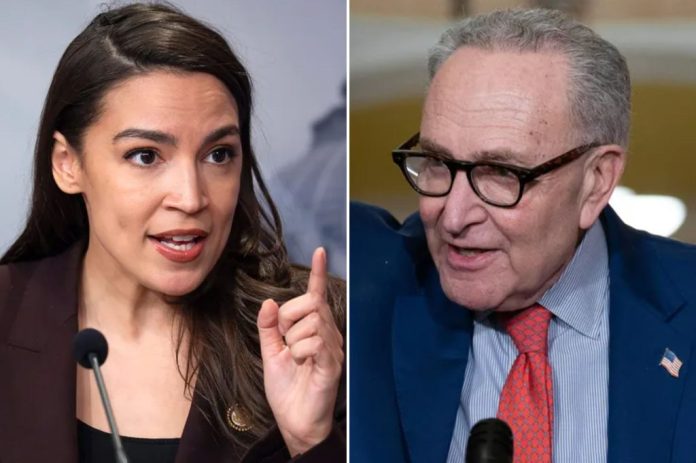
Rep. Alexandria Ocasio-Cortez (D-NY) is turning Michigan‘s Senate race into a proxy fight with Senate Minority Leader Chuck Schumer (D-NY), placing herself directly at odds with his preferred candidate in a primary that has implications for the future of New York and national politics.
On Thursday, Ocasio-Cortez waded into her first contested Senate race of the 2026 cycle, endorsing public health official Abdul El-Sayed over the Schumer-backed Haley Stevens (D-MI), a four-term congresswoman.
The race is a test of whether a socialist wave that swept New York last month can translate to Michigan primary voters. El-Sayed, though not a member of the Democratic Socialists of America, embraces the same brand of anti-establishment progressivism that helped them unseat two House incumbents, and he is neck and neck with Stevens, a relative centrist, ahead of the Aug. 4 primary.
For Ocasio-Cortez and Schumer, the race will be interpreted through the lens of their relative influence as Democratic Party power brokers. Ocasio-Cortez is thought to be considering a run for president in 2028 and has previously been encouraged to challenge Schumer when he is up for reelection.
A loss by Stevens would hand Schumer another black mark after his preferred Senate candidate in Maine, Gov. Janet Mills (D-ME), floundered against scandal-plagued oyster farmer Graham Platner. And it could put Michigan further in play for Republicans who are viewing El-Sayed as an easier general election matchup.
There is a third Senate candidate competing for the Democratic nomination in Michigan, state Sen. Mallory McMorrow, but she is polling in the single digits with primary voters.
Ocasio-Cortez downplayed the split screen with Schumer in announcing her endorsement of El-Sayed to the New York Times, arguing “it’s natural to not be in agreement 100% of the time on 100% of decisions.”
Still, Ocasio-Cortez’s supporters see the primary in starkly ideological terms. She’s no longer the upstart bartender who famously unseated a member of House leadership in 2018. That insurgent mantle has since shifted to socialist New York City Mayor Zohran Mamdani, who shocked the political establishment last year with his defeat of former Gov. Andrew Cuomo.
Ocasio-Cortez, 36, is nonetheless a progressive icon, in New York and nationally, and her youth makes her a natural foil to the 75-year-old Schumer, a pragmatist serving his fifth term in the Senate.
“It sort of makes the race a real contest for the future of the Democratic Party,” said Grace Mausser, a co-chair of the Democratic Socialists of America’s New York City chapter.
SCHUMER’S GRIP ON NEW YORK LOOSENS UNDER TRUMP 2.0
In general, Ocasio-Cortez has been cautious with her endorsement strategy and, with a handful of exceptions, has stayed away from getting on the wrong side of Democratic leadership in Washington.
She declined to back the DSA challengers who won in New York, endorsements that would have put her at odds with her own House colleagues. Ocasio-Cortez has also tended to wait longer before issuing an endorsement.
Her support in Michigan comes a full year after Sen. Bernie Sanders (I-VT) backed El-Sayed. Rep. Ro Khanna (D-CA), another expected contender for president, also endorsed El-Sayed early in the race and was campaigning with him this past week.
The delay has opened Ocasio-Cortez up to the criticism that she’s protecting her endorsement record, and rather than steering her party is waiting until polling gives a clearer picture of a given race.
Lately, El-Sayed has been considered the front-runner, with polling showing him about 5 points ahead of Stevens.
“Three months ago, this is a bold look,” said Lincoln Mitchell, a New York-based political pundit and lecturer at Columbia University. “Now, it feels like jumping on the bandwagon almost.”
Ocasio-Cortez’s defenders argue her caution is a sign she’s “serious about governing.”
“That often means making compromises and being respectful and cordial with your colleagues in the body that you serve,” Mausser said.
The Michigan race is not the first time Ocasio-Cortez has clashed with Schumer. She drew headlines last year for chastising his vote to avoid a government shutdown at the outset of the Trump administration.
But it does mark a departure for her on the campaign trail, and the primary is the first contested Senate race in which she’s decided to get involved.
Ocasio-Cortez notably sidestepped Platner’s candidacy in Maine even as other progressives defended him from the controversy surrounding his infidelity and old social media posts. In House races, she’s endorsed successful candidates in California, Pennsylvania, and beyond.
The friction between Ocasio-Cortez and Schumer has kicked up speculation over whether she will challenge him for Senate in 2028, assuming Schumer runs for another term. The left-wing group Data for Progress released a poll after Ocasio-Cortez’s government funding criticism showing her ahead by double digits in a hypothetical primary.
But some in the DSA would prefer to see Ocasio-Cortez run for president instead, arguing there’s a lane for a socialist in a crowded presidential field and that the organization has a deep enough bench in state and local politics to mount a serious challenge against Schumer.
Chi Osse, a New York City councilman, notably considered challenging Schumer’s House counterpart, Minority Leader Hakeem Jeffries (D-NY), last year but ended his campaign at the urging of Mamdani.
When asked about Schumer’s staying power in New York politics, Mausser complimented him as an “excellent retail politician” and said he, to this day, maintains a ubiquitous presence in the state.
“It feels like he’s everywhere at once,” she said, before criticizing his inability to stop Donald Trump from becoming president in 2024.
“People are mad,” she added. “They’re mad that Democrats and Democratic leaders have failed, and I think that will continue to be an issue for him if he chooses to seek reelection.”
MASSIE REVIVES DEMOCRATS’ FIGHT OVER ISRAEL WITH HOUSE VOTE ENDING US MILITARY AID
In Michigan, El-Sayed has used Schumer’s involvement in the primary to cast himself as an outsider taking on the political establishment and has suggested he would not back him as Senate Democratic leader if elected in November.
Stevens, for her part, has generally sidestepped questions about her view of Schumer, but called him a “great leader” before entering the Senate race.