A record-breaking 49,000 broke into Ceuta in just one day on Thursday as the authorities focus on facilitating, not preventing, the crisis.
The post Ceuta ‘Invasion’: 49,000+ Illegals Swim to Spanish Territory in 24 Hours as Powerless Police, Army Look On appeared first on Breitbart.
Tens of thousands of illegals have landed on Spanish soil this week, with a record-breaking 49,000 arriving in the city of Ceuta just one day on Thursday, but locals have clashed with the new arrivals as the authorities focus on facilitating, not preventing, the crisis.
While estimates remain uncertain as border control totally collapsed, the number of migrants thought to have taken advantage of a Spanish Supreme Court ruling that prevents police from opposing anyone entering Spain by sea soared over the course of Thursday from a couple of thousand, to 20,000 by evening, and then on to 50,000. The city government went further to estimate 60,000, but this was challenged by the Ministry of the Interior.
At the time of publication, 34 people are known to have died so far.
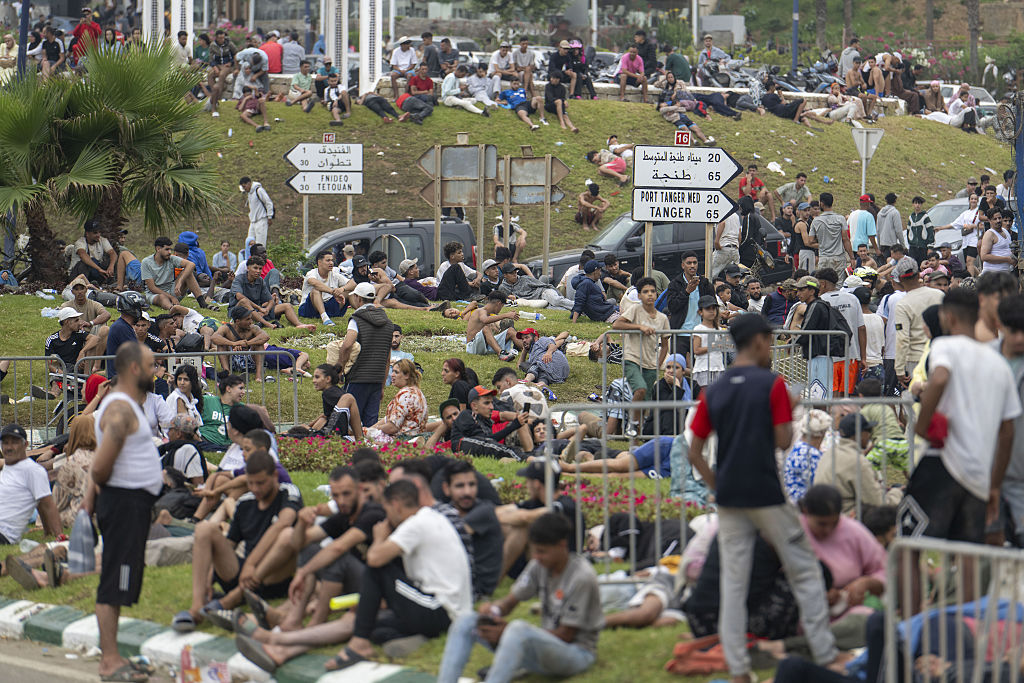
FNIDEQ, MOROCCO – JULY 31: Moroccan security forces deploy near the northern city of Fnideq as thousands of irregular migrants attempt to reach the Spanish-administered territory, on July 31, 2026 in Fnideq, Morocco. (Photo by Abu Adem Muhammed/Anadolu via Getty Images)
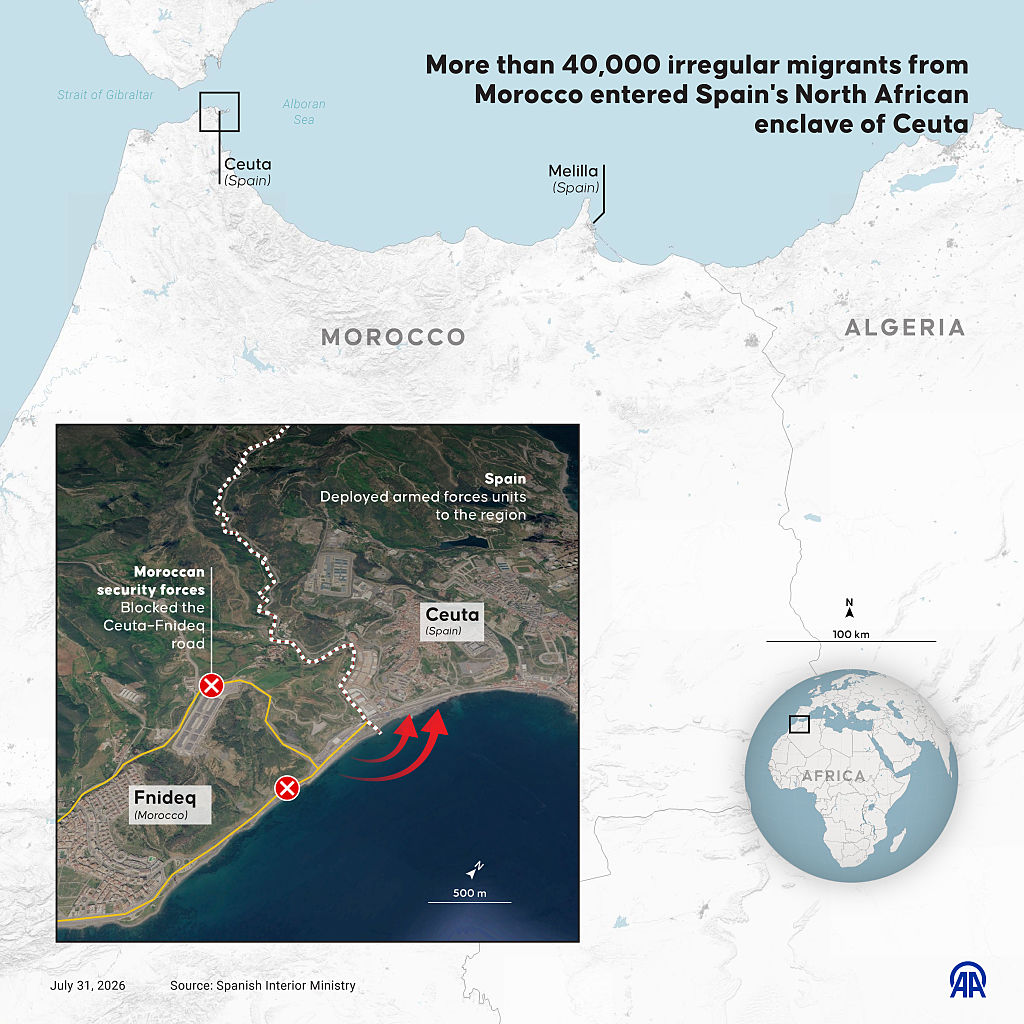
ANKARA, TURKIYE – JULY 31: An infographic titled “More than 40,000 irregular migrants from Morocco entered Spain’s North African enclave of Ceuta” created in Ankara, Turkiye on July 31, 2026. (Photo by Yasin Demirci/Anadolu via Getty Images)
Regardless, 49,000 in 24 hours sets the record for most migrants in a single day having broken into Ceuta, the Spanish territorial exclave in North Africa which is surrounded by Morocco on one side and the Mediterranean on the other, since the migrant crisis began over a decade ago.
The local Ceuta administration demanded Madrid act, declare a state of emergency, and deploy the army but it took until Thursday afternoon for any action. Even when the army was turned out of its barracks and a column of armoured vehicles rushed to the porous border, the troops were not there to enforce border controls — which remains illegal after the Supreme Court ruling — and merely attempted to bolster the civil forces there to welcome and manage the arriving flow.
Indeed, even after the army arrived, the migrant flow continued and Spanish media reports the border remains porous this morning.
Given the normal population of the Spanish city of Ceuta is just 80,000, the scale of arrivals is considerable, and the 500-man migrant arrival processing centre was already totally overwhelmed by the drumbeat of illegal border crossings in the earlier part of the week, long before the surge. Consequently the city has been plunged into a state of disorder, with tens of thousands sleeping in the open air and unable to access drinking water, food, and toilet facilities, and there were chaotic scenes as state control failed.
Spanish newspaper El Pais states that in at least some cases locals resolved to protect themselves even if the police and army wouldn’t, and many shops and cafes are outright refusing to serve outsiders, only residents, denying the illegals the chance to buy food or water. The paper further notes claims that in some areas locals physically clashed with migrants, pelting them with stones and threatening them with guns to deter them from some neighbourhoods.
CEUTA, SPAIN – JULY 31: Migrants arrive on the shore of the Spanish city of Ceuta in North Africa after attempting to swim from Morocco on July 31, 2026. (Photo by Marcos Moreno/Anadolu via Getty Images)
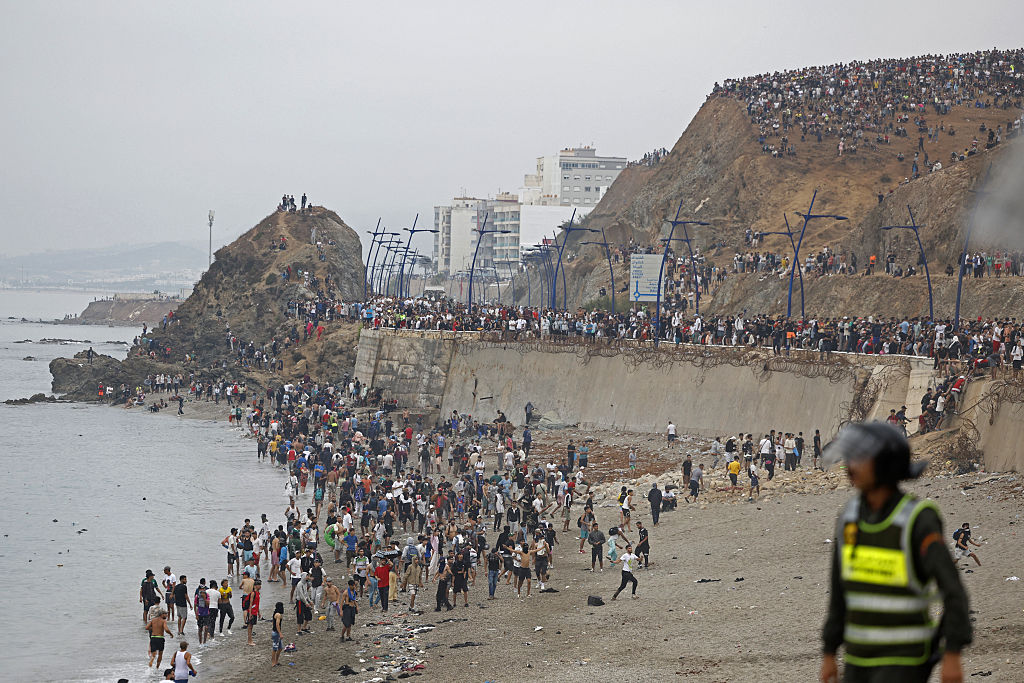
People gather along the fence at the site of clashes near Fnideq, on the Morocco-Spain border, on July 31, 2026. (Photo by Abdel Majid BZIOUAT / AFP via Getty Images)
Local media el Periodicode Ceuta states stores are shuttered across the city, including international chains. A further report offered by El Mundo notes many locals are this morning reported thefts of their property as migrant arrivals raided premises for supplies. By some accounts, the police have been harsher on local Spanish citizens expressing their displeasure at the migrant “invasion” then they have on the migrants themselves.
While more migrants continue to arrive on Friday, the Spanish media note that these inhospitable conditions have driven the least determined of yesterday’s arrivals to voluntarily return to neighbouring Morocco, with “hundreds” and “thousands” reported to have gone back.
Nevertheless, many of the arrivals were jubilant at having made it to Spain, and even in disbelief that despite the heavy police and army presence, actually illegally crossing the border was so easy and unopposed. Men hugged and cheered in groups once on European Union territory among shouts of “long live Spain”. El Mundo reports one teen who despite having been unable to get a drink of water since illegally crossing was determined to stay now in the European Union and told a reporter: “I want to be Spanish like you. In my country, there is only hunger”.
While the new legal loophole meaning a migrant who swam just a few yards around the border breakwater from Moroccan to Spanish territory technically arrived by sea and consequently couldn’t be repulsed by border guards is one of the immediate causes of this week’s sudden migrant surge, and Spain’s creation of clear pro-migrant incentives is another, some blame is also being apportioned to Morocco itself. Like several countries that border Europe’s soft south, Morocco’s government has long ago figured out it can manage migrant flows — or not — to place pressure on European capitals, for diplomatic leverage.
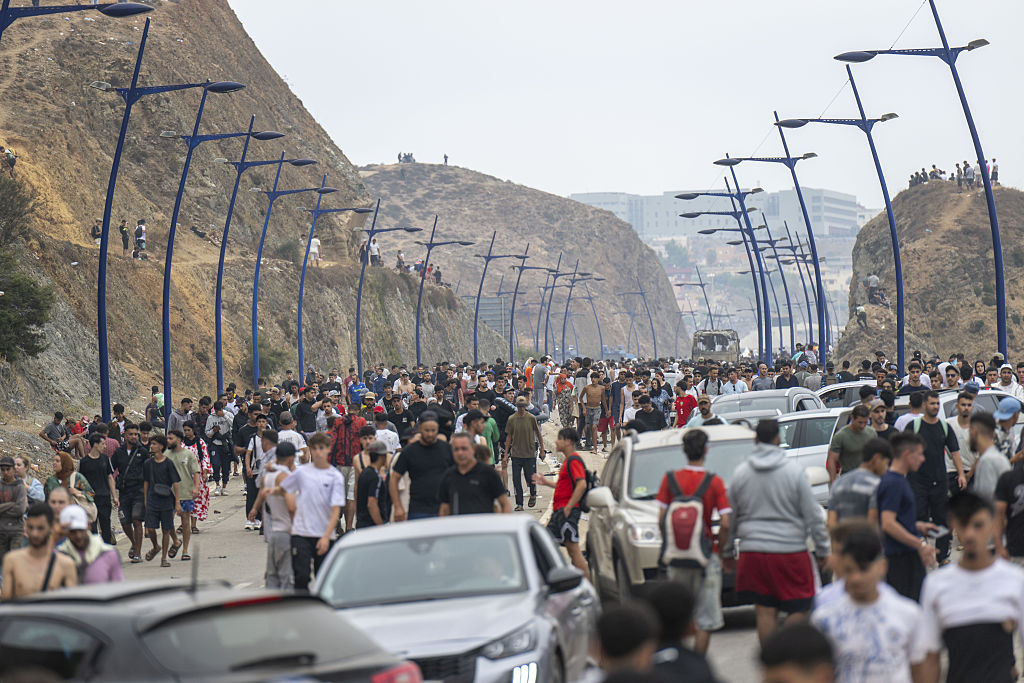
FNIDEQ, MOROCCO – JULY 31: Moroccan security forces deploy near the northern city of Fnideq as thousands of irregular migrants attempt to reach the Spanish-administered territory, on July 31, 2026 in Fnideq, Morocco. Authorities blocked roads across the northern city and deployed additional security measures to prevent migrants from reaching Ceuta, the Spanish-administered territory in North Africa. (Photo by Abu Adem Muhammed/Anadolu via Getty Images)
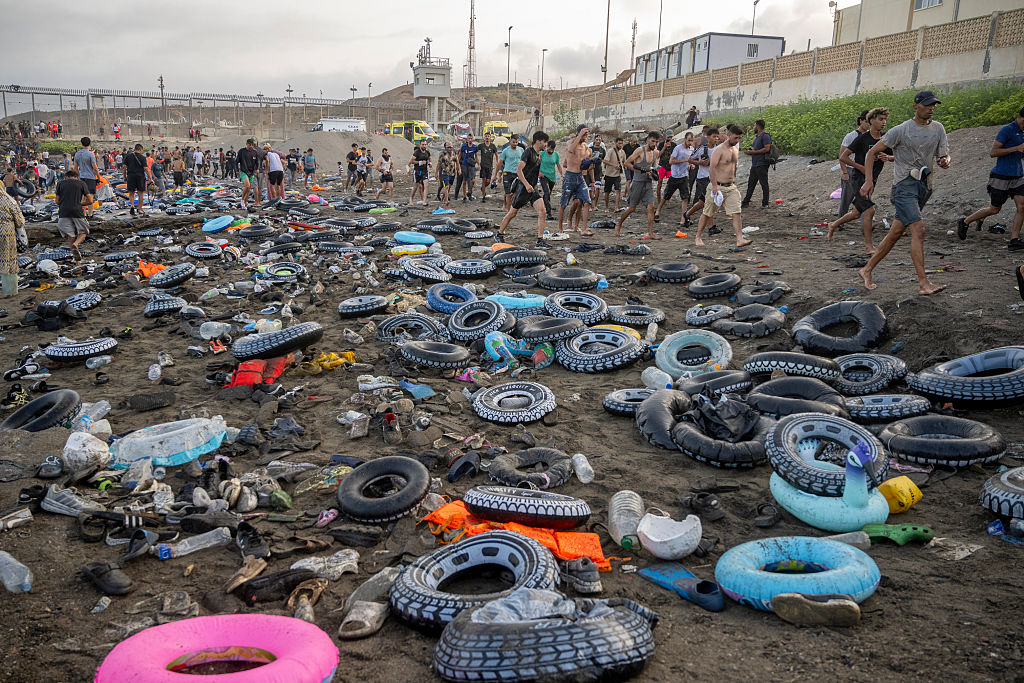
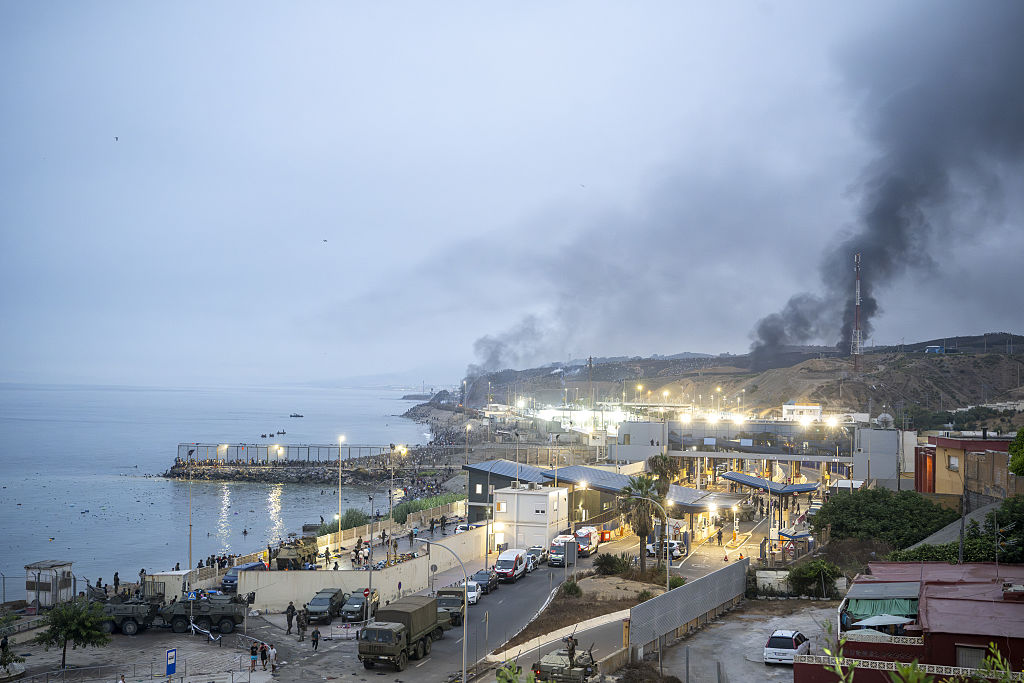
MADRID, SPAIN – JULY 30: Boat people and migrants after crossing the border between Ceuta and Morocco, on 31 July 2026, in Ceuta, Spain. Large numbers of people continued to enter Ceuta from Morocco in an uncontrolled manner as night fell on Thursday, 30 July. From early in the morning, thousands of migrants had entered the autonomous city by swimming and also on foot, skirting the breakwater that separates the autonomous city from Morocco. The units responsible for border control in Ceuta have recovered the bodies of 16 people from the water in the last 24 hours, bringing the total number of foreign nationals found dead in Ceuta’s waters whilst attempting to swim across from Morocco so far this year to 47. (Photo By Marcos Moreno/Europa Press via Getty Images)
That this week Moroccan police sat on their hands and did nothing to control their side of the border has been seen as a key factor in those tens of thousands of arrivals being able to take advantage of that newfound legal loophole. The El Mundo report cites the remarks of an anonymous Civil Guard police officer deployed to Ceuta, who said of the Moroccans: “We’ve known for days that thousands of young people were arriving from all over the country. They could have dispersed them and kept them away from the border, as they’ve done before when they know there are groups of hundreds of sub-Saharan Africans near the fence.
“But, just like five years ago, they didn’t want to this time either. There’s been permissiveness. The cooperation these past few days was limited to picking up those who were swimming toward the border, whom we pointed out to them in the middle of the sea with our boat. Yesterday, the gates of Ceuta were finally opened. Politicians will say no, because it’s not convenient, but this doesn’t happen if the neighbour doesn’t want it.”
Moroccan riot police did appear to finally move in and attempt to control the situation on their side of the border late Thursday evening, leading to major clashes with would-be illegal migrants. Perhaps dozens of cars were burnt out or destroyed, as officers and water canon pacified the region.
Also blaming the Moroccans — although naturally silent on the Spanish state’s hand in driving the invasion — was Prime Minister Pedro Sánchez, who flew into Ceuta for a photo opportunity on Friday morning. While the rest of the city deals with the arrival of over 50,000 people with limited access to shelter or toilet facilities sleeping in the open, the areas Sánchez is visiting today, including around the city hall, were secured and evacuated by police early Friday morning, and street sweeping teams brought in to present a vision of calm for the news media following the Prime Minister.
Sánchez said: “What happened yesterday was an attack, a violation of the territorial integrity of Spain” and promised the government would deploy a series of buoys out into the water where the Spanish and Moroccan borders meet off Ceuta, to make it harder to swim around.
Meanwhile, the Sánchez government comes under ever greater political pressure for its failures from both within and without. Leader of sovereigntist party VOX Santiago Abascal called the events of the past 48 hours an “invasion”, said Sánchez is “abandoning the Spanish people”, and seems more interested in protecting his “cronies” than the country. Several European Union member state countries have mooted suspending the bloc’s internal open borders system to keep the arrivals in Spain.