Spanish Transport Minister Óscar Puente fueled online claims blaming Israel for Spain's migrant crisis in the North African enclave of Ceuta on Friday after Israeli U.N. Ambassador Danny Danon criticized Madrid's handling of the border emergency, escalating an already tense diplomatic dispute between Jerusalem and Spain.
The post Spanish Minister Fuels Blame Toward Israel for Ceuta Crisis After Israeli U.N. Ambassador Criticizes Madrid appeared first on Breitbart.
Spanish Transport Minister Óscar Puente fueled online claims blaming Israel for Spain’s migrant crisis in the North African enclave of Ceuta on Friday after Israeli U.N. Ambassador Danny Danon criticized Madrid’s handling of the border emergency, escalating an already tense diplomatic dispute between Jerusalem and Spain.
The exchange followed Danon’s criticism of Spain after Madrid declared a state of emergency and deployed military forces to Ceuta following an unprecedented surge of migrants crossing into the Spanish enclave from neighboring Morocco. Puente’s cryptic response helped fuel conspiracy theories circulating on Spanish social media alleging Israel — and in some cases the United States — was behind the crisis.
Danon accused Spain of hypocrisy as Madrid struggled to contain one of Europe’s largest recent illegal migration surges.
“Spain, which never misses an opportunity to lecture Israel, has declared a state of emergency in Ceuta following the crisis over its immigration policy,” Danon wrote on X.
“Maybe before it continues lecturing us, it’s time it explained to the world why it still maintains colonial enclaves in Africa,” he added, referring to the Spanish territories of Ceuta and Melilla on Morocco’s Mediterranean coast.
Puente, one of Prime Minister Pedro Sánchez’s most outspoken ministers on social media, reposted Danon’s remarks on X and added only: “Well, things are starting to become quite clear.”
While the minister did not elaborate, Spanish media widely interpreted the post as lending credibility to online claims blaming Israel for the migrant crisis.
Those claims spread rapidly after several Spanish politicians and commentators alleged Israel was seeking to retaliate against Sánchez’s government over its criticism of Jerusalem’s war against Hamas, while others suggested the United States also stood to benefit politically from instability in Spain. No public evidence was presented supporting those allegations.
Among those advancing similar claims were commentator Carolina Alonso, who alleged Israel was attempting to undermine Sánchez’s government through Morocco; Spanish lawmaker Gabriel Rufián, who argued the migration crisis was serving American and Israeli interests; journalist José Vizner, who questioned whether the crisis represented “revenge” against Sánchez; and commentator Rubén Gisbert, who argued Morocco’s posture toward Ceuta and Melilla shifted as Spain adopted increasingly hostile positions toward Israel.
Israel’s Foreign Ministry quickly distanced itself from Danon’s remarks.
Israeli Chargé d’Affaires Dana Erlich wrote on X that Israel was “closely monitoring the situation in Ceuta,” but stressed that “the comment made by Israel’s Ambassador to the U.N. on the issue does not represent the position of the State of Israel.”
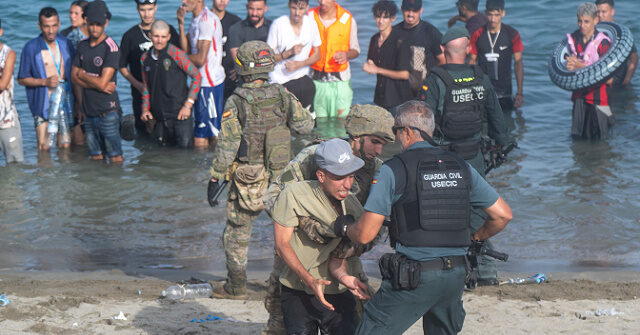
The diplomatic dispute unfolded as Spain confronted its worst migration crisis in Ceuta since 2021 after Spanish officials said roughly 49,000 migrants crossed into the North African enclave from Morocco in less than 24 hours.
Videos circulating online showed migrants swimming around border barriers, using inner tubes to reach Spanish territory, and forcing their way through land crossings as local authorities struggled to respond.
Juan Jesús Vivas, president of Ceuta’s regional government, described the situation as “a total humanitarian and social emergency” and urged Madrid to declare a national state of emergency.
The Spanish government responded by deploying military units, increasing naval and air assets, and dispatching diving teams to patrol the coastline. Sánchez condemned what he described as “an attack on Spain’s territorial integrity” and vowed to use the full resources of the state to restore order.
The crisis also triggered sharp criticism inside Spain and across Europe.
Opposition Vox leader Santiago Abascal described the influx as “an invasion,” while Popular Party leader Alberto Núñez Feijóo called the situation “desperate” and demanded stronger government action. Italian Prime Minister Giorgia Meloni warned the scenes in Ceuta demonstrated “once again” that uncontrolled illegal immigration posed a direct threat to Europe’s borders, while senior Italian officials raised the possibility of suspending Spain from the Schengen open-border area if the crisis continued.
President Donald Trump likewise pointed to the events in Ceuta as a warning for the United States.
“It looks like an invasion of a country,” Trump said Friday, warning the United States would face an even larger migrant surge if Democrats returned to power. The White House also blamed Spain’s left-wing immigration policies for helping fuel the crisis.
Relations between Jerusalem and Madrid have deteriorated sharply since Hamas’s horrific October 7 terrorist massacre against Israel. Sánchez has become one of Europe’s most outspoken critics of Israel’s military campaign against Hamas, recognized a Palestinian state, and repeatedly called for increased international pressure on the Jewish state.
Friday’s dispute added a new diplomatic flashpoint to those already strained relations, with Spain’s migration emergency becoming the latest issue to spill into the increasingly public confrontation between Madrid and Jerusalem.
Joshua Klein is a reporter for Breitbart News. Email him at [email protected]. Follow him on Twitter @JoshuaKlein.