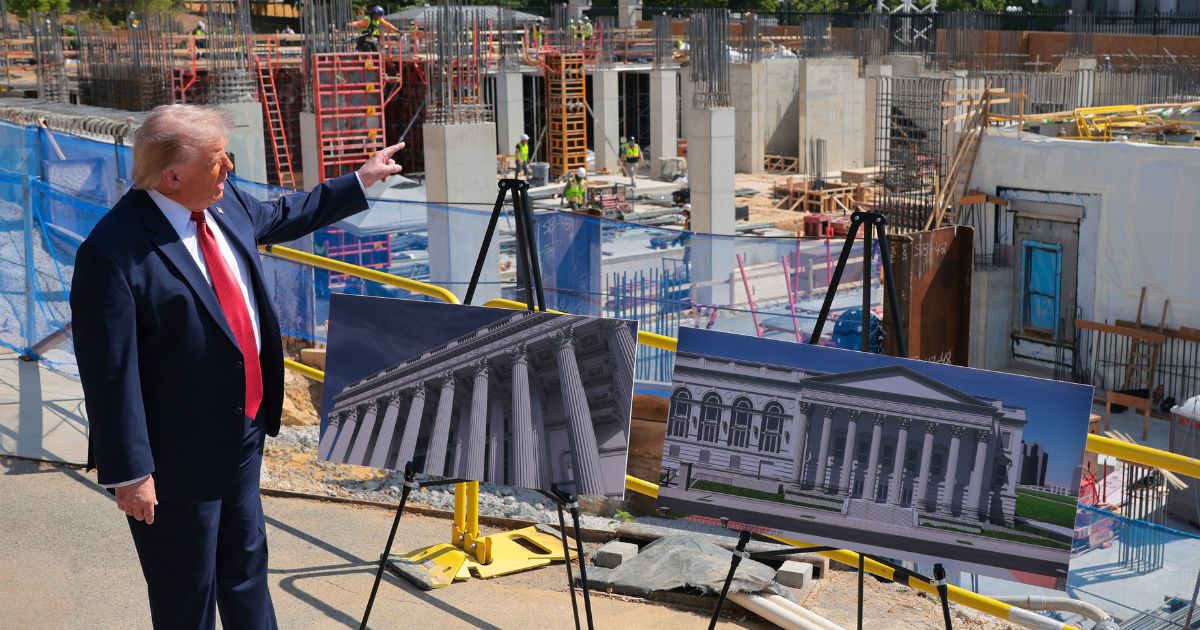
Chief Justice John Roberts ruled on Friday that the building of the White House ballroom can go forward.
Roberts’ directive read, in part, “it is ordered that the preliminary injunction entered on April 16, 2026, by the United States District Court for the District of Columbia…is hereby stayed pending further order of the Chief Justice or of the [Supreme] Court.”
🚨 Chief Justice John Roberts entered an order allowing construction of President Trump’s White House ballroom to continue while the Supreme Court further considers the Trump administration’s appeal. pic.twitter.com/CwXdi5RRhm
— SCOTUS Wire (@scotus_wire) August 21, 2026
Earlier this month, a three-judge D.C. Court of Appeals panel on Friday upheld a lower court ruling blocking President Donald Trump from going forward with constructing the ballroom.
Last fall, Trump directed the construction of a 90,000-square-foot ballroom on the east side of the White House with $400 million in private donations. Underneath it, a new bunker is also being constructed by the Department of War with enhanced security measures.
🚨 BREAKING: US Supreme Court Chief Justice John Roberts has allowed construction of President Trump’s White House Ballroom to PROCEED
A HUGE blow to activist judges hellbent on kiIIing the project 🔥
The Supreme Court will be hearing the full case at some point, and Democrats… pic.twitter.com/QATzhqFYfM
— Nick Sortor (@nicksortor) August 21, 2026
Do you support Trump’s White House Ballroom project?
Yes: 0% (0 Votes)
No: 0% (0 Votes)
In a 2-1 ruling, Judges Patricia Millett, an Obama appointee, and Bradley Garcia, a Biden appointee, wrote in their majority opinion, “Whether or not a massive ballroom should be constructed is for Congress to decide and is not a matter for Executive self-help.”
“This holding has nothing at all to do with whether the proposed ballroom is desirable, or not, as a matter of policy. This ruling does not even necessarily mean that the Defendants may not ultimately construct the ballroom,” the judges continued.
“What it does mean is that the Defendants may not do so during the district court’s expeditious litigation without securing Congress’s authorization, as the Constitution and laws require,” Millett and Garcia said.
However, Judge Neomi Rao, a Trump appointee, held a different view in her dissent. She first contended that the National Trust for Historic Preservation, which filed the suit, had no standing to bring it, and that the federal district court had no authority to issue a preliminary injunction in the spring stopping its construction.
“This was a blatant abuse of discretion. To begin with, the district court had no jurisdiction because the Trust has no standing to stop construction at the White House. The ballroom is also likely within the President’s authority to make improvements to the Executive Residence at the White House,” Rao wrote.
Trump responded to Roberts’ favorable ruling with a post on Truth Social.
Both the U.S. Commission of Fine Arts and the 12-member National Capital Planning Commission have approved the ballroom plans.
Advertise with The Western Journal and reach millions of highly engaged readers, while supporting our work. Advertise Today.