The Islamist Iranian regime reportedly hacked into a British power plant and shut it down for multiple days in a deeply concerning demonstration of power.
The post Iran Hacked and Shut Down a British Power Plant for Days: Report appeared first on Breitbart.
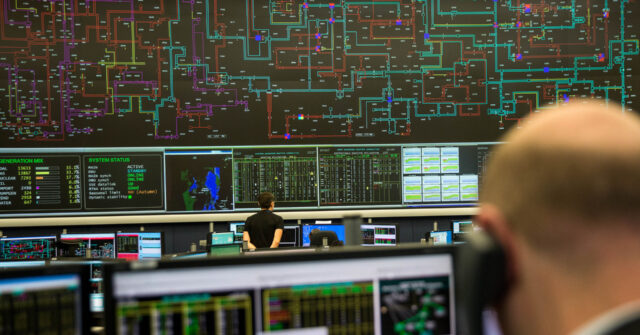
The Islamist Iranian regime reportedly hacked into a British power plant and shut it down for multiple days in a deeply concerning first of its kind attack that should theoretically be impossible.
According to London’s Daily Telegraph broadsheet, a British power plant was shut down by hackers working on behalf of the regime in what appears to have been a coordinated series of strikes, including several hacking attacks on water infrastructure in the United States.
While British officials refused to identify which plant was affected, it is believed to have been small enough not to have dramatically impacted the UK’s energy supply during the four days it remained offline.
UK officials were quick to downplay the scale of the attack, with a government source telling the paper: “We have thresholds for important generators to legally notify us of cyber activity, and this site is nowhere near. It’s a very small scale site, less than a rounding error compared to grid capacity”. Yet concerningly, British energy officials have recently been accused of whitewashing other power grid concerns, leaving the ultimate truth of the matter unclear.
While such a cyber attack on parts of the power grid should be impossible, with best practice requiring critical infrastructure be ‘air gapped’ from the internet, increasing automation and connectivity may introduce vulnerabilities that simply wouldn’t have existed in the past.
However, the apparent hack may serve as a harbinger of what’s to come and a demonstration of the capabilities of the Iranian regime, despite having been severely weakened in recent months by military strikes conducted by the United States and Israel.
Although the British government publicly refused to allow the Trump administration to use its military bases to launch offensive strikes on Iran, the UK has remained a top target of the Mullahs in Tehran, who view Britain as an extension of the American empire.
Indeed, within hours of the first U.S. strikes, the Islamist regime had its Hezbollah proxy terrorists in Lebanon fire an Iranian-manufactured Shahed-type drone at the British military base in Cyprus.
Later in March, Iran fired ballistic missiles towards the British Overseas Territory of the Chagos Islands, which are home to a joint UK-U.S. military base on the island of Diego Garcia. Although the strikes were unsuccessful, with one missile being shot down and the other suffering a technical malfunction, the target’s distance indicated a new threshold of capability.
Israeli intelligence officials warned that if Iran has the capability of hitting the Chagos Islands with a missile, it would also be able to strike Berlin, London, or Paris.
Although the intelligence and security committee in the House of Commons found last year that an impactful Iranian hack against British critical infrastructure was “unlikely”, it noted that cyber warfare remains a “significant area of asymmetric strength” for the regime given that it spends tens of millions per year funding various hacking groups.
In April, Security Minister Dan Jarvis warned that Artificial Intelligence tools have made strikes on Infrastructure easier to carry out, saying: “The nature of the threat is changing faster than any previous government has had to confront. AI is lowering the barrier to entry for our adversaries. It is automating attacks. It is finding vulnerabilities in critical systems faster than any human team can patch them.”
Commenting on the apparent Iranian hack of a power plant, a British government spokesman said: “The UK has a highly resilient energy system. We work closely with the energy sector to protect infrastructure and ensure the highest security standards.
“This story refers to an incident impacting a small-scale energy generator, and at no point was there a risk to the wider energy system.”