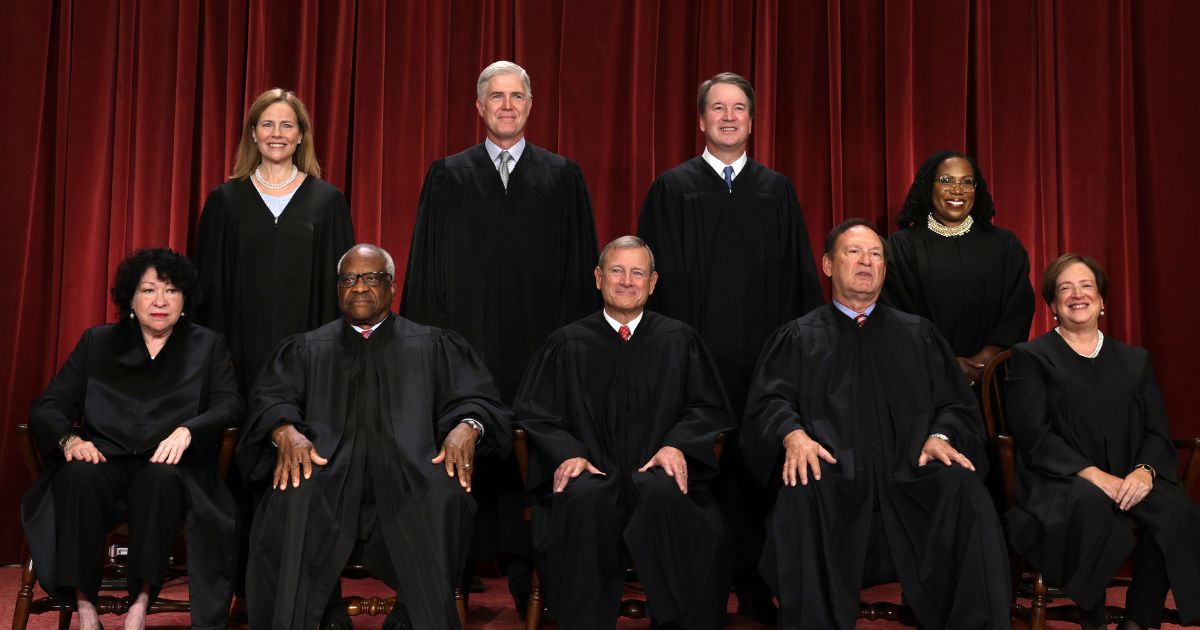
The U.S. Supreme Court on Monday allowed President Donald Trump’s executive order regarding mail-in ballots to go forward.
In late March, Trump issued an executive order requiring states to send a list of names of those receiving mail-in ballots so they could be verified as U.S. citizens, with the Department of Homeland Security working in conjunction with the Social Security Administration.
“The Federal Government has an unavoidable duty under Article II of the Constitution of the United States to enforce Federal law, which includes preventing violations of Federal criminal law and maintaining public confidence in election outcomes,” the directive read.
The U.S. Postal Service was instructed not to deliver ballots to those unverified as citizens.
Further, states are required to have “unique ballot envelope identifiers, such as bar codes, [to] enable confirmation that only citizens receive and cast ballots, reducing the risk of fraud and protecting the integrity of Federal elections.”
Twenty-three states, along with the District of Columbia, sued the Trump administration in federal court seeking to block the order.
Massachusetts-based federal Judge Indira Talwani, appointed by Barack Obama, issued an injunction blocking the implementation, which the First U.S. District Court of Appeals upheld in late July.
Should absentee voting be restricted solely to men and women in uniform overseas?
Yes: 63% (5 Votes)
No: 37% (3 Votes)
In its Monday 6-3 ruling reversing the injunction, the Supreme Court did not decide whether Trump’s order was lawful, but determined the states suing to block it did not have standing because they could not prove any “concrete” harms had been suffered by their citizens, concluding their arguments are “conjecture.”
In her dissent, Justice Ketanji Brown Jackson accused the majority of “[t]aking its eye off the ball” and thus “miss[ing] the Government’s actual objective: to secure our imprimatur for its effort to foment chaos ahead of the November elections.”
Meanwhile, Justice Sonia Sotomayor, joined by Justice Elena Kagan, wrote in a separate dissenting opinion, “Today’s decision does not address whether the President’s attempts to interfere with States’ administration of the November 2026 elections are lawful. Nor does it suggest that the Executive Branch has any constitutional or statutory authority to implement the President’s directives. Instead, today’s decision merely postpones adjudication of those challenges.”
The states challenging Trump’s order wrote in their brief to the Supreme Court that implementing it “would allow the federal government to rush out an unprecedented, legally indefensible voter-verification and ballot-interception program that would, among other things, give the U.S. Postal Service far-reaching new powers and responsibilities.”
But SCOTUSBlog reported that Alabama and 11 other states supporting the order countered in their brief that two recent rulings by the U.S. Court of Appeals for the District of Columbia Circuit involving the same executive order concluded it was too early to challenge it without proof of actual harm to the states.
Senate Minority Leader Chuck Schumer responded to the ruling, calling it “a disgrace,” adding that it is thrusting a “dagger into the heart of our democracy.”
“Trump’s effort to turn the Postal Service into a voter suppression machine is blatantly unconstitutional – yet his MAGA Supreme Court is refusing to stop it from going forward,” Schumer posted on X. “Trump’s malicious effort to stop mail-in voting is nothing but election interference in broad daylight.”
It’s a disgrace that the highest court in the nation is allowing Trump to put a dagger into the heart of our democracy.
Trump’s effort to turn the Postal Service into a voter suppression machine is blatantly unconstitutional – yet his MAGA Supreme Court is refusing to stop it… https://t.co/hDu16qD7Wd
— Chuck Schumer (@SenSchumer) August 24, 2026
The New York Post reported that Democratic New York Attorney General Letitia James, who was part of the lawsuit, vowed that the “fight is far from over.”
“This decision is a painful setback, but it will not be the final word,” James said in a statement. “The right to vote is sacred, and no administration should be allowed to put that right in jeopardy by making it harder for eligible voters to cast their ballots.”
The Supreme Court’s decision to strike down access to mail-in voting is a painful setback, but it won’t be the final word.
The right to vote is sacred, and no administration should be able to put that right in jeopardy.
We’re exploring our legal options.https://t.co/P7NrfLUSxO
— NY AG James (@NewYorkStateAG) August 24, 2026
The United States Postal Service published a rule on Friday requiring states to provide it with lists of voters who received mail-in ballots at least 60 days before the midterm elections.
The Post noted that about 30 percent of all ballots cast in the 2024 presidential election were by mail, based on data reviewed by the Associated Press.
Advertise with The Western Journal and reach millions of highly engaged readers, while supporting our work. Advertise Today.