President Donald Trump warned Friday that the United States may strike Iran’s heavily fortified Pickaxe Mountain nuclear site “very soon,” declaring that Washington is closely tracking activity at the underground complex and will prevent Tehran from using it to rebuild its nuclear program.
The post Trump: U.S. May Strike Iran’s Pickaxe Mountain Nuclear Site ‘Very Soon’ appeared first on Breitbart.
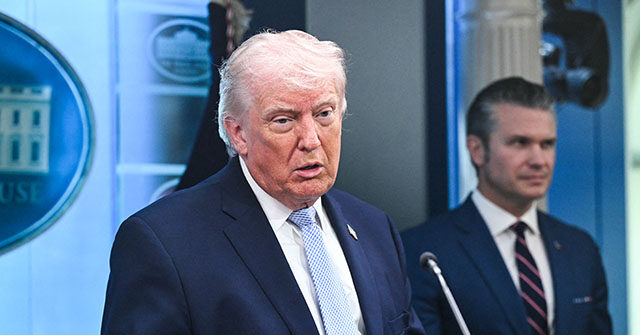
President Donald Trump warned Friday that the United States may strike Iran’s heavily fortified Pickaxe Mountain nuclear site “very soon,” declaring that Washington is closely tracking activity at the underground complex and will prevent Tehran from using it to rebuild its nuclear program.
“We may hit Pickaxe very soon,” Trump told reporters at the White House, warning that the United States is prepared to act if it detects renewed nuclear activity there.
Trump said American surveillance extends not only over Pickaxe Mountain but across Iran, giving Washington the ability to detect movements around the site and respond rapidly.
“We know everybody that’s moving at Pickaxe. We know everybody that’s moving everywhere all over Iran,” he said. “And if anything goes bad, we hit them. We hit them hard.”
The warning reinforced what Trump has repeatedly described as the overriding objective of the U.S. campaign against Tehran: ensuring Iran never obtains a nuclear weapon.
“Iran will not have a nuclear weapon,” Trump declared. “We’ve stopped them from having” one.
Trump offered a similar assessment just one day earlier in an interview with Britain’s GB News, pointing to U.S. surveillance capabilities, including those provided by the Space Force, as giving Washington extraordinary visibility over Iran’s remaining nuclear infrastructure.
“We have cameras on every major area of the first three. And we also have cameras on Pickaxe Mountain,” Trump said Thursday, referring to the three primary Iranian nuclear facilities struck by the United States last year.
“We know everybody that walks in and walks out,” he said, expressing confidence that Washington knows what is taking place inside the mountain.
Pickaxe Mountain, located near the devastated Natanz nuclear complex, has emerged as a central concern over Iran’s ability to eventually reconstitute its nuclear program. The heavily fortified facility contains two tunnel complexes constructed deep beneath Kolang Gaz La mountain, with experts assessing that portions of the complex may be even more deeply buried than Fordow, which was once considered Iran’s most difficult nuclear facility to strike.
Israeli intelligence reportedly believes Iran transferred thousands of advanced centrifuges into Pickaxe Mountain last fall, potentially giving Tehran equipment that could be used to restore enrichment capabilities destroyed in previous U.S. and Israeli attacks.
Trump has consequently spent months warning that Pickaxe will be destroyed if Iran attempts to turn the site into the foundation of a rebuilt nuclear program.
Asked in July about the reported centrifuge transfer, Trump said the United States was closely tracking Iran’s remaining nuclear material and made clear that rebuilding elsewhere would only bring another American attack.
“We’ll be hitting that area probably pretty soon,” he warned. “There’s not a thing they can do about it.”
Trump broadened that threat beyond Pickaxe, declaring that the United States would strike “any site where they’re even thinking about nuclear” and do so “very, very powerfully.”
Days earlier, Trump told radio host Hugh Hewitt that International Atomic Energy Agency inspectors would have to gain access to Pickaxe as part of any future agreement with Tehran. While saying U.S. surveillance had detected no activity there at the time, Trump nevertheless described the mountain as a possible target for “a nice, big, fat shot right into the front door.”
By the end of the interview, his warning was unequivocal: “We’re going to take out Pickaxe Mountain.”
Those threats carry particular weight after Operation Midnight Hammer, the massive U.S. strike that destroyed Iran’s three principal nuclear facilities in the closing stage of Israel’s 12-day Operation Rising Lion campaign in June 2025.
Seven B-2 Spirit stealth bombers penetrated Iranian airspace during the operation, dropping 14 30,000-pound GBU-57 Massive Ordnance Penetrator bunker-buster bombs against Fordow and Natanz while a U.S. submarine fired more than two dozen Tomahawk cruise missiles at infrastructure at Isfahan.
Fordow presented the most formidable target. The enrichment complex was buried roughly 300 feet beneath a mountain near Qom and protected by layers of rock and reinforced concrete, requiring years of specialized American planning and the first operational use of the massive GBU-57.
Chairman of the Joint Chiefs of Staff Gen. Dan Caine later revealed that American forces attacked ventilation shafts leading into the underground complex, using initial weapons to blast through concrete Iran had placed over the openings before subsequent bunker-busters followed into the mountain. The Pentagon later said its assessment was that Fordow, Natanz, and Isfahan had been completely obliterated.
The depth of the intelligence effort behind the attack became even clearer last month when former Mossad chief Yossi Cohen revealed that Israeli intelligence had “toured” Fordow “many times” in order to understand the site before American forces ultimately destroyed it. Cohen did not specify if Israeli operatives had physically entered the underground complex.
Trump has repeatedly pointed to that combination of intelligence penetration, surveillance and overwhelming strike capability as the reason Tehran cannot secretly rebuild what the United States and Israel destroyed.
Washington demonstrated that willingness again this week after Iran attempted to restore military capabilities around the Strait of Hormuz and continued threatening the strategic waterway.
U.S. forces struck newly installed Iranian radar and missile systems along the strait, as well as a capability Trump said Tehran was developing to deploy additional mines — following repeated warnings from the president against renewed efforts to threaten commercial shipping.
“They brought in radar because we knocked it out once. Now we knocked it out twice,” Trump said Friday, adding that Washington no longer sees activity around the destroyed systems.
The renewed strikes have accompanied Washington’s effort to keep Hormuz open to commercial shipping while preventing Iran from rebuilding capabilities that could threaten the waterway — the other major front of the administration’s pressure campaign.
Vice President JD Vance laid out those objectives at the White House on Thursday, placing preventing a nuclear-armed Iran first and maintaining the flow of commercial shipping through Hormuz alongside it.
“Number one, it’s so that Iran never has a nuclear weapon,” Vance said.
Trump on Friday characterized the current confrontation as an intermittent “military conflict,” noting that the United States is not engaged in continuous fighting even as it retains the ability to strike Iran whenever necessary.
Asked when Americans could expect a final resolution to the confrontation, Trump declined to set a timetable, instead pointing to what he described as the overriding achievement of the campaign.
“I can’t tell you, but we’ve already won the big thing,” Trump said. “There’s not going to be a nuclear weapon.”
Joshua Klein is a reporter for Breitbart News. Email him at [email protected]. Follow him on Twitter @JoshuaKlein.