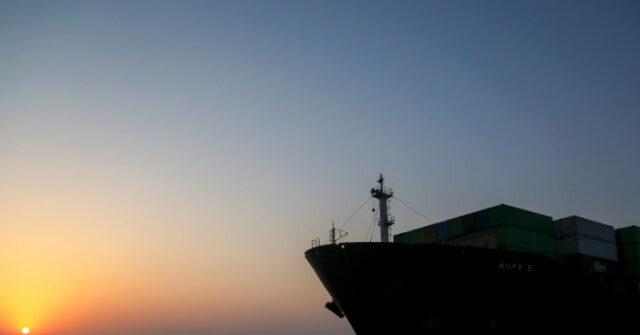
U.S. forces have supported the passage of more than one billion barrels of crude oil through the Strait of Hormuz in recent months while Iran has exported none under Washington’s “ironclad blockade,” U.S. Central Command (CENTCOM) chief Adm. Brad Cooper announced Saturday.
The post CENTCOM: 1 Billion Barrels Move Through Hormuz — ‘Ironclad Blockade’ Holds Iran to Zero appeared first on Breitbart.
U.S. forces have supported the passage of more than one billion barrels of crude oil through the Strait of Hormuz in recent months while Iran has exported none under Washington’s “ironclad blockade,” U.S. Central Command (CENTCOM) chief Adm. Brad Cooper announced Saturday.
Cooper said American forces reached the milestone while providing coordinated protection for more than 2,000 commercial ship transits through the strategic waterway.
“Clearly, momentum is building,” he said in a video update.
The volume of crude oil, cargo, and liquefied natural gas moving through Hormuz over the past two weeks is higher than at any point in the six months since the war began on February 28, Cooper said, while the strait’s primary transit lanes remain clear of mines.
“Over one billion barrels of crude have been shipped from Gulf partners through the Strait of Hormuz, and Iran has exported zero barrels, thanks to our ironclad blockade,” Cooper said.
Saturday’s update builds on what Cooper called a “major milestone” on August 28, when CENTCOM announced that U.S. forces had cleared Iranian sea mines from the internationally recognized transit lanes through Hormuz after months of dangerous mine-clearing operations.
Cooper said the work was carried out “meticulously and quietly” by forces across the U.S. military, declaring at the time that the international shipping lanes were open and “momentum is building.”
Even as U.S. forces have expanded protected commercial traffic through Hormuz, the blockade against Iran has remained in force. CENTCOM said Friday that American forces had redirected 105 commercial vessels to ensure compliance, maintaining what Cooper says has been a complete cutoff of Iranian oil exports through the waterway.
CENTCOM has described the missions as separate but simultaneous: restoring freedom of navigation through Hormuz for international commerce while preventing trade from entering or leaving Iranian ports.
The naval blockade has been reinforced by Operation Economic Outcast, the Trump administration’s whole-of-government campaign to sever Tehran’s remaining economic lifelines by targeting the financial channels, sanctions-evasion networks, and oil-smuggling operations that generate revenue for the Iranian regime.
Cooper said CENTCOM is working with all six Gulf Cooperation Council nations, as well as U.S. agencies, insurers, and shipping companies, to further increase traffic through the strait.
“The effort is paying off,” Cooper said.
The command is also working with regional partners to bolster their air defenses and establish a “new coalition attack drone unit” as missile and drone threats intensify elsewhere in the region.
The announcement came amid another escalation in Saudi Arabia on Saturday, when the Saudi-led coalition said it intercepted a Houthi ballistic missile targeting Riyadh. The Iran-backed Houthis separately claimed missile and drone attacks on “sensitive” sites in the Saudi capital, while flames and black smoke were observed near King Khalid International Airport. The cause of the fire near the airport was not immediately established.
Iran’s military, meanwhile, rejected Cooper’s account, with armed forces spokesman Brig. Gen. Abolfazl Shekarchi calling the CENTCOM figures “false” and “ridiculous” and dismissing the announcement as a “failed psychological operation.”
“The initiative in the Strait of Hormuz remains in the hands of Iran’s powerful armed forces,” Shekarchi said through Iranian state media.
The expanding U.S.-Gulf military coordination comes days before President Donald Trump is expected to meet with leaders of all six Gulf Arab nations in New York as his administration weighs its next steps in the nearly seven-month conflict with Iran.
U.S. Ambassador to the United Nations Mike Waltz told Breitbart News Saturday that Trump remains “very focused” on ensuring Iran never obtains a nuclear weapon and said the upcoming U.N. General Assembly will provide “a moment to continue that diplomacy.”
Joshua Klein is a reporter for Breitbart News. Email him at [email protected]. Follow him on Twitter @JoshuaKlein.