WASHINGTON — Secretary of State Marco Rubio sat down late last week with Breitbart News at the State Department in Washington for his first major exclusive long-form on-camera interview after delivering an address at the Acropolis in Athens, Greece.
The post Exclusive — Secretary Marco Rubio after Acropolis Address: Americans ‘the Heirs’ of Western Civilization, ‘Things We Believe as a Country Are Important’ appeared first on Breitbart.
WASHINGTON — Secretary of State Marco Rubio sat down late last week with Breitbart News at the State Department in Washington for his first major exclusive long-form on-camera interview after delivering an address at the Acropolis in Athens, Greece, describing Americans as “the heirs” of Western Civilization from ancient Greeks and Romans and explaining that the values the United States stands for are “important” to the world.
Asked about the historic address earlier this month, Rubio described the message in it as “at the core” of the America First foreign policy agenda. A previously released clip from this interview shows Rubio discussing the America First foreign policy and explaining how, as President Donald Trump told the United Nations General Assembly (UNGA) last month, it is centralized around using American power to advance the American interest—and that oftentimes that American interest helps America’s friends and allies around the world, lifting up the entire West. Now, this full interview has Rubio going much deeper in explaining much of the thinking behind that address and the broader Trump foreign policy doctrines as well as various issues and challenges that lay ahead.
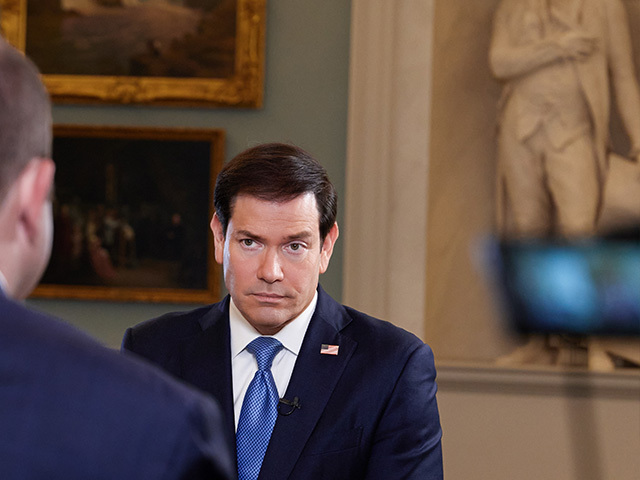
Secretary of State Marco Rubio sits for an interview with Breitbart News Washington Bureau Chief Matthew Boyle on Thursday, October 15, 2026, in the Thomas Jefferson State Reception Room at the State Department in Washington, DC. (Dan Fleuette/Breitbart News)
“Well, I think the message is at the core of a lot of what we’re trying to instill in our foreign policy,” Rubio told Breitbart News of his Acropolis address in Athens. “I think people sometimes forget, like look around our system of government, our culture, our values, the things we believe as a country are important. They’re not just words on a paper. They are backed up by thousands of years of civilization. We are the heirs—we inherited from Greece and from Rome, and ultimately through Europe, many of the values that today underpin our country. A lot of people view that as an attack on other cultures. It’s not. I’m just saying every culture should be proud of themselves. The only culture and the only civilization in the world today who seems apologetic about its history and its achievements is the West, and it’s having a dramatic impact on foreign policy. It is important for us to remind ourselves that we too are heirs to a great civilization that has done great things for humanity and for the world. That many of the things we take for granted in our everyday life, whether it’s the size and wealth of our country, whether it’s our democracy and our republic, whether it’s all of these things, they didn’t come from nowhere. They came from a shared history that we need to rediscover and embrace. We’re doing that here in this country under President Trump. We want more Western leaders to do the same.”
Rubio told Breitbart News that many European and other Western leaders are in fact coming around to embracing this view of the world, especially since his speech earlier this year at the Munich Security Conference and a similar one last year from Vice President JD Vance. He said “it takes time” for those messages to “translate into policy” after they sink in, but he is noticing a shift especially “privately” from around the world to more concretely embracing the Trump vision for the world.
“Yeah, I think I’ve noticed they are receptive to what we’re saying, and even privately, a lot of leaders will tell you ‘that was a great speech—we agree with you,’” Rubio said. “Obviously, it takes time for that to translate into policy. I also think there is still, and I think this is true even in our country but certainly in Europe and in other parts of the world, there is still worry that signing up for this point of view and speaking the way we have will open them up to criticisms from their far left, from their media, from their academia, from their entrenched bureaucracy, because we’ve allowed this point of view to be stigmatized as something that’s evil, when in fact it should be embraced as something that is good. So the answer is yes. I sense more receptivity, and I think what you’re really going to start seeing is that play out in elections as more and more leaders are willing to say these things and then get elected. That is ultimately what is going to shift the way other countries respond to our shared interests.”
Rubio’s Acropolis address had lots of people buzzing about whether he would back off previous comments he made about not intending to run for president against Vance should Vance run in 2028, and Breitbart News asked him if anything changed since then. Rubio said he would not answer 2028 questions and said he has already said all he will say on the subject for now—and also made clear everyone in the administration from himself to Vance to Treasury Secretary Scott Bessent and more are focused on just doing their jobs.
“I’ve said everything. I’ve already said things. Like it doesn’t matter how many times you say it. So at this point, I’m just not answering any more 2028 questions,” Rubio said. “Not anything against you. It’s the first time we’ve talked, I know. But some of these reporters, that’s all they ever ask me about. I’m just done with it. I’m doing my job. I have two jobs, and I’m focused on them—and they take like every hour of the day. Sometimes I don’t have enough hours in the day, depending on the day, to deal with my job. I just don’t have time anymore for those questions. As far as the speech is concerned, what am I supposed to be doing? I mean, I’m the Secretary of State. I’m supposed to be representing this country on the international stage. I think people, if people like the speech, I think they should be happy and pleased that their Secretary of State is delivering an important message on the global stage. I’m just doing my job. Everybody here is doing their job. The Vice President right now is out there campaigning for candidates to keep us [in the majorities in Congress]. He’s doing his job. You know, the Secretary of Treasury is crushing Iran with sanctions—he’s doing his job. Everyone’s doing their job, and I think we’re all part of the same team. And I think we should all be encouraged when members of the team are doing their job and are doing it well. And I hope I’m doing it well in my roles. That’s kind of where it’s at.”
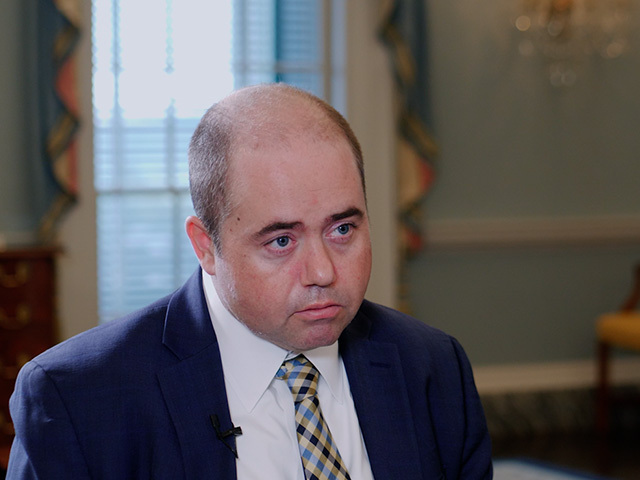
Breitbart News Washington Bureau Chief Matthew Boyle interviews Secretary of State Marco Rubio on Thursday, October 15, 2026, in the Thomas Jefferson State Reception Room at the State Department in Washington, DC. (Matthew Perdie/Breitbart News)
This long-form on-camera interview with Rubio, interestingly, was filmed on Thursday, before violent leftist riots swept across the European continent from France to Italy to Albania and more. It also comes right ahead of Serbian elections, where the former President Aleksandar Vucic is running to become Prime Minister after he stepped down earlier this year because he was term-limited out of the presidency. Vucic has embraced Trump’s view of the world, and told Breitbart News in an exclusive interview in Belgrade earlier this year that Trump would receive a hero’s welcome should he visit Serbia during his second term in office. Trump shared that interview on Truth Social. France, meanwhile, has upcoming elections in 2027, where the conservative Marine Le Pen seems to be the favorite to win the presidency and of course in Italy a coalition government is headed by Prime Minister Giorgia Meloni and the far more conservative nationalist Deputy Prime Minister Matteo Salvini. Salvini sat for an interview with Breitbart News earlier this year as well in Milan—the site of the violent leftist riots this weekend that Meloni has condemned—another one that Trump shared on Truth Social.
Rubio’s trip to Greece was particularly important at this time because it comes as the Greeks and Cypriots both pursue a very American energy independence strategy. Both countries are aggressively partnering with American energy giants to seek out and tap their vast reserves in the seas around their countries of natural gas—something much of the rest of Europe has resisted doing—thereby seeking to weaken adversaries of the west like the Russians and some Middle Eastern actors when it comes to energy dominance. Rubio, sources familiar with the matter told Breitbart News, discussed in his meeting with Greek Prime Minister Kyriakos Mitsotakis a great deal about energy. Mitsotakis has also sat for a couple different Breitbart News interviews over the last two years, both of which earned effusive praise for him and for Greece from none other than Trump himself. Cyprus’s president, Nikos Christodoulides, also sat for a Breitbart News interview that Trump also shared on Truth Social just last month at the UNGA.
Asked about this energy focus—something a lot of the coverage of the Rubio visit from establishment press missed—Rubio told Breitbart News that Greece can help lead the way for the world when it comes to energy development. In addition to Greece’s focus on “energy exploration” and production, Rubio also said that the Greeks have because of their geopolitical location a massive advantage over many other world powers because they can be the “connector” for the world from the East to the West and from the North to the South—and vice versa on both.
“Well, if you noticed, there was a lot of silliness around the world for the last 10 years about how energy, trying to de-emphasize energy, in fact, bragging about how expensive energy needed to become, fossil fuels in order to get rid of them, no one’s talking about that anymore, right?” Rubio said when asked about this focus of his visit. “Everyone now, unfortunately, this global crisis has reminded us that at the core of anything we want to do, whether it’s power our daily lives, our industries, or our defenses, it requires energy. I think Greece is in a very unique place, both geographically and politically. Politically, they are open to energy exploration. In fact, they are encouraged by it. They’re excited about it, and their population seems to support it as well. So that’s good. And then geographically, they’re located in a very key place as a transit corridor to build pipelines and ways to transmit energy. Because energy is only as good as your ability to move it, whether it’s oil or gas or the generation of electricity. They’re in a very important place because they are in the perfect place. They’ve always been the connector between Europe, Africa, and the Middle East. They’re in a very key place where, in addition to generating energy, they can actually help transport it north into Europe and south into Israel, the Middle East, and broader. They’re in a very advantageous position geographically now for energy, as they have been for trade and so many other industries throughout history.”
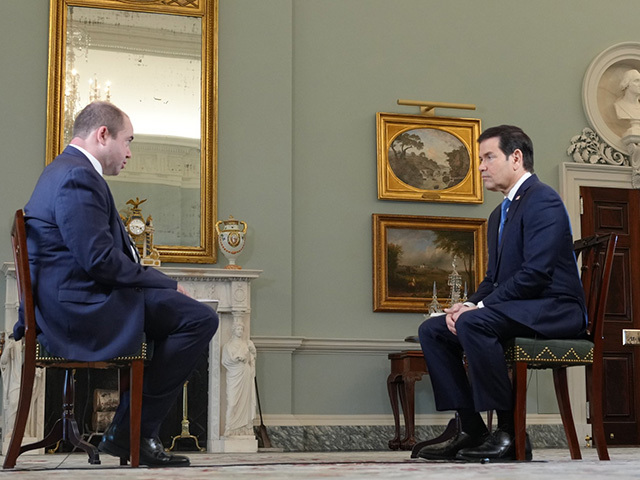
Secretary of State Marco Rubio sits for an interview with Breitbart News Washington Bureau Chief Matthew Boyle on Thursday, October 15, 2026, in the Thomas Jefferson State Reception Room at the State Department in Washington, DC. (Photo courtesy of the State Department)
One of the things Greece has already embraced, thanks in large part to the Trump administration, is being the central fulcrum point of the so-called Vertical Corridor, which takes American natural gas—and eventually hopefully Greek, Cypriot, and other Western nations’ natural gas—up pipelines and other trade corridors from Southeastern Europe up into central and northern and eastern Europe to Ukraine and everywhere along the way. Asked about this, and whether the Trump administration hopes that the rest of Europe like the British, the Germans, the French, and the Italians come around to the wiser positions that Greece has embraced on energy exploration, production, and movement so as to counter the flow of adversarial nations’ energy into the West—like the Europeans’ previous dependence on Russian natural gas in the lead-up to the Russian invasion of Ukraine during Democrat President Joe Biden’s term in the White House—Rubio said “absolutely.”
“I remember I was in the Senate at the time, but President Trump—in his first term—said that the Germans had left themselves vulnerable to Russian energy as a tool of blackmail in case of conflict and they laughed, they mocked him,” Rubio said. “Our media mocked the president for saying that, and our media celebrated European leaders that laughed at the president. Well, guess what? That’s exactly what happened. Their dependence on Russian energy is one of the reasons why Putin went into Ukraine because he thought he could, because he believed Europe wasn’t going to do anything about it, so I hope they’ve learned that lesson. It seems like they now are, but it takes time now to reverse engineer twenty years of both this green hyperbole in terms of believing they’re going to go completely green and their belief that they could somehow not develop any domestic sources of energy and in fact just be overly reliant on one method. So the answer is I hope they are because Europe’s future depends on it. Right now, their economy faces, unfortunately, real stagnation in most of these countries because their fuel costs, both for electricity and transport, are incredibly high. They were already higher than they should have been even before the recent conflicts.”
This is also the first major interview Rubio has done since the now-former Ambassador to Greece Kimberly Guilfoyle resigned. Asked about what’s next for U.S.-Greece relations, Rubio said since it had only been a couple days since her resignation the administration was obviously not ready to name a replacement yet but that the relationship between the two countries is as strong as ever and will only grow stronger. He specifically praised Greece’s role in NATO, as Greece is one of the only countries that went up on its defense spending independently of pushing from Trump.
“Well, Greece is an important country, very important. They’re a great ally of the United States,” Rubio said. “They’ve been helping us in so many different ways, and they’re important for our future. They’re at the cornerstone of so much of what we care about, whether it’s energy independence, whether it’s regional stability, whether it’s NATO, and the role they play in NATO. So Greece deserves a strong and good ambassador that has access to and the confidence of the president. So obviously we’re in early stages. This interview is like 48 hours after all of this happened. So there will be a process to identify the right person, and obviously we have to go through the whole confirmation process. In the meantime, we’ll make sure we have a good team of people there on the ground. In no way should it be—any of this be—viewed as sort of a de-emphasizing of the Greek relationship. On the contrary, I think it’s so important to us that it is important that the person that’s there have the complete support and confidence of the president. So we’ll have to take time to identify who the right person is because we want to give Greece the kind of ambassador they deserve and merit, and that rises to the level of the relationship and how important it is.”
One of the key areas of major success in Trump’s second term, Rubio argued, is in the swings across Latin America and throughout the Western Hemisphere toward pro-American governments and away from leftists and socialists. Recently, elections in Colombia and Peru saw conservative, pro-American presidents elected, and Brazil seems to be on the verge of doing the same. Rubio argued that Trump does not get enough credit for this. He also said a huge focus on the second Trump term has been on the United States’s own backyard here in the Western Hemisphere.
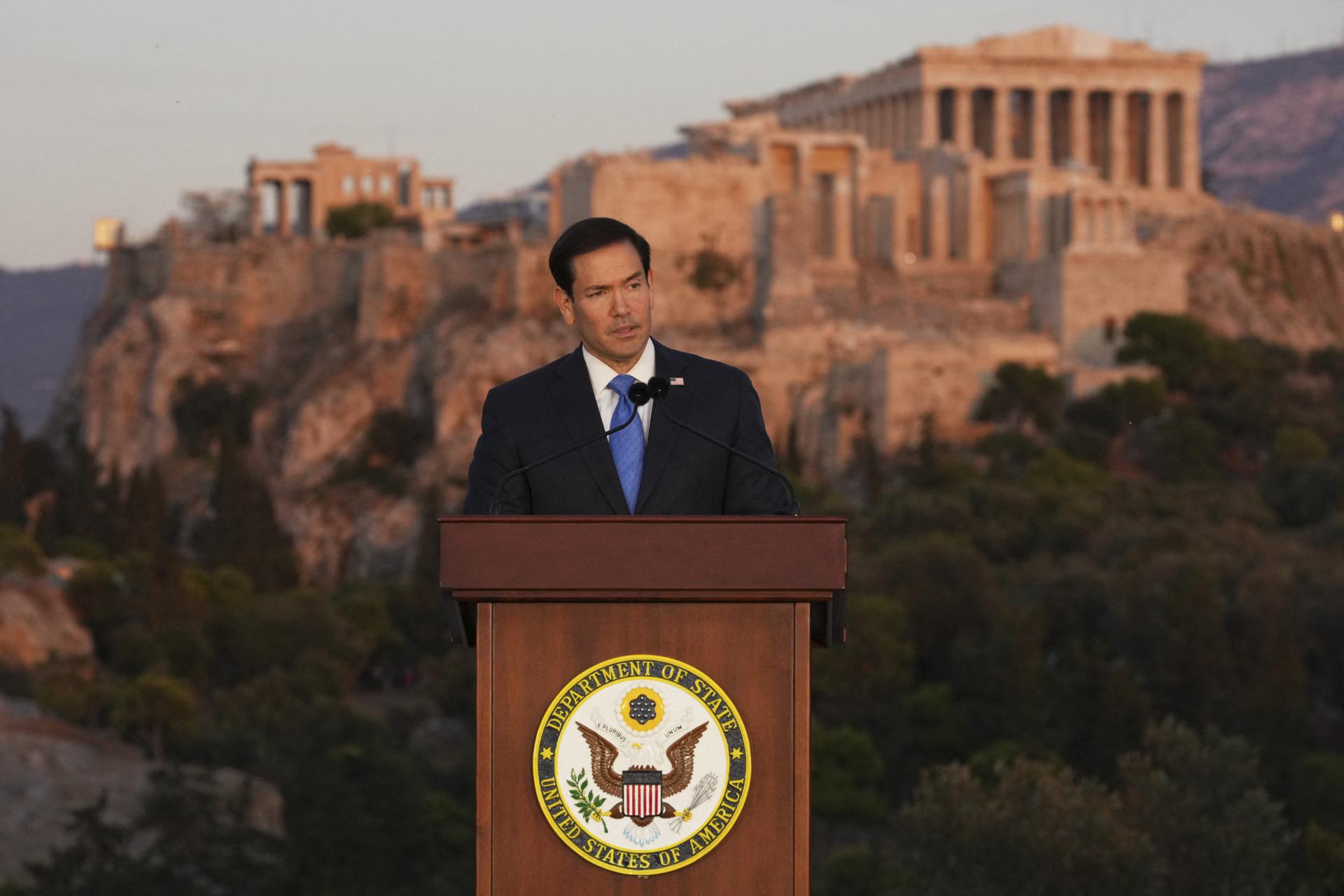
U.S. Secretary of State Marco Rubio speaks at the Pnyx hill, where ancient Athenians held democratic assemblies, with the ancient Parthenon temple atop the Acropolis seen in the background, in Athens on October 7, 2026. (Mark Schiefelbein / POOL / AFP via Getty Images)
“I think technology has allowed us to connect with the world, so that today you can instantaneously talk to someone halfway around the world,” Rubio said. “That in some ways caused us to forget that despite that geography is still real. When it comes to people, geography is still real. Anything bad that happens in the Western Hemisphere is going to impact us faster than if something bad is happening in Africa or in the Middle East or in Asia or anywhere for that matter. So we need to care about it just from our national interest. Understand that America’s foreign policy, at its core, has to be what’s in the national interest of the United States. It is in the national interest of the United States to live in a region in which we have as many not just partners but allies who are as stable and secure as possible, and that’s what we’re hoping to achieve. You see that now. Now the people of these countries have made this choice through their elections, but we have seen country after country choose pro-Western, pro-American, anti-drug cartel candidates in place after place after place, and it has created a historic and unique opportunity, which frankly hasn’t gotten the coverage it deserves, and President Trump hasn’t gotten the credit he deserves, for the fact that today, if I put a map of the Western Hemisphere in front of you, and we said red for pro-American, blue for anti-American, the reds continue to grow, and the blue continues to diminish to just a handful of places. This is an extraordinary historic achievement, one that we need to build on, and that we are very focused on.”
Some have speculated whether the closure of USAID, the now-defunct U.S. Agency for International Development that Trump and Rubio shuttered over concerns that American tax dollars were funding anti-American leftist non-governmental organizations (NGOs), has had the additional impact of undercutting leftist socialists throughout Latin America. Rubio said he does not think the two things are entirely unrelated.
“I don’t think it’s a coincidence to some extent that the pulling of foreign aid into the State Department and away from the sort of independent, do whatever they want organization, which was USAID, has had a direct impact on what’s happening in the region,” Rubio said. “Absolutely, there are groups in that region that are clearly aligned with anti-American leftists. Now they may be dressed up as an environmental NGO or a group that works for the indigenous population in these countries, but the reality of it is they are part of this anti-American global network of NGOs, and we were funding many of them. We were funding many of them. Now our foreign aid—we’re still the most generous country in the world in foreign aid—but the difference is our foreign aid is now designed specifically to further the national interest. We are not going to pay for things that are bad for America. We are not going to give money to people or organizations that hate America, and whether I can prove to you that’s had a direct impact on these elections, I’m not sure we’ve studied it but I don’t think it’s a coincidence in my personal view. I think the other thing that’s happening is these are not puppet presidents. These are elected by their populations. They’re going to make decisions, as they should, that are in the national interest of their respective countries. But what they are is they are not leaders that hate America. They are leaders that would prefer to partner with us more than any other country in the world, and who share our same priorities. They want to dismantle these narco terrorist organizations that are operating in the region. They want more American investment in their countries. They want to be supportive of what we’re doing on the global stage. I think this is an extraordinary achievement of President Trump, and one that I just don’t think has gotten enough coverage yet. But that’s okay. History and the next few months and years will, I think, begin to give him the credit he deserves.”
Since USAID shuttered, the State Department has handled foreign aid, especially around disasters, directly. Most recently, the State Department has helped Panama respond to a brutal earthquake that hit the all-important ally earlier this month—and has similarly helped respond to earthquakes in Colombia and Venezuela as well as a hurricane in Jamaica.
“There is foreign aid, like helping them deal with health issues and economic development issues,” Rubio said. “And then there’s humanitarian response: hurricane, earthquake, natural disaster. Without a doubt, the foreign aid has gotten way better in terms of direct aid, and it’s getting better. But there’s work still to be done. We’re improving it, and it’s an adjustment process. The one that is unequivocally better right now—I mean, by far, just night and day—is humanitarian response. It is faster. It is more effective. It gets to the target way faster than ever before. We are able to deploy, for example, search and rescue teams substantially faster than the old model, and even the first responders are admitting and telling us that. So every case is different. Venezuela was a disaster, and we had to go in there and basically run their airport because their airport was shut down. You couldn’t get aid in without that. But just the amount of assistance that went there was extraordinary and historic. Jamaica was the first test of our system—it worked excellent there. Panama, different than Venezuela, not as bad, appears to be no significant loss of life per se, but they had that destruction. What you’re seeing is media coverage. Ambassador [Kevin] Cabrera is going to tell you this: the media coverage in Panama is recognizing it. They are seeing that America was there fast and first. We’re not doing more than we need to. We are doing everything we need to, and we’re doing it based on what they’re telling us they need, not what we tell them they need, and it’s worked extraordinarily well. So all is very different. By the way, it’s not just there. We’ve been able to help with that mudslide out in Asia. We’ve been able to help in other places, but we rely on those countries to tell us ‘this is what we need, this is what we desire,’ and then we try to fill that gap if available to us. But it’s no doubt it’s part of this. One of the things is this: If you’re going to be a pro-American leader in a democracy, you have to go to voters and say, ‘Guys, we are friends of the United States, and here are the benefits of being a friend of the United States.’ I think the people of Panama are seeing that right now, and I think they saw it in Jamaica, and I think they’ve seen it in Venezuela. So for a long time we demanded countries be friendly to us, but we didn’t reward them. There was no reward for being nice to the U.S. Oftentimes we seem to pay more attention to our adversaries than we did to our friends. That has changed under President Trump, and I think in many ways is at the core of not just the change you’ve seen in the hemisphere, but what I hope will make it permanent and enduring.”
Rubio also in this interview discussed both major global conflicts playing out right now; the Russian war in Ukraine and the war with Iran. Asked how the U.S. ends the war in Ukraine, as many Americans would like to see happen, as well as about the recent deal Trump announced with the Russians on diesel fuel, Rubio broke it down into multiple parts first addressing the diesel deal.
“So let me break this out into two buckets because they’re both very important. Let me start with the most important one, and that is ultimately the job of the president of the United States and all of us who work for him is to make sure that the national interest of the United States is foremost before anything else,” Rubio said. “Okay, before what is good for another country, before what is good for another continent, it’s what’s good for America. It has to be because if we’re not looking out for our national interest, nobody else is going to. By the way, I expect every country to view things that way. Like I expect the Colombian government to put as their priority the national interest of Colombia, so we have to put our national interest as the number one priority above everything else. That doesn’t mean we’re deliberately looking for things that are bad for other countries, and hopefully, what’s in our national interest is in their national interest. But if it comes down to a conflict between what’s good for them and what’s good for us, we always have to be for what’s good for us. Right now, this economy, given what’s going on around the world, needs a bigger diesel supply in the global economy, and we’ve already done this once before. The president chose to do it again, which is a 30-day moratorium on sanctions to allow more Russian delivery of diesel into the global marketplace. That’ll impact and help the United States. It’ll help other countries as well, and that’s a decision he made not because it’s bad for Ukraine or good for Russia, but because it’s good for America and it’s important for America.”
With regard to ending the war, he said the fight is down to just a fraction of a part of eastern Ukraine and the Ukrainians are rightly concerned he said about a possible Russian military avenue straight to Kiev if the Russians were to take control of that remaining part of the eastern province.
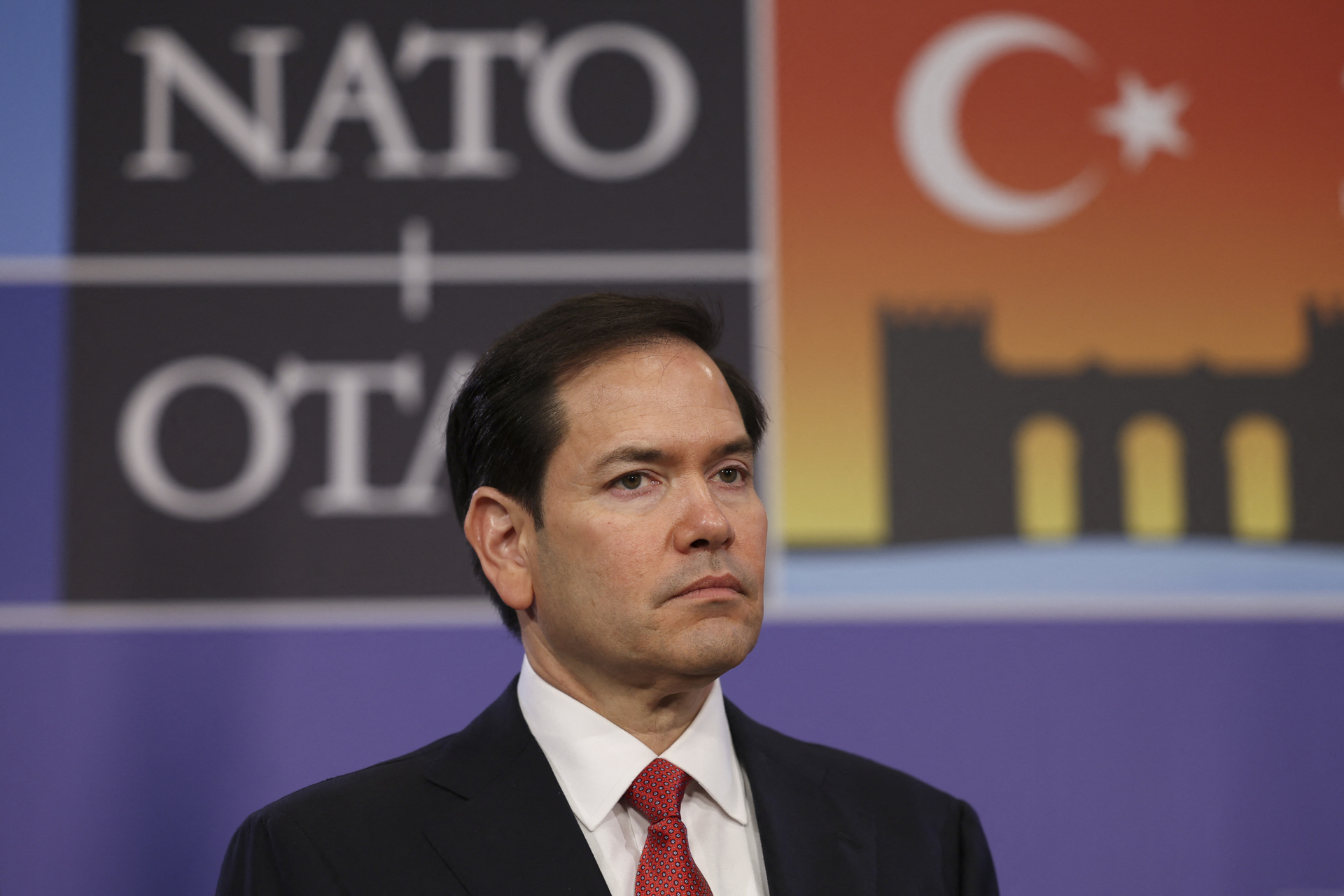
Secretary of State Marco Rubio talks to the press during an informal meeting of The North Atlantic Treaty Organisation (NATO) foreign ministers ahead of potential peace talks between Ukraine and Russia in Turkey, in Antalya, on May 15, 2025. (Umit Bektas /AFP via Getty Images)
“Now let’s talk about that conflict between Russia, the war between Russia and Ukraine,” Rubio said. “Here’s the reality of it: this war is honestly about one part of Ukraine called Donetsk. The Russians occupy all but about 11 percent of that area, in that province, Donetsk, or in that region of Donetsk, the Ukrainians have a defensive line that they’ve embedded themselves in. They argue, and military strategists say is true, that it is the last defensible line. That if they give that up, there is nothing to defend Kiev. From there, it’s just a straight shot into Kiev. The core of this conflict is Russia demands all of Donetsk, including that defensive line, as part of their territory. That’s what they’ve defined as victory. And Ukraine has said ‘we can’t give up that 11 percent that’s remaining of Donetsk because that defensive line is our last defensible line.’ Hence, that is at the core of this conflict. Now there are a lot of other issues going on, but ultimately that is really what they’re fighting over. How are they fighting over it? The Russians have not been able to advance in the battlefield and take that region. So what they are doing is they are applying extraordinary pain on the people of Ukraine through drone strikes, through ballistic missile strikes, trying to destroy their energy infrastructure, their electricity—the ability of Ukraine to generate electricity, especially with winter coming up. How has Ukraine responded? They have responded by going after Russian oil and gas refineries, which is at the core of how their economy funds itself, and bringing the war home for the first time. Russians are seeing explosions going on in Moscow, in St. Petersburg, deep into their territory. It’s no longer a faraway war. Hence, this is the situation we find ourselves in—not an easy one to negotiate and not an easy one to fix. The United States remains willing, able, and prepared to play a mediating role if the opportunity presents itself to end this war through a negotiated settlement, which is how we think this war will ultimately end. But it has not been easy, not for lack of trying, not because Jared [Kushner] and Steve [Witkoff] and others have invested a lot of time into it, but because the dynamics I just described to you seem deeply entrenched right now. We’re going to keep trying as much as we can to see what we can do. We’d like the war to end, but ultimately we also have other priorities around the world we’re focused on as well.”
Ukrainian President Volodymyr Zelensky is about two and a half years past the term to which he was elected democratically, and Ukraine has—as its constitution allows with a declaration of martial law—suspended elections since the war began several years ago. Asked if it is time for Ukraine to call for an election so Ukrainian voters can weigh in on this, Rubio said the election issue is important and not “irrelevant” but fundamentally would not solve the dynamics of the problems there.
“Look, the election issue comes up, and I’m not saying it’s irrelevant, but that’s not at the core of why there’s still a war going on,” Rubio said. “What I would say is the frustration more than anything else, and we’ve talked about this publicly. For example, months ago, we have seen strikes on energy vessels in the Black Sea, and there’s been complaints a lot because we have American companies calling us and saying, ‘Hey, that was our oil on that ship that was hit by Ukraine.’ Now, I don’t believe Ukraine intentionally targeted them, but those ships got hit, and we already have a world that is facing an energy crisis because of what’s happening in Hormuz, what’s happening in the Red Sea, what’s happening in different places. We don’t need any exacerbating situations, and there’s been frustration that despite these asks, that has happened. So that’s bubbled to the surface. That doesn’t mean we don’t have frustrations with the Russian side either. The president does not like to see this image of a ballistic missile hitting into an apartment building in Kyiv, and innocent civilians being wiped out as a result of it. He doesn’t like that either. That’s why this has been so frustrating to try to get resolution to it.”
On Iran, Rubio said that he understands where American voters are in wanting it over with but also argued that Trump has achieved a great military objective of stopping Iran from ever getting a nuclear weapon.
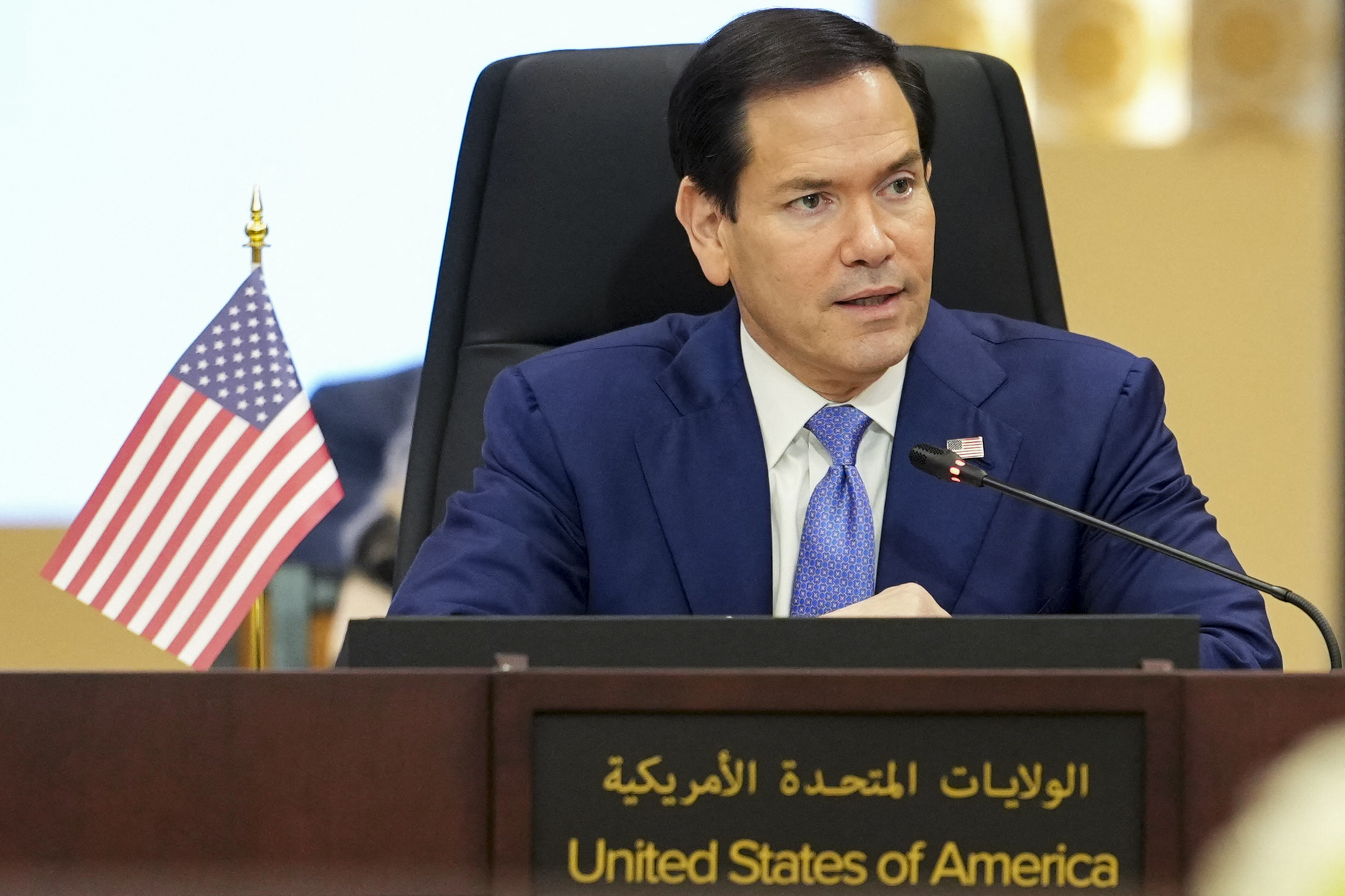
Secretary of State Marco Rubio speaks during a meeting with foreign ministers of the Gulf Cooperation Council Member States during his visit to the Middle East to discuss the interim deal between the U.S. and Iran with Arab Gulf allies, in Manama on June 25, 2026. (Eric Lee/AFP via Getty Images)
“Well, it’s important to remind people why this started in the first place,” Rubio said of the war in Iran. “Iran wanted to build a conventional shield of tens and tens of thousands of missiles and drones. Once they got to that point, they would be able to say to the world, ‘Guys, we’re now going to build a nuclear weapon, and there’s nothing you can do about it because we have so many drones and so many missiles that we will destroy the entire region, so you can’t touch us. We are immune.’ The president was not going to allow them to build a nuclear weapon hiding behind the conventional weapons shield that they were trying to achieve. So he destroyed their navy, he destroyed their air force, he destroyed their factories that make the missiles. Now they still have them, but they can’t make as many as they used to—they are far less able to make the way they used to, because he’s destroyed their factories for drones and missiles. They don’t have an air force. They don’t have a navy, and they’ve lost a lot of air defenses as well. Large portions of their country are deeply vulnerable to future strikes if necessary. So he’s achieved that objective. They can no longer hide behind a conventional shield to build a nuclear weapon. The second objective is they chose to take the Strait of Hormuz hostage. They would have done it anyway. Imagine if Iran had a nuclear weapon. At that point, they could say, ‘by the way, we own the Strait of Hormuz, and you guys can’t do anything about it because we won’t just hit ships, we’ll use a nuclear weapon against you if you try to do anything about it.’ They are trying to control the Strait of Hormuz. They lost control of the Strait today. On average, over the last 10 days… about 13 to 14 million barrels of oil are going through the Strait of Hormuz out to the global market [per day]. Some days it’s actually equivalent to what it was pre-conflict. The U.S. military is involved in escorting and defending these ships from these strikes. Iran is still shooting at these, but by and large we’ve been able to get that flow going. At the same time, because Iran continues to fire at these ships, we have imposed crippling additional sanctions that Scott Bessent’s doing a great job on, and a blockade. The only country in the world that cannot get a single barrel of oil through the Strait of Hormuz is Iran. They’re the only ones, and we’re inflicting tremendous sanctions. In addition, these sanctions are costing them money, which means that’s money they don’t have. Every dollar you deny them in sanctions is $1 they don’t have for Hezbollah, $1 they don’t have for Hamas, $1 they don’t have for the terrorist militias inside of Iraq, and $1 they don’t have for their own military or their own nuclear ambitions. So I understand people’s frustration because we all want it to be wrapped up. In some ways, it is. Right now, we are basically in a Strait of Hormuz defense posture and doing an excellent job of crippling their economy in the process.”
Rubio also said that just like the lack of credit Trump gets for Latin America and Western Hemisphere successes, the president also gets a lot less credit than he deserves for fundamentally changing the Middle East.
“So, look, I think traditionally, the American political class thought that peace in the Middle East, the core central issue, is the Palestinian question,” Rubio said. “It’s an important issue. It’s not irrelevant. I’m not saying it’s irrelevant, but I think what President Trump has exposed is that the number one driver of instability and war and conflict and the number one obstacle to peace in the Middle East is the Islamic regime in Tehran, and I think the evidence bears it out in Lebanon. Why is Lebanon a country that’s used as an attack point against Israel and other interests? Who sponsors Hezbollah? Hezbollah is 100 percent an agent of Iran. In Iraq, why does that country still have terrorist militias that operate from their territory and can launch missiles against Saudi Arabia, against Israel? Who sponsors them? Their Shia militias are sponsored by Iran, which is the only country in the region that has launched not simply proxy attacks, but direct attacks against Saudi Arabia, the United Arab Emirates, Bahrain, Kuwait, Jordan. I’m probably leaving somebody out. Who’s the only country in the region that’s done that? Iran. Direct attacks, in addition to what their proxies have done. By the way, with the Houthis now in Saudi Arabia, who is the number one sponsor of the Houthis? Iran. So, if you look at all of the things that are going on in that region and all the flashpoints that exist there, they all track back to the Islamic Republic of Iran, to the radical clerics that run Iran from Tehran. They are the central problem in that region. If there was no Islamic clerics, these radical Shia clerics in Iran—if they didn’t exist, if that wasn’t there—none of these problems would exist. You may still have a Palestinian issue. I would argue that issue would be easier to deal with if Iran didn’t exist. So they’re at the core of all of these problems, and I think correctly identifying who it is that’s driving instability and war in the Middle East is important in order to solve it. That issue has to be confronted. I think what’s happened over the last few months is it’s revealed for the world to see.”
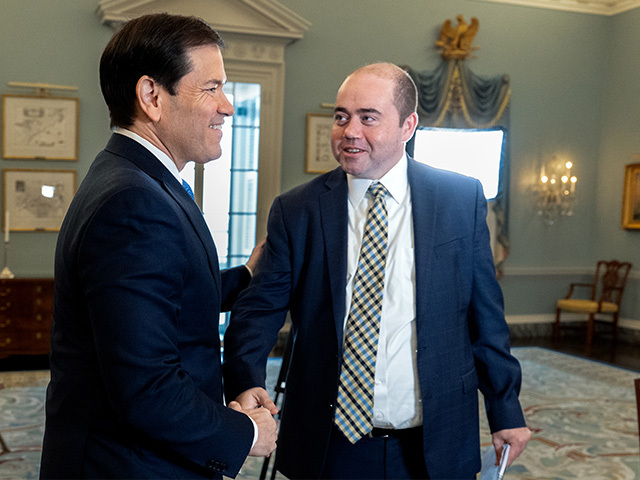
Secretary of State Marco Rubio and Breitbart’s Matt Boyle greet each other prior to sitting down for an exclusive interview on Thursday, October 15, 2026, in the Thomas Jefferson State Reception Room at the State Department in Washington, DC. (Dan Fleuette/Breitbart News)
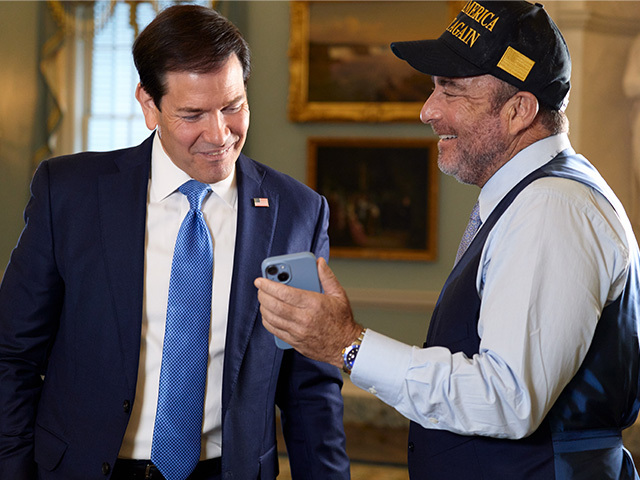
Breitbart News’ COO Jon Kahn and Secretary of State Marco Rubio share a moment following an exclusive interview on Thursday, October 15, 2026, in the Thomas Jefferson State Reception Room at the State Department in Washington, DC. (Dan Fleuette/Breitbart News)