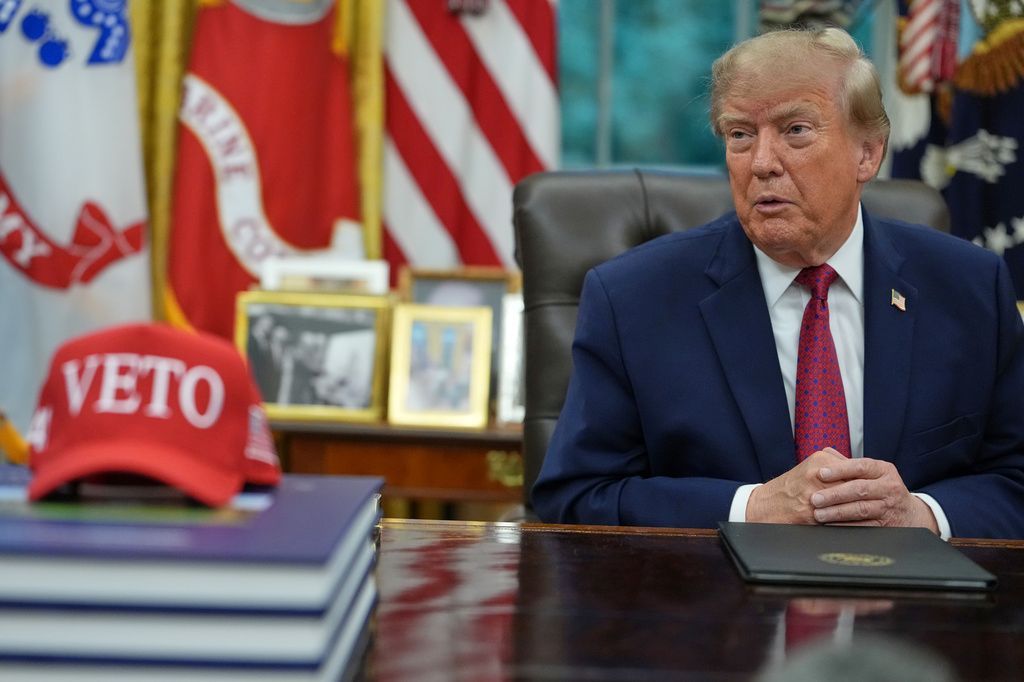
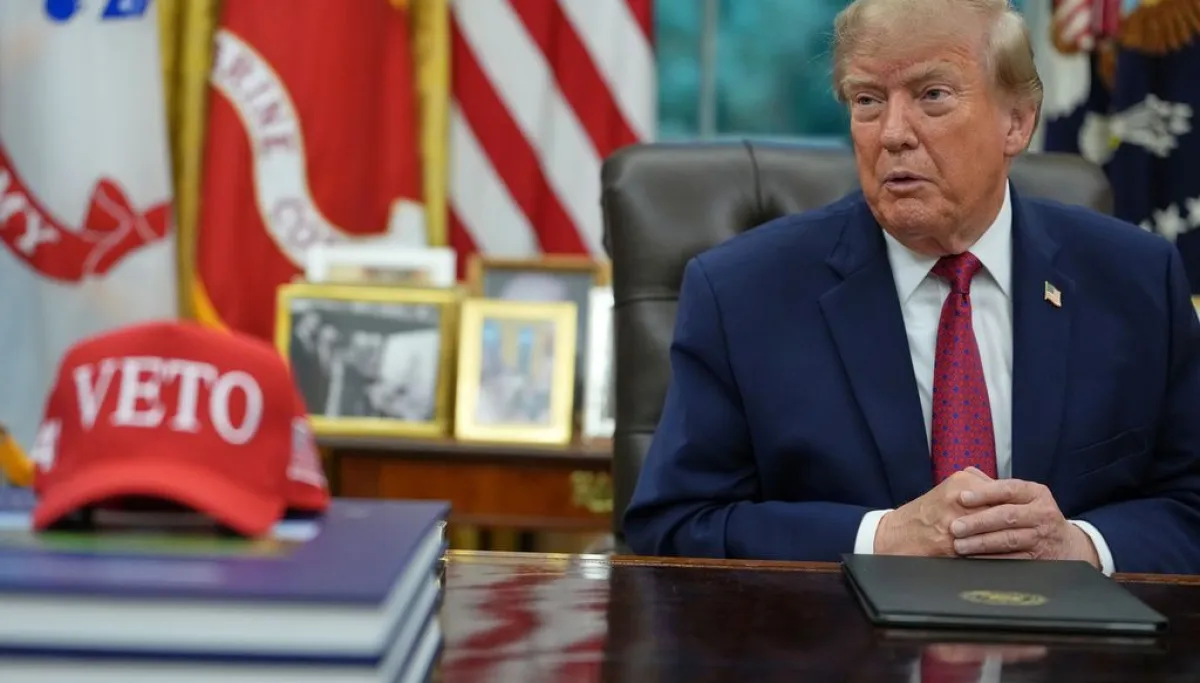
President Donald Trump got one of the rarest things in American politics: a second chance. In this month’s midterm elections, voters rendered the verdict that he blew it. While his second, nonconsecutive term is not over, Trump is running out of time to change their minds — and Republicans are starting to look past him for something new.
This wasn’t just a typical midterm election in which the party in power grows complacent while the other party’s base is hyper-engaged and ready to take out any incumbent within voting distance. This went much deeper than the purple-state races and swing congressional districts, of which there were relatively few.
Democrats struck at the core of the Republican majority in states that had voted for Trump by double digits just two years ago, including places where the GOP has dominated for decades. They flipped at least seven Senate seats and are headed toward a net gain of at least 40 House seats, with the Associated Press calling both chambers for the Democrats by the early morning hours of Nov. 4.
The chairman of the House GOP campaign arm, Rep. Richard Hudson (R-NC), lost his seat. Rep. Brian Fitzpatrick (R-PA), one of just three House Republicans representing a Hillary Clinton-won district to be reelected in the 2018 wave, was defeated.
South Carolina elected its first Democratic senator since 1998. Texas did the same for the first time since 1988. Kansas sent a Democrat to the Senate for the first time since 1932. These are states Republicans can win if they turn out their voters and get them to pull the correct lever. There simply aren’t enough Democrats to surge to the polls to win on Election Day.
Three socialist, or at least socialist-adjacent, candidates were elected to the Senate, and a fourth came awfully close.
Gov. Ron DeSantis (R-FL), whose state narrowly averted the Republican disaster that unfolded almost everywhere else, said afterward that it was insufficient to describe the drubbing as a blue wave or tsunami. He likened it to a “meteor strike,” a characterization that sits easily alongside the “thumpin’” George W. Bush’s GOP endured in 2006 or the “shellacking” experienced by Barack Obama’s Democrats in 2010.
The polls were so favorable to Democrats in the run-up to the election that the pollsters themselves didn’t believe them. The New York Times and Washington Post ran stories admitting they were having trouble getting Republicans to answer their polls and therefore couldn’t guarantee their accuracy.
Recent polling misses have been biggest in red-state Senate races. The polls were also wrong in the Maine Senate race six years ago, when Sen. Susan Collins (R-ME) won by nearly 9 points despite trailing throughout, and in the Michigan Democratic Senate primary this year.
But if there was any polling bias, it wasn’t necessarily in the Democrats’ favor. The New York Times was apologetic about its survey showing Texas Democratic Senate nominee James Talarico leading Republican Ken Paxton by 7 points. Talarico actually won by 12. The same pollster showed Sen. Darline Graham (R-SC) and her Democratic challenger Annie Andrews tied. Andrews won by 4.4 points.
The electoral rebuke of Trump was quite broad. The national exit polls found that 44% voted to express opposition to Trump, while only 16% voted to support him, despite his request that Republicans pretend he is on the ballot. Another 40% said Trump wasn’t a factor in their vote either way.
There are some notable areas of slippage. In 2024, Trump won 55% of men. This year, Democrats took 50% to the GOP’s 48%. Trump won 60% of white men, Republicans 53%. Trump won 53% of white women, Republicans just 46% to 52% for the Democrats. Trump won 46% of Hispanics, compared with former Vice President Kamala Harris’s 51%. Democrats beat Republicans by 30 points, 64% to 34%. Trump won Latino men 54% to 44%, Republicans lost them with 38% to the Democrats’ 58%.
Even white voters without college degrees, the president’s bread-and-butter electorally, slipped from 66% for Trump to 60% for Republicans. Only 35% of white women without degrees voted for Harris, but 41% voted for Democrats in the midterm elections.
Thirty-seven percent approved of the job Trump was doing compared to 63% who disapproved. The exact same breakdown appeared on the question of whether Trump “fights for people like you.” Only 36% said Trump had the right priorities compared to 64% who said he did not. Sixty-two percent said he prioritized his own needs above the country’s interests.
Only 27% believed Trump’s policies improved national economic conditions to 66% who said they made things worse and another 7% who felt they had no impact. Sixty-three percent blamed higher prices on Trump’s policies.
Just 2% described the state of the economy as “excellent,” and another 23% picked “good.” “Not so good” was the choice of 39%, while 36% said, “poor.” The economy was the top issue for a plurality at 39%, with 52% of them voting for Democrats. The only issue to reach double digits on which Republicans were favored was immigration.
Nearly half of voters rated the cost of living as a crucial issue, and they went for Democrats by 34 points. One in three said the war in Iran was crucial to their congressional vote, and 72% of them supported Democrats. Perhaps surprisingly, 55% said government corruption was a crucial factor and 63% voted for Democrats. Fully 70% said the U.S. economic system favors the wealthy, with 76% of that group voting Democratic. Nearly 60% said they were very concerned about the price of gasoline or diesel, with two out of three backing Democrats. A similar percentage said they were concerned about the cost of food and groceries, with 68% supporting Democrats.
Almost four out of five voters said that inflation had been a severe or moderate hardship this past year, with 62% voting for Democrats. Two-thirds said that Trump’s tariffs have hurt the national economy, with 81% supporting Democrats, and 64% said they hurt the economy in their area.
In short, just two years after an election in which Democrats were said to be on the wrong side of too many 80-20 issues, Trump’s GOP is on the losing end of a number of 60-40 issues. Democrats are currently leading in the House popular vote by 11.6 points. That’s up from 8.4 points in the 2018 blue wave and 8.8 points in the final RealClearPolitics average for the generic congressional ballot.
By way of comparison, in Trump’s first midterm election in 2018, Republicans didn’t lose a single House seat in a district he had carried by at least 20 points two years earlier and actually gained Senate seats in red states. This time, the red firewall didn’t hold.
Trump was elected in part to address the affordability crisis that began when inflation spiked to a 41-year high under the Democrats, between his two terms. While the rate of inflation is lower now than it was then, it has risen since the Iran war. The conflict has boosted energy prices and kept inflation above the Federal Reserve’s preferred rate, thus keeping interest rates up. Tariffs have increased the prices of certain imported goods and some other products that compete with them.
Trump didn’t do enough to promote things his administration was doing to bring costs down, such as on pharmaceutical drugs. He allowed a bipartisan affordability bill to become law without his signature. At times, he dismissed the issue as a “hoax” and generally showed little empathy for supporters suffering from the high cost of living. Voters heavily associated him with the war and tariffs, which made things more expensive.
The president did little to build the case for either the war or his tariffs publicly and involved Congress in neither. He frequently changed the tariff rates, seemingly without warning. On Iran, he alternated between threatened escalations, tentative ceasefires, and declarations of victory. The war has now lasted longer than he promised, and neither the mullahs nor the voters are sure they can believe much of what he says about it.
“I think it’s largely true because it drove the gasoline up a little bit short term and probably that’s, probably it’s true,” Trump acknowledged the day after the election when asked about a social media post by Vice President JD Vance largely blaming the war for the outcome at the ballot box. “But at the same time, if I had it to do again, I’d have to do it again, because long term, it’s the only answer. You can’t let Iran have a nuclear weapon.”
The night before, Trump told Fox News he understood why voters disliked the high gas prices, but thought they should understand it was a “short-term” cost.
As the public’s confidence in Trump’s economic stewardship, long one of his biggest political advantages, began to collapse, concern about his corruption increased. Perhaps emboldened by term limits or angered by Democratic assaults on his business empire, he has grown more brazen about his self-dealing in his second term.
But the economy has made certain voters less tolerant of Trump’s extracurricular activities and his foibles across the board. His jokes on the campaign trail, including repeated references to candidates’ posteriors, landed flatter than usual. GOP lawmakers began to bristle at his brusque manner, impulsive decision-making, and erratic leadership style.
Trump’s involvement in the Republican primaries often backfired as well. He arranged to have Sen. Lindsey Graham’s sister replace him after his death not just as a placeholder for the remainder of his term, but as a candidate to win another six years. She displayed little policy or political acumen, bred resentment among more experienced Republican politicians who might otherwise have been in line to run for Senate, and made many South Carolinians feel as though the seat was being passed down through blood lineage. Trump was able to power her through the primary over an especially miffed Rep. Ralph Norman (R-SC), but she fell to neophyte Democrat Annie Andrews in the general election.
Trump feuded with Sen. Thom Tillis (R-NC) ahead of what would have likely been a tough reelection race regardless. Tillis responded by retiring. Democrats coaxed popular former Gov. Roy Cooper into the race. Trump’s handpicked replacement for Tillis, former Republican National Committee Chairman Michael Whatley, was never competitive. Cooper beat Whatley by nearly 20 points.
Top Republicans begged Trump to endorse Sen. John Cornyn (R-TX). The president at first seemed to be considering doing just that. But he eventually decided that Cornyn was insufficiently loyal and perhaps unlikely to survive a runoff election against Paxton. Trump endorsed Paxton, widely viewed as a weak and corrupt candidate as well as a poor fundraiser and lazy campaigner, instead.
Not everything can be blamed on Trump. Gov. Greg Abbott (R-TX) and the rest of Texas’s statewide GOP ticket lost as well, suggesting that perhaps Cornyn would have been unseated even if Trump could have helped him secure renomination. There was clearly more afoot in the Lone Star State.
There were numerous complaints in the days leading up to the elections from Republican operatives slagging GOP candidates, including incumbents, as ill-prepared for competitive races. Many hadn’t faced serious challengers in years. Yet there were also candidates like former sportscaster Michele Tafoya running for the Senate in Minnesota, former Sen. John Sununu running again in New Hampshire, Oregon gubernatorial candidate Christine Drazan, and incumbent Collins in Maine, who would have been stronger without the national drag.
Congress is itself deeply unpopular. Only 3% strongly approve of the job it is doing, according to the exit polls, with 20% somewhat approving. Compare that to 30% who somewhat disapprove and 47% who strongly disapprove. Of the 77% who disapprove of Congress to varying degrees, 66% broke for the Democrats.
It’s also the case that Trump rewrote the Electoral College playbook for the Republican Party. He attracted white working-class voters to the coalition and made steady gains in Hispanic support, although there has been significant movement back to the Democrats among the latter bloc this year. He has stiffened the spines of what was becoming an increasingly timid GOP leadership class, taking the fight to liberals in government, media, and academia. And while even this hasn’t been without electoral cost, Trump has not once but twice closed a porous border and curtailed mass migration.
There is likely no going back to the pre-Trump GOP. Times have changed — the voters have spoken. But 10 years is a long time at the helm of a major political party. Republicans have gone through highs and lows with Trump over this time period — his improbable sprint through the 2016 primaries; his stunning upset of Hillary Clinton; the setbacks of 2018; the pandemic; the impeachments; the humiliations of 2020 and beyond, both of his own making (litigating the election all the way through the disgrace of Jan. 6) and his opponents’ (the lawfare that followed him out of office); a 2024 comeback campaign like no other; and, finally, the current predicament.
Trump has made daring Houdini-like political escapes before when it seemed as if he had finally been defeated. Perhaps he has another one in him over the next two years. But Republicans are tired, and their ranks have thinned. Trump is 80 and term-limited. He will be leaving Washington and will give way to a successor.
If the first 100 days of Trump 2.0 were a powerful advertisement of the benefits of a president serving nonconsecutive terms, the last 10 months have shown why this isn’t a common practice. Trump has been disproportionately focused on legacy projects such as the ballroom and putting his name on things. He has often behaved like a man who will never have to face the voters again. And the ambitious things he is attempting to do, such as reordering the Middle East and the global economy, likely take eight straight years, if they can be done at all.
Trump’s flaws and propensity toward chaos have been evident the whole time.
The midterm elections have created no new Republican stars because there were so few wins. But DeSantis, Sen. Ted Cruz (R-TX), and even Trump’s own vice president have been finding their voice and charting their own path in the days since the blue wipeout.
The task of rebuilding is upon them and other GOP leaders now. While 2028 looks bleak right now, it is also a lifetime away in modern politics. It will be an arduous task, but Republicans have no choice but to undertake it. Might as well start now.
W. James Antle III (@jimantle) is executive editor of the Washington Examiner magazine.